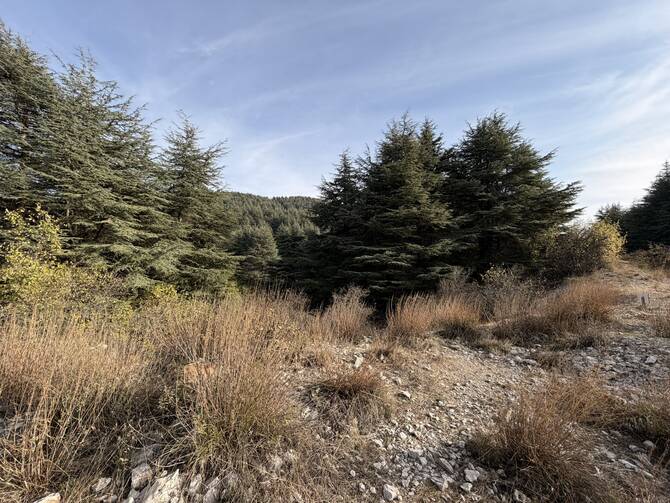

BEIRUT: Lebanon’s Al-Shouf Cedar Reserve has opened a new trail named in honor of King Charles III, in a symbolic gesture of friendship between the UK and Lebanon.
British Ambassador to Lebanon Hamish Cowell said the trail commemorated the king’s May 2023 coronation and featured 96 cedar trees.

British Ambassador to Lebanon Hamish Cowell, far right, said the trail commemorated the king’s May 2023 coronation. (Supplied)
“The trail reflects the UK’s enduring commitment to Lebanon’s environmental resilience,” he said in a post on X.
The 6 km trail stands alongside the Queen Elizabeth II trail, established in 2016 to mark the late monarch’s 90th birthday. This includes 90 cedar trees, with an additional tree planted in November 2022 on the anniversary of her death, as part of the Queen’s Green Canopy initiative.
The new trail extends through the Bmahray–Ain Zahalta forest in Mount Lebanon, at an altitude ranging from 1,300-1,800 meters. It also connects to the renowned Lebanon Mountain Trail, offering hikers an experience rich in biodiversity.

Officials work together to plant a cedar tree. (Supplied)
Faisal Abu Ezzeddine, head of the reserve committee, told Arab News: “Visitors walking this trail will encounter some of the finest cedar trees and take in breathtaking views of the surrounding valleys and mountains”.
The route is a valuable addition to the ecotourism infrastructure of the Al-Shouf Cedar Reserve, one of the country’s most notable natural areas, renowned for its biodiversity and exceptional beauty.
The project was funded by the UK government’s Climate Diplomacy Fund, which supports global leadership in climate action and helps partner countries adopt sustainable energy solutions.
Abu Ezzeddine described the initiative as “a new step to reforest, preserve the environment, and promote environmental development and ecotourism — and a good publicity for everyone.”
He said the new trail complemented existing routes that honored Lebanon’s rich natural heritage Developed in collaboration with local communities, it brings together history and geography and strengthens the reserve’s identity as a haven of beauty, biodiversity and peace.
The cedar tree, Lebanon’s national emblem, embodies resilience and fortitude and, according to the British ambassador, “stands at the heart of this initiative.”
Cowell added the King Charles III trail reflected the shared commitment of the UK and Lebanon to climate action, biodiversity and the preservation of Lebanon’s natural heritage.

A signpost for the newly opened trail alongside the Queen Elizabeth II Cedar Trail. (Supplied)
“As we look ahead, this trail stands as a living testament to our partnership and our joint efforts to build a greener, more resilient future,” he said.
The Al-Shouf Cedar Reserve stretches along the central peaks of Lebanon’s western mountain range, from Toumat Niha in the south to Ain Dara and Dahr El-Baydar in the north. Covering approximately 550 sq. km, it is one of the country’s largest nature reserves, with elevations ranging between 1,200 and 1,984 meters above sea level. Around 70 percent of the reserve lies within the Al-Shouf region, while the remaining 30 percent extends into the Western Bekaa Valley.
The reserve protects over 30 percent of Lebanon’s remaining cedar forests, spread across three major woodlands— Ain Zahalta–Bmahray, Barouk and Maaser El-Chouf. Some of the trees are believed to be as many as 2,000 years old.
The reserve is home to 532 species of trees and plants, including many unique to Lebanon or found only in limited regions globally. It also shelters around 30 species of medium-sized mammals — such as wolves, hyenas, foxes, porcupines, ibex, wildcats and wild boar — as well as 27 species of reptiles and amphibians.

The Al-Shouf Cedar Reserve stretches along the central peaks of Lebanon’s western mountain range. (Supplied)
Its vast, uninhabited mountain terrain, largely untouched by agriculture or pollution, has made the reserve a vital destination for migratory birds. BirdLife International has designated it an “Important Migratory Bird Area,” with approximately 290 species passing through each year,
Visitors to the reserve, which welcomes between 60,000-120,000 people each year, can enjoy eco-tourism activities including hiking, cycling, snowshoeing, mountain climbing and wildlife watching. These experiences are often guided by trained young locals from nearby villages, connecting conservation with community development.
Like many parts of the world, the reserve has been affected by changing climate conditions. However, Abu Ezzedine highlighted the progress made over its 29-year history: “The thriving bird and wildlife populations, along with the rural development linked to the reserve, speak for themselves,” he said. “It has become a magnet for eco-tourism and a catalyst for revitalizing the 24 surrounding villages.”
He added that several other countries also supported the reserve, while a cedar cultivation project allowed donors to contribute by funding new trails or planting cedar trees.