

Pakistan calls for reset in South Asia as dialogue with India hits 11-year freeze

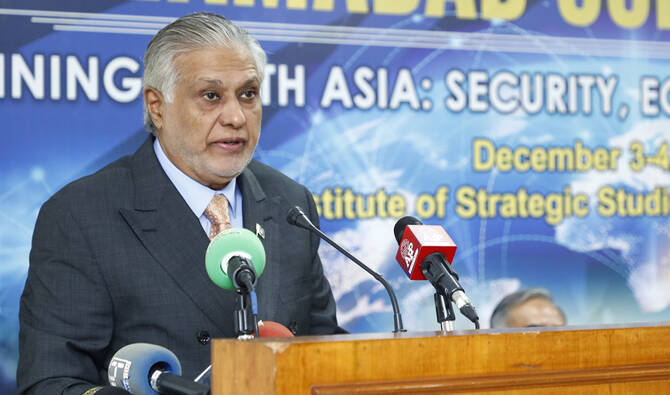
Pakistan’s Deputy Prime Minister Ishaq Dar addresses the “Islamabad Conclave 2025” at the Institute of Strategic Studies in Islamabad, Pakistan, on December 3, 2025. (ISSI)
Short Url
Updated 03 December 2025
Follow

Pakistan calls for reset in South Asia as dialogue with India hits 11-year freeze

  • Deputy PM criticizes SAARC’s paralysis, says rising climate pressures require renewed regional cooperation
  • Ishaq Dar speaks in favor of multilateralism, warns that states are using force in disregard of international law

ISLAMABAD: Pakistan’s Deputy Prime Minister Ishaq Dar on Wednesday urged a “reimagining” of South Asia’s fractured regional architecture, saying an 11-year freeze in dialogue with India was undermining prospects for long-term stability and peace in one of the world’s most volatile regions.

India and Pakistan fought a brief but intense military clash in May this year in which both nuclear-armed neighbors exchanged missiles, artillery fire and deployed fighter jets. The standoff lasted about four days before the United States brokered a ceasefire, saying the two sides had agreed to talk.

While Pakistan continued to call for a “composite dialogue” to resolve all outstanding disputes, India declined to proceed with negotiations.

Dar made the remarks while addressing the Islamabad Conclave 2025, a two-day gathering focused on security, economy, climate and connectivity in South Asia.

“The end of Cold War largely bypassed South Asia, leaving the region with few peace dividends,” Dar said while addressing the gathering. “We, the South Asians, need to think really hard. Are we doomed to remain mired in confrontation and conflict while other regions progress and prosper? The answer should be a clear no.”

He noted the region had weak conflict management and dispute resolution institutions, pointing out that “structured dialogue process between India and Pakistan remains stalled for over 11 years.”

Dar said South Asia’s fragmented political landscape, economic vulnerabilities and climate pressures had made cooperation increasingly urgent, warning that rising temperatures, extreme weather events and glacial melt were threatening water security, agriculture and livelihoods across the region.

He said the cumulative challenges of security, economic fragility and climate change were “too grave to disregard” and could not be effectively tackled without a more functional regional architecture.

He also criticized the paralysis of the South Asian Association for Regional Cooperation (SAARC) which has remained largely inactive for more than a decade, saying “artificial obstacles” must be removed to allow the organization to resume its role as a platform for economic cooperation.

Dar pointed to new trilateral initiatives, including one between Pakistan, China and Bangladesh, as examples of how smaller regional groupings could advance connectivity and collaboration where broader institutions had stalled.

Calling for South Asia to move beyond “zero-sum mindsets,” the deputy prime minister said the region needed dialogue, peaceful coexistence and economic interdependence, adding that open and inclusive regionalism remained essential for sustainable peace.

He maintained Pakistan envisioned a South Asia “where connectivity replaces divisions” and where disputes were resolved in accordance with international legitimacy.

Dar said the region would only realize its economic and political potential if all countries committed to cooperation.

He also spoke in favor of multilateralism, saying the world was witnessing growing military conflicts as states increasingly resorted to the use of force to settle disputes, showing disregard for international law and the principles of the UN Charter.


Pakistan, global crypto exchange discuss modernizing digital payments, creating job prospects 

Updated 05 December 2025
Follow

Pakistan, global crypto exchange discuss modernizing digital payments, creating job prospects 

  • Pakistani officials, Binance team discuss coordination between Islamabad, local banks and global exchanges
  • Pakistan has attempted to tap into growing crypto market to curb illicit transactions, improve oversight

ISLAMABAD: Pakistan’s finance officials and the team of a global cryptocurrency exchange on Friday held discussions aimed at modernizing the country’s digital payments system and building local talent pipelines to meet rising demand for blockchain and Web3 skills, the finance ministry said.

The development took place during a high-level meeting between Finance Minister Muhammad Aurangzeb, Pakistan Virtual Assets Regulatory Authority (PVARA) Chairman Bilal bin Saqib, domestic bank presidents and a Binance team led by Global CEO Richard Teng. The meeting was held to advance work on Pakistan’s National Digital Asset Framework, a regulatory setup to govern Pakistan’s digital assets.

Pakistan has been moving to regulate its fast-growing crypto and digital assets market by bringing virtual asset service providers (VASPs) under a formal licensing regime. Officials say the push is aimed at curbing illicit transactions, improving oversight, and encouraging innovation in blockchain-based financial services.

“Participants reviewed opportunities to modernize Pakistan’s digital payments landscape, noting that blockchain-based systems could significantly reduce costs from the country’s $38 billion annual remittance flows,” the finance ministry said in a statement. 

“Discussions also emphasized building local talent pipelines to meet rising global demand for blockchain and Web3 skills, creating high-value employment prospects for Pakistani youth.”

Blockchain is a type of digital database that is shared, transparent and tamper-resistant. Instead of being stored on one computer, the data is kept on a distributed network of computers, making it very hard to alter or hack.

Web3 refers to the next generation of the Internet built using blockchain, focusing on giving users more control over their data, identity and digital assets rather than big tech companies controlling it.

Participants of the meeting also discussed sovereign debt tokenization, which is the process of converting a country’s debt such as government bonds, into digital tokens on a blockchain, the ministry said. 

Aurangzeb called for close coordination between the government, domestic banks and global exchanges to modernize Pakistan’s payment landscape.

Participants of the meeting also discussed considering a “time-bound amnesty” to encourage users to move assets onto regulated platforms, stressing the need for stronger verifications and a risk-mitigation system.

Pakistan has attempted in recent months to tap into the country’s growing crypto market, crack down on money laundering and terror financing, and promote responsible innovation — a move analysts say could bring an estimated $25 billion in virtual assets into the tax net.

In September, Islamabad invited international crypto exchanges and other VASPs to apply for licenses to operate in the country, a step aimed at formalizing and regulating its fast-growing digital market.