

‘We chose it’: PKK fighters cherish life in Iraq’s mountains

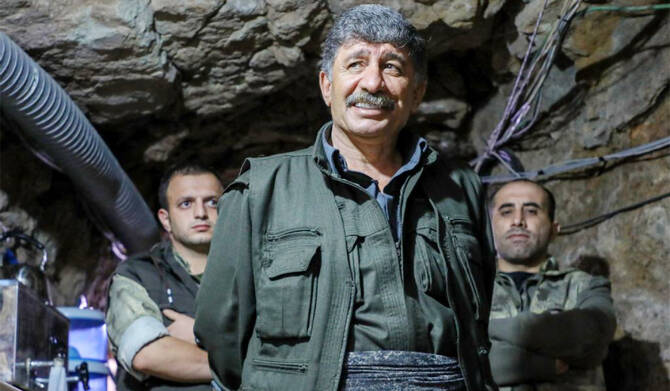
Amed Malazgirt, a senior commanders of Kurdistan Workers' Party (PKK), speaks during an interview with AFP in a cave network located in the Qandil Mountains, part of the Zagros mountain range, near the Iraqi-Iranian-Turkish borders on November 29, 2025. (AFP)
Short Url
Updated 02 December 2025
Follow

‘We chose it’: PKK fighters cherish life in Iraq’s mountains

  • Kurdish militants take historic steps toward ending decades-old fight against Turkiye

QANDIL MOUNTAINS, Iraq: A Kurdish militant picks his way along a switchback road in Iraq’s mountains before pulling over to alert his comrades in a nearby hidden bunker that they are about to have company.
After calling from a phone dangling from a tree, he leads a team of  journalists into a bunker under the Qandil mountains, where they have been granted rare access to the Kurdistan Workers’ Party (PKK) rear base in northern Iraq.
“A peace process doesn’t mean leaving the mountains,” says Serda Mazlum Gabar, a 47-year-old commander with her long, rust-colored hair and unfailing smile.

HIGHLIGHT

Iraq’s mountains have recently welcomed new arrivals — fighters who withdrew from Turkiye to show the group’s commitment to the peace process.

“Even if we leave, we will live the same way,” she added. “Nature doesn’t scare me, but I wouldn’t feel safe walking around a city, with its cars, smoke and traffic.”
Answering a call from the group’s imprisoned founder Abdullah Ocalan, the PKK has taken historic steps in recent months toward ending its decades-old fight against Turkiye that has claimed around 50,000 lives.
The group formally renounced its armed struggle. Thirty of its fighters even burned their weapons in a symbolic move, although many fighters based in Qandil carried rifles during the journalists’ visit.
For decades, the PKK has found sanctuary in mountains in northern Iraq and southeastern Turkiye.
Even if fighting has stopped, the guerrilla lifestyle won’t end. It will rather adapt to new “peaceful” ways, the commander said.
“We were not forced into this life. We chose it,” she added.At the entrance, a large fan is attached to a duct that runs into a concealed passage, ventilating fresh air to the hidden bunker.
The tunnel then opens into a broader corridor where PKK members and commanders dressed in their traditional military dress — olive green fatigues or a dusty-colored sirwal and vest — line up to greet visitors.
The corridor branches out to several rooms, each serving a purpose. One, its entrance decorated with fresh plants and strings of lights, is quarters designated for women fighters.
Iraq’s mountains have recently welcomed new arrivals — fighters who withdrew from Turkiye to show the group’s commitment to the peace process.
Among them is Vejin Dersim who joined the PKK at only 23 and had spent most of her time in southeastern Turkiye.
Now 34, she has withdrawn to Iraq’s mountains.
“Leaving was very emotional. It is a very special place there, especially because we were closer to leader Apo,” she said, referring to Ocalan, who has been held in solitary confinement on Turkiye’s Imrali island since 1999.
Her comrade Devrim Palu, 47, joined the movement in 1999 and has recently returned to Iraq.
“In our movement, it doesn’t matter where you are fighting, and one doesn’t stay in one place,” he said in a soft, low voice.
Today is the time for change, he said.
He added that the PKK is capable of changing the nature of the conflict and transition from war to peaceful engagement.
Over decades, the PKK — still formally designated a “terrorist group” by the US and the EU — has gone through several periods of peace talks with Turkiye.
They have gone through several seismic shifts from starting as a separatist movement to gradually becoming advocates for Kurdish equality in Turkiye.
It now says it is entering a new phase by pursuing a democratic path to defend the rights of the Kurdish minority.
According to Devrim Palu, it is generally easier to be based in Iraq because the top commanders are closer, and news arrives firsthand.
In the bunker that AFP visited, the walls are adorned with pictures of Ocalan and fallen fighters.
In a kitchen, PKK members knead dough to make lahmajun, which is bread topped with meat. Others watched TV, drank tea or chatted in the corridors.
One is a designated room to maintain communications with others in the surrounding mountains.
Qandil has been home to the PKK for years — a place that offered greater refuge than the mountains of southeast Turkiye.
At first, fighters hid in caves, then began carving and digging dozens of their own well-maintained bunkers. Qandil became their headquarters.
“I could drive these mountains with my eyes closed,” one member said, skillfully navigating the rugged tracks at high speed in the pitch-dark night.


Japan, UNOPS sign $4.6m project to restore customs capacity at major Yemeni ports

Updated 9 sec ago
Follow

Japan, UNOPS sign $4.6m project to restore customs capacity at major Yemeni ports

  • The notes for the project were signed and exchanged in Riyadh on Thursday

RIYADH: Japan and the United Nations Office for Project Services have signed an agreement for a new grant aid project aimed at improving customs functions at key ports in Yemen.

The notes for the project were signed and exchanged in Riyadh on Thursday by Yoichi Nakashima, Japan’s ambassador to Yemen, and Muhammad Usman Akram, representative and director of the UNOPS Operational Hub in Amman. The grant amounts to 732 million yen (approximately $4.6 million).

The initiative, titled “The Project for the Improvement of Customs Functions at Major Ports,” seeks to address mounting operational challenges facing Yemen’s customs authorities after years of conflict.

Officials said damage to cargo inspection infrastructure, particularly X-ray screening systems, has significantly reduced inspection capacity at customs facilities. As a result, only about 20 percent of cargo entering through affected ports can be scanned, while the remaining shipments are subject to manual inspection.

This imbalance has contributed to prolonged clearance times and increased risks, including the potential smuggling of weapons, narcotics and other prohibited goods, according to statements delivered at the ceremony.

The project will focus on three major entry points: Aden Sea Port in Aden Governorate, Al-Shihn Land Port in Al-Mahra, and Al-Wadiah Land Port in Hadramout.

Under the agreement, Japan will fund the rehabilitation of X-ray inspection systems and the provision of modern detection equipment. The program also includes capacity development measures, including specialized training for Yemeni customs officials.

Speaking at the event, Nakashima said the project was designed to strengthen the operational capabilities of the Yemeni Customs Authority over an 18-month period. Improving inspection efficiency would help accelerate procedures while reducing reliance on manual checks.

Strengthening customs systems was expected to facilitate smoother trade flows and improve the handling of humanitarian shipments, which remain critical amid Yemen’s ongoing humanitarian crisis, he added.

UNOPS representative Akram described the agreement as a significant step forward in supporting Yemen’s customs authorities through Japanese funding.

“Today marks a significant step forward in strengthening the Yemeni Customs Authority through vital and much appreciated funding from our longstanding partner, the Government of Japan,” he said during the ceremony.

He added the project aimed to address key operational challenges facing the Yemen Customs Authority and enhance efficiency by strengthening institutional capacity in cargo inspection and clearance procedures.

According to Akram, the initiative is expected to reduce the time and costs associated with importing goods into Yemen, including humanitarian assistance.

To achieve these objectives, UNOPS will draw on its procurement expertise to acquire cargo inspection devices and critical spare parts required to restore existing vehicle and container scanners, alongside other necessary equipment.

Akram added that the program will also include capacity-building and training components to support effective operationalization of the upgraded systems.

He said Yemen had a historical role as a major trading crossroads linking the Red Sea and the Gulf of Aden, describing the measures under the project as an important step toward revitalizing and modernizing the country’s customs infrastructure.

The improvements, he said, were expected to facilitate trade, strengthen revenue collection and support the Yemeni government’s broader reconstruction and development priorities.

Akram also expressed appreciation to the Government of Japan for its continued partnership, as well as to Yemeni authorities for their cooperation in facilitating operational and logistical processes related to UNOPS projects.

“UNOPS remains committed to supporting the efforts of the Government of Yemen towards reconstruction and sustainable development with the valuable support of the international community,” he said.

Yemen’s Deputy Finance Minister Hani Wahab welcomed the agreement, describing the project as a major step in improving customs infrastructure and operational efficiency.

Speaking during the ceremony, he said the initiative would contribute to modernizing automated inspection systems, providing spare parts for equipment and supporting personnel training. He added improved customs capacity would help facilitate trade, strengthen revenue collection and combat the trafficking of illegal goods.

Nakashima also highlighted Japan’s broader development engagement with Yemen, saying the country had provided technical support in customs management through training programs implemented by JICA in recent years.

With the latest grant, total Japanese assistance to Yemen since 2015 has reached approximately $497 million. Japan said it would continue working with UN agencies and international partners to support peace and institutional resilience in Yemen.

This article also appears on Arab News Japan