

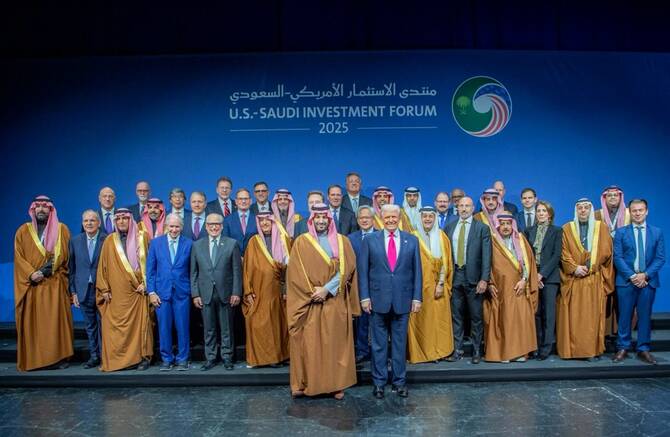

WASHINGTON: Saudi Arabia and the US, along with several companies and institutions from both nations, signed a series of agreements and memoranda of understanding during Crown Prince Mohammed bin Salman's visit to Washington on 18–19 November 2025.
The visit featured a meeting between the crown prince and President Donald Trump, as well as their joint participation in the Saudi–US Investment Forum, attended by prominent investors and major corporations.
Below is a full list of all deals reached.
Government agreements
1. The Saudi–US Strategic Defence Agreement (SDA) opens the door to broader military cooperation, encompassing technology transfers, joint training programs, and the supply of armaments.
a. A landmark defense accord reaffirming a military partnership spanning over eight decades and bolstering regional deterrence.
b. Provisions to facilitate the operations of American defense firms within Saudi Arabia.
c. Mechanisms introduced for sharing the financial burden of security between the two countries.
d. Formal announcement of Saudi Arabia’s designation as a “Major Non-NATO Ally.”
e. President Trump officially conferred the “Major Non-NATO Ally” status on Saudi Arabia.
2) Nuclear Agreement. A joint declaration was issued to finalize negotiations on civilian nuclear energy cooperation.
a. Establishes a long-term partnership in the field of civilian nuclear development.
b. Positions American firms as the preferred partners in the construction of Saudi Arabia’s nuclear energy programme.
c. Links cooperation to non-proliferation standards and international regulatory oversight.
3) Rare and Critical Minerals. A joint governmental framework to coordinate policies on strategic minerals.
a. Seeks to diversify global supply chains and reduce dependence on China.
b. Covers exploration, refining, and the development of value chains.
4) Artificial Intelligence. A strategic memorandum of understanding on artificial intelligence.
a. Grants Saudi Arabia access to advanced AI technologies, with safeguards in place to protect proprietary systems.
b. Aims to position Saudi Arabia as a global leader in the field of artificial intelligence.
c. Encompasses collaboration in research, computing infrastructure, and human capacity building.
5) Accelerating Investment. A strategic framework designed to accelerate investment flows between Saudi Arabia and the United States.
a. Streamlines investment approvals and expedites the launch of joint ventures across sectors such as energy, infrastructure, technology, and defence.
b. Includes regulatory alignment on vehicle standards.
c. Saudi recognition that vehicles and spare parts compliant with US standards meet domestic safety requirements.
6) Financial and Banking Cooperation. Agreements between the US Department of the Treasury and the Saudi Ministry of Finance to deepen cooperation in the following areas:
a. Capital markets
b. Financial technologies (fintech)
c. Regulatory standards
d. International financial institutions
Defense and Arms Deals
1. F-35 fighter jet deal. US authorization for the sale of advanced F-35 fighter jets to Saudi Arabia as part of a broader defense package.
a. A deal for the purchase of nearly 300 state-of-the-art American tanks to bolster the operational strength of Saudi ground forces.
b. Enhanced cooperation in operational planning and defense coordination.
c. Provisions to facilitate the deployment of defense systems such as Patriot and THAAD within Saudi Arabia.
d. Upgraded levels of intelligence and information-sharing cooperation.
Energy and Nuclear
1. Civilian Nuclear Energy. A civil nuclear cooperation agreement.
a. Affirms that enrichment and reprocessing activities will not be permitted within Saudi Arabia.
b. Paves the way for the construction of nuclear reactors using American technology.
c. Incorporates long-term financing arrangements.
2. Energy (Oil, Gas, and Services) A package of memoranda of understanding between Saudi Aramco and American companies, valued at over $30 billion, including:
a. Investments in the liquefied natural gas project at Lake Charles in partnership with MidOcean Energy.
b. An agreement with Commonwealth LNG.
c. Collaborations in oilfield services and technologies with Baker Hughes and Halliburton.
d. Financing partnerships with Blackstone and J.P.Morgan.
Rare and Critical Minerals
A governmental framework on critical minerals covering uranium, permanent magnets, and supply chains. A Saudi–US joint venture with MP Materials to establish a rare earth elements refinery within the country.
Ownership structure:
Maaden: at least 51 percent
MP Materials and the US Department of Defense: 49 percent
Objective: To reduce global dependence on China for rare earth refining.
Artificial intelligence, technology, and digital infrastructure
1. Government Agreements
a. The Saudi–US Strategic AI Partnership
I. Provision of advanced GPUs within the country.
II. Development of data centers and supercomputing facilities.
III. Transfer of knowledge and collaboration in research and development.
2. Private sector partnerships in technology and artificial intelligence
a. Data Centre Project involving AMD, Cisco and the Saudi company HUMAIN.
b. Launching with a 100-megawatt capacity data centre in Saudi Arabia, with plans to scale up to 1 gigawatt.
c. The Halo Project: a 2-gigawatt computing supercluster in partnership between HUMAIN and Luma AI.
d. Partnership with Elon Musk's xAI
e. A 500-megawatt computing project in collaboration with Nvidia.
f. AI Engineering Hub: A partnership between Qualcomm and HUMAIN with support from Adobe.
Public Investment and Finance
1. Saudi investment commitments in the US are nearing $1 trillion, covering infrastructure, energy, industry, and technology projects.
2. Agreements valued at $270 billion signed at the Saudi–US Investment Forum.
3. Media estimates suggest the total value of announced deals during the visit stands at approximately $557bn.
4. Confirmation that the United States remains the largest foreign investor in Saudi Arabia, accounting for around 25% of its total foreign direct investment.
Private sector partnerships
1. American energy and oil companies
a. Baker Hughes
b. Halliburton.
2. Investment and financial firms
a. Blackstone Inc.
b. J.P.Morgan.
3. Entertainment and creative infrastructure firms Involving American small- and medium-sized firms seeking partnerships in:
a. Entertainment.
b. Sports.
c. Major events.
d. Creative infrastructure, such as Convergenz.


