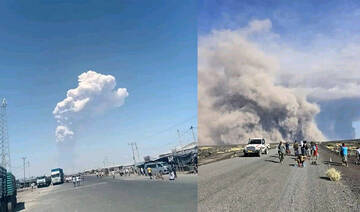
ADDIS ABABA: Volcanic activity in northern Ethiopia’s long-dormant Hayli Gubbi volcano subsided Tuesday, days after an eruption that left a trail of destruction in nearby villages and caused flight cancelations after ash plumes disrupted high-altitude flight paths.
Villages in the district of Afdera in the Afar region were covered in ash, officials said residents were coughing, and livestock found their grass and water totally covered.
Airlines canceled dozens of flights scheduled to fly over affected areas as the meteorological department said the ash clouds were expected to clear later in the day.
India’s flag carrier, Air India, said it canceled 11 flights, most of them international, on Monday and Tuesday to inspect aircraft that may have flown over affected areas, acting on a directive from India’s aviation safety regulator.
Another Indian operator, Akasa Air, said it had canceled flights to Middle East destinations such as Jeddah, Saudi Arabia; Kuwait; and Abu Dhabi in the United Arab Emirates.
At least seven international flights scheduled to depart from and arrive at Indira Gandhi International Airport in New Delhi were canceled Tuesday, while at least a dozen were delayed, according to an official at the airport.
An official in charge of health in northern Ethiopia’s Afdera district, Abedella Mussa, said the residents were coughing and mobile medical services from the larger Afar region had been launched in the remote area.
“Two medical teams have been dispatched to the affected kebeles (neighborhoods) like Fia and Nemma-Gubi to provide mobile medical services,” he said.
Another official in charge of livestock, Nuur Mussa, said animals were unable to find clean water or grass. “Many animals, especially in the two affected kebeles, cannot drink clean water or feed on grass because it is covered by volcanic ash,” he said.
Atalay Ayele, a geologist at Addis Ababa University, said such eruptions occur because Ethiopia is situated along an active rift system where volcanism and earthquakes are frequent.
“This is the first recorded eruption of Hayli Gubbi in the last 10,000 years,” he told The Associated Press. “It will likely continue for a short period and then stop until the next cycle.”
High-level winds carried the ash cloud from Ethiopia across the Red Sea, Yemen, Oman, the Arabian Sea and then toward western and northern India, the India Meteorological Department said in a statement. The ash cloud was moving toward China and expected to clear Indian skies late Tuesday.


![]()

Eruption of long-dormant Ethiopian volcano subsides

Short Url
https://arab.news/rj8kq
Eruption of long-dormant Ethiopian volcano subsides
- Villages in the district of Afdera in the Afar region were covered in ash
- Airlines canceled dozens of flights scheduled to fly over affected areas

Latest updates


© 2026 SAUDI RESEARCH & PUBLISHING COMPANY, All Rights Reserved And subject to Terms of Use Agreement.