

Security forces kill seven Pakistani Taliban militants in troubled northwest — military

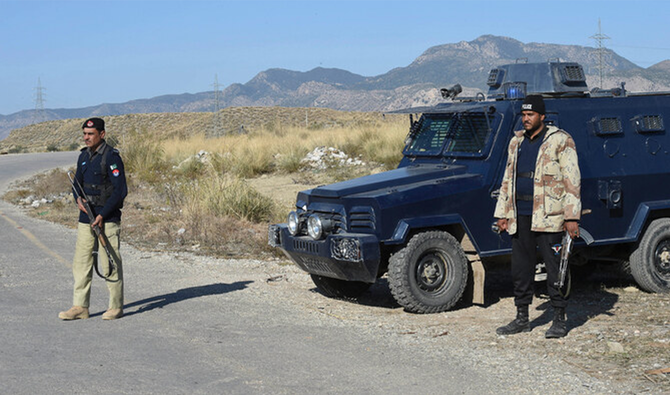
Policemen stand guard along a road in a village in Karak district in Pakistan on December 31, 2020. (AFP/File)
Short Url
Updated 02 December 2025
Follow

Security forces kill seven Pakistani Taliban militants in troubled northwest — military

  • The militants were killed in separate intelligence-based operations in the North Waziristan district that borders Afghanistan
  • The development comes hours after a militant attack in Pakistan’s northwest killed four, including a top administration official

ISLAMABAD: Security forces have killed seven Pakistani Taliban militants in the northwestern Khyber Pakhtunkhwa (KP) province, the Pakistani military said on Tuesday, as the South Asian country battles a surge in militancy.

The militants were killed in two intelligence-based operations in the North Waziristan district that borders Afghanistan, according to the Inter-Services Public Relations (ISPR), the Pakistani military’s media wing.

Weapons and ammunition were also recovered from the deceased “Indian-sponsored” militants, who remained actively involved in attacks against security forces and law enforcement agencies and target killing of civilians.

There was no immediate response from the Indian side to the statement.

“Sanitization operations are being conducted to eliminate any other Indian-sponsored kharji (militant) found in the area,” the ISPR said in a statement.

KP has seen a surge in militancy in recent years, with the Pakistani Taliban, or the Tehreek-e-Taliban Pakistan (TTP), and other militant groups frequently targeting security forces convoys and check-posts, besides targeted killings and kidnappings of law enforcers and government officials.

Earlier in the day, a militant attack on a government convoy in the province killed a senior administration official, two police officers and a civilian, officials said.

Islamabad has long accused Kabul of allowing its soil and India of backing militant groups, including the TTP, for attacks against Pakistan. Kabul and New Delhi have consistently denied this.

The uptick in militant violence triggered fierce clashes between Pakistan and Afghanistan in Oct. The two countries agreed to a ceasefire in Doha on Oct. 19, but tensions remain high between the neighbors.


Pakistan signals commitment to regulate digital assets in meeting with Binance leadership

Updated 6 sec ago
Follow

Pakistan signals commitment to regulate digital assets in meeting with Binance leadership

  • Binance delegation led by CEO Richard Teng meets Pakistan’s prime minister, army chief in Islamabad
  • Pakistan has attempted to tap into growing crypto market to curb illicit transactions, improve oversight

ISLAMABAD: Pakistan’s government has signaled its “strong commitment” to digital asset regulation as the country’s senior officials met the leadership of Binance, one of the world’s most prominent global cryptocurrency exchanges, the Prime Minister’s Office (PMO) said on Saturday. 

The Binance team, led by its Chief Executive Officer Richard Teng, is in Pakistan and has held meetings with Finance Minister Muhammad Aurangzeb, Pakistan Virtual Assets Regulatory Authority (PVARA) Chairman Bilal bin Saqib and senior Pakistani bank officials this week. 

Pakistan has been attempting to regulate its fast-growing crypto and digital assets market by bringing virtual asset service providers (VASPs) under a formal licensing regime. Officials say the push is aimed at curbing illicit transactions, improving oversight and encouraging innovation in blockchain-based financial services.

“Binance senior leadership visits Pakistan as government signals strong commitment to digital asset regulation,” the PMO said. 

A Binance delegation led by Teng met Chief of Army Staff and Chief of Defense Forces Field Marshal Syed Asim Munir in Islamabad. 

Saqib also attended the meeting and gave the Binance team a briefing about his organization.

Pakistan has attempted in recent months to tap into the country’s growing crypto market, a move analysts say could bring an estimated $25 billion in virtual assets into the tax net.

In September, Islamabad invited international crypto exchanges and other VASPs to apply for licenses to operate in the country, a step aimed at formalizing and regulating its fast-growing digital market.