

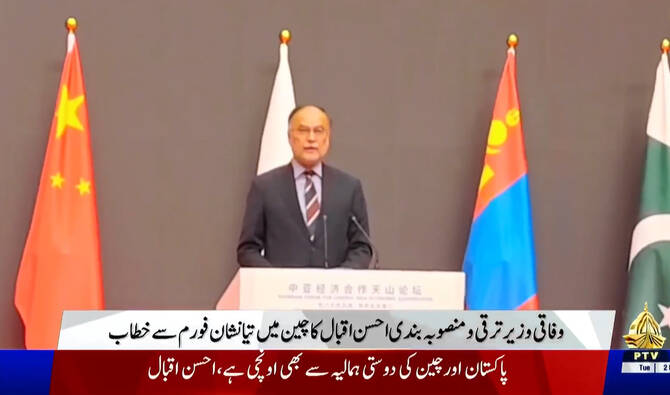

ISLAMABAD: Minister for Planning Ahsan Iqbal said on Monday Pakistan aims to position itself as a central trade and connectivity hub for China and Central Asia, telling the inaugural Tianshan Forum in Xinjiang that Pakistan’s Gwadar Port could offer the region the fastest maritime access to global markets and drastically reduce transit times for goods.
Iqbal delivered the forum as Pakistan seeks to shift from a traditional geopolitical posture toward a more geoeconomic model, anchored in corridors that connect western China and Central Asia to the Arabian Sea. His remarks come amid a broader push by Beijing to deepen regional integration under the Belt and Road Initiative (BRI), and by the landlocked Central Asian states seeking shorter, more reliable export routes.
The Tianshan Forum, launched this year in Urumqi, the capital of China’s Xinjiang region, aims to promote cross-border connectivity, logistics harmonization and regional development. For Pakistan, the platform provides an opportunity to highlight the role of the China-Pakistan Economic Corridor (CPEC), Pakistan’s $60 billion flagship of the BRI , and the Gwadar Port in a new Eurasian supply chain stretching from western China to the Middle East, Africa and Europe.
“The global landscape is undergoing profound transformation,” Iqbal said in his address.
“Economic strength is shifting from the Atlantic to the Indo-Pacific… China, Central Asia and South Asia is emerging a major engine of global growth.”
He argued that Pakistan’s geography made it uniquely positioned to serve as the region’s southern trade anchor.
“Our objective is clear, to become the most efficient, reliable and cost-effective connectivity hub between Central Asia, China, South Asia and Middle East and global markets,” he said, adding that for Xinjiang, Gwadar offers “the shortest route to global trade” and that “transit time reduces by up to 70 percent.”
Iqbal used the forum to unveil four “actionable and time-bound” cooperation mechanisms that he said could accelerate regional integration: a joint task force on economic connectivity and trade facilitation; co-developed regional special economic zones; a Eurasian Energy and Green Transition Partnership; and a Digital Silk Road and Future Skills Alliance focusing on AI, cybersecurity and fintech.
He said such measures could sharply reduce logistics costs, expand industrial output and strengthen energy security across Eurasia.
“This forum embodies that wisdom, uniting our efforts toward development-centered cooperation,” he told delegates.
Iqbal described CPEC as “a strategic development framework built on trust and long-lasting partnership,” highlighting achievements including 8,000 megawatts added to Pakistan’s power grid, over 1,000 kilometers of new motorways and highways, the operationalization of Gwadar Port and the creation of a “digital backbone for future IT and artificial intelligence cooperation.”
Linking Pakistan’s development agenda to China’s global initiatives, he said:
“Frameworks such as Global Development Initiative, Global Security Initiative and Global Civilization Initiatives by President Xi Jinping offer a timely, equitable and people-centric approach.”
The planning minister said Pakistan remained “ready, committed and optimistic” about deeper collaboration with China and Central Asian states:
“If we choose connectivity over isolation… then our region can emerge as the strategic economic center of the world.”


