

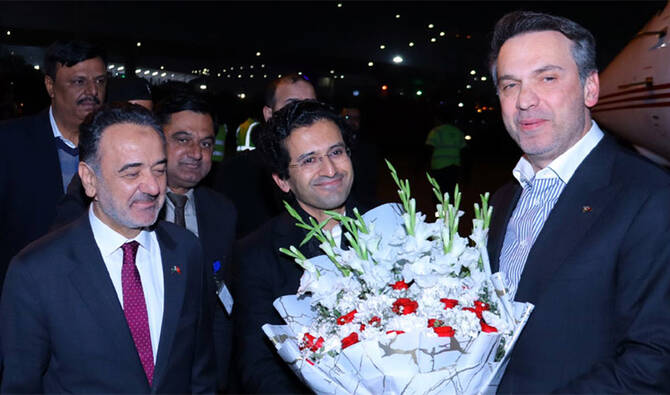

ISLAMABAD: Türkiye’s Minister of Energy and Natural Resources, Alparslan Bayraktar, arrived in Islamabad late on Monday at the head of a high-level delegation, as Pakistan seeks to expand cooperation with Ankara across energy, petroleum and mineral exploration, sectors critical to the country’s economic revival.
The visit comes amid Pakistan’s push to attract foreign investment into its oil, gas and mining sectors to ease severe energy shortages, cut reliance on imported fuels and tap underexplored reserves. Türkiye, meanwhile, has steadily broadened its commercial and strategic footprint in South Asia and already has multiple energy firms operating in Pakistan.
“The visit will play a significant role in enhancing cooperation between the two countries in energy and minerals sectors,” Radio Pakistan reported after Bayraktar was received at Islamabad airport by Pakistan’s Federal Petroleum Minister Ali Pervaiz Malik, Turkish Ambassador Irfan Neziroglu and senior petroleum-sector officials.
The Turkish minister’s arrival follows his comments last week that Türkiye was preparing to formalize a new energy accord with Pakistan covering both offshore and onshore exploration.
“We’re preparing to sign our accord for Pakistan’s first deep-sea drilling project,” he told reporters. “Our cooperation will begin with exploration work in two onshore blocks and one offshore zone.”
Deep-sea drilling, never previously executed in Pakistan, has long been viewed as a frontier opportunity, though past attempts stalled due to cost, technological barriers and inconsistent policy frameworks. A formal Turkish commitment would mark one of the most significant foreign partnerships in Pakistan’s upstream energy sector in years.
Last month, Pakistan approved a new offshore exploration consortium, clearing Turkish Petroleum Overseas Company (TPC) to take over operatorship of the Eastern Offshore Block-C as part of a push to revive drilling. Pakistan’s Economic Coordination Committee approved Pakistan Petroleum Limited’s request to assign part of its interest in the block to TPOC, Mari Energies and state-run Oil & Gas Development Co. Ltd, leaving PPL with a 35 percent stake.
TPOC will hold 25 percent and will operate the block once a formal agreement is signed.
In October, bids were awarded for 23 of 40 offshore blocks offered, covering around 53,500 square kilometers, in Pakistan’s first offshore bidding round since 2007.
Pakistan’s 300,000 square kilometer offshore zone, bordering energy-rich Oman, the United Arab Emirates and Iran, has seen just 18 wells drilled since independence in 1947, too few to fully assess its hydrocarbon potential.
EXPANDING TIES
Pakistan and Türkiye have expanded security and defense ties in recent years, but energy and minerals are now emerging as priority sectors. For Pakistan, grappling with fuel import bills, periodic gas shortages and a need to diversify energy sources, joint exploration with Türkiye offers both investment and technology transfer.
For Türkiye, the partnership aligns with its wider strategy of increasing its global energy footprint, securing resource access and strengthening ties with key Muslim-majority economies.
Ahead of the delegation’s arrival on Monday night, Pakistan’s petroleum minister Malik met Turkish Ambassador Neziroglu on Sunday to finalize arrangements.
A statement released after the meeting said officials reviewed the growing collaboration between the two countries in oil, gas and minerals, noting that Turkish Petroleum (TPAO), Türkiye’s state energy company, has already joined both offshore and onshore exploration initiatives with Pakistani partners.
Malik said Pakistan’s key companies like OGDCL, PPL and Mari Petroleum were working alongside TPAO, creating “new opportunities for joint ventures and strengthening cooperation on the global stage.”
According to the Pakistani statement, Ambassador Neziroglu said the delegation also includes a major Turkish mining-sector company, signaling broader investment interest in Pakistan’s high-potential mineral deposits, including copper, gold and rare earth elements.
Both sides said they were committed to ensuring a successful visit and translating mutual goodwill into “meaningful economic and strategic outcomes.”


