

Pakistan urges expanded economic, defense cooperation as UAE marks National Day

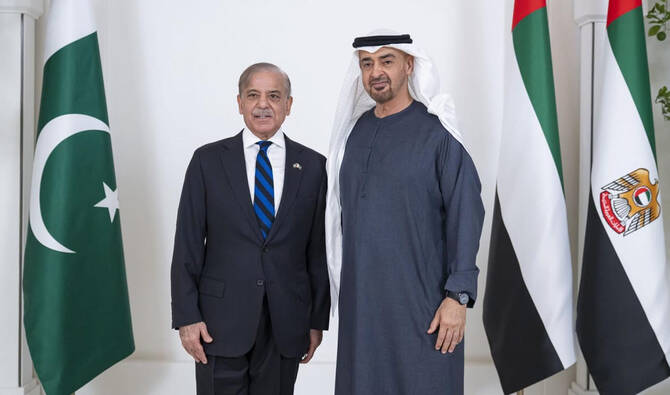
United Arab Emirates President Sheikh Mohamed bin Zayed Al Nahyan meeting Pakistan Prime Minister Shehbaz Sharif (left) at the Qasr Al Shati in Abu Dhabi, UAE, on June 12, 2025. (PID/File)
Short Url
Updated 02 December 2025
Follow

Pakistan urges expanded economic, defense cooperation as UAE marks National Day

  • UAE marks its National Day on Dec. 2, celebrating the 1971 unification of the Emirates
  • Pakistan–UAE ties span decades of close economic, investment, defense cooperation

KARACHI: Pakistani Prime Minister Shehbaz Sharif on Tuesday called for deepening economic, trade, investment and defense cooperation with the United Arab Emirates (UAE) as the Gulf nation marks its National Day, saying both countries remain committed to shared goals of stability and prosperity.

Pakistan and the UAE maintain one of the closest bilateral relationships in the Gulf region. The UAE is Pakistan’s second-largest trading partner, a major investor in energy, ports, banking and logistics, and home to more than 1.6 million Pakistani workers, whose remittances form a critical source of foreign exchange for Islamabad.

The UAE celebrates National Day on Dec. 2 each year, marking the founding of the federation in 1971 and its emergence as one of the Middle East’s most influential economic and diplomatic actors.

Sharif, in a message issued by the Prime Minister’s Office, said the two countries were “resolute in striving for achieving the common goals of peace and stability, development and prosperity,” adding that expanding cooperation across key sectors would benefit both nations.

“Insha Allah, our cooperation in the economic, bilateral trade, investment and defense sectors will pave the way for the well-being of the peoples of both countries,” he said.

The prime minister noted that Pakistan-UAE ties are grounded in shared religious and cultural values and mutual trust, and credited the leadership of the late Sheikh Zayed bin Sultan Al Nahyan, and later President Sheikh Mohamed bin Zayed Al Nahyan and Prime Minister Sheikh Mohammed bin Rashid Al Maktoum, with strengthening those bonds.

Sharif also highlighted the role of Pakistani workers and professionals based in the UAE, saying their contributions “positively” reinforce the partnership.

He said the “warmth between our two peoples” reflects deep public affection on both sides, expressing hope that the relationship would “grow from strength to strength in the times to come.”


Pakistan offers Kyrgyzstan Arabian Sea access as two states sign 15 cooperation accords

Updated 5 sec ago
Follow

Pakistan offers Kyrgyzstan Arabian Sea access as two states sign 15 cooperation accords

  • Pakistan and Kyrgyzstan sign MOUs spanning trade, energy, agriculture, ports, education, security cooperation
  • Kyrgyz president is on first visit to Pakistan in 20 years as both sides push connectivity and CASA-1000 power links

ISLAMABAD: Pakistan on Thursday offered Kyrgyzstan the shortest and most economical route to the Arabian Sea as the two countries signed 15 agreements and memoranda of understanding aimed at boosting cooperation across trade, energy, agriculture, education, customs data-sharing and port logistics.

The accords were signed during a visit to Islamabad by President Sadyr Zhaparov, the first by a Kyrgyz head of state to Pakistan in two decades, and part of Islamabad’s renewed push to link South Asia with landlocked Central Asian economies through ports, power corridors and transport routes.

For Pakistan, Kyrgyzstan offers access to hydropower through CASA-1000, a $1.2 billion regional electricity transmission project designed to carry surplus summer electricity from Kyrgyzstan and Tajikistan through Afghanistan into Pakistan. For Bishkek, Pakistan provides overland access to warm-water ports on the Arabian Sea, creating a shorter commercial route to global markets.

“President Asif Ali Zardari has reiterated Pakistan’s readiness to offer Kyrgyzstan the shortest and most economical route to the Arabian Sea,” Radio Pakistan reported after Zhaparov met the Pakistani president. 

The two leaders also discussed expanding direct flights to deepen business, tourism and people-to-people ties.

Zardari welcomed Kyrgyzstan’s completion of its segment of the CASA-1000 project and “reaffirmed Pakistan’s commitment to completing its part of the project, which is now at an advanced stage,” the state broadcaster said. 

Zhaparov thanked Islamabad for supporting Bishkek’s candidacy for a non-permanent UN Security Council seat and invited Zardari to visit Kyrgyzstan at a time of his convenience. Both sides expressed satisfaction with progress under the Quadrilateral Traffic in Transit Agreement, designed to facilitate road movement between Pakistan, Kyrgyzstan, Kazakhstan and China.

Earlier, both governments exchanged 15 sectoral cooperation documents covering commerce, mining, geosciences, power, agriculture, youth programs, the exchange of convicted persons, customs electronic data systems and a sister-city linkage between Islamabad and Bishkek.

According to APP, the MOUs were signed by ministers representing foreign affairs, commerce, economy, energy, power, railways, interior, culture, health and tourism. Agreements also covered cooperation between Pakistan’s Foreign Service Academy and the Diplomatic Academy of Kyrgyzstan, as well as collaboration between universities, youth ministries and cultural institutions.

“Our present mutual trade, comprising of about $15–16 million will be enhanced to $200 million in the next two years,” Prime Minister Shehbaz Sharif said after the agreements were signed, calling them “a framework for structured, result-oriented engagement and closer institutional linkages.”

Sharif said Pakistan was ready to serve as a maritime outlet for the landlocked Central Asian republic, offering access to Karachi, Port Qasim and Gwadar to help Kyrgyz goods reach regional and global markets.