


KARACHI: Pakistan’s economic future depends on how effectively it can manage its rapidly growing population and escalating climate threats, the country’s finance minister warned on Monday, urging coordinated reforms to unlock the nation’s full development potential.
Pakistan’s over 241 million population, the fifth largest in the world, continues to strain an already limited resource base, putting pressure on public services, infrastructure, and the job market. With millions entering the workforce every year, the country struggles to create enough employment opportunities, while expanding demands for housing, healthcare and education widen fiscal gaps.
At the same time, worsening climate-related challenges, ranging from heatwaves and droughts to floods and glacial melt, are hitting key sectors such as agriculture, energy and water supply. These disruptions not only drive up costs for households and businesses but also force diversion of scarce resources to disaster response and recovery. Analysts say the twin pressures are deepening economic fragility, making sustainable growth increasingly difficult.
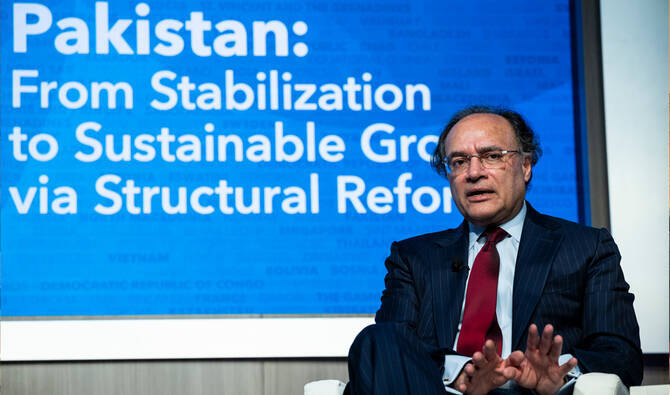
Speaking at the Pakistan Population Summit 2025 in Islamabad, Finance Minister Muhammad Aurangzeb said while the government continues to focus on economic recovery and the transition from stabilization to growth, the country’s long-term potential envisioned in various studies, projecting Pakistan as a $3 trillion economy by 2047, cannot be realized without addressing the core issues of climate change and population growth.
"Climate impacts are already affecting growth, with recent flooding expected to shave 0.5 percent off GDP this year," Aurangzeb said. "Population pressures similarly constrain real economic gains, as higher growth figures lose meaning if population expansion is not managed... Real progress hinges on harnessing the population dividend, particularly the youth, who make up 64 percent of the population."
He said Pakistan has long understood the "what" and the "why" of population challenges, and that the real task now lies in the "how" of implementation," hoping the summit would collectively produce actionable pathways for implementation.
Economic transformation will come not from government jobs but from freelancers, IT professionals and young innovators leading Pakistan’s digital economy, according to the finance minister.
He pointed to advancements in AI, blockchain, Web 3.0 and the rising participation of Pakistanis in global crypto activity.
Aurangzeb drew attention to the severe challenge of stunting, affecting 40 percent of Pakistani children under five, and termed it “intellectual poverty” that undermines future workforce and leadership. He highlighted rising urbanization and the need to focus on poor urban communities, where failures in water, sanitation and hygiene significantly contribute to stunting.
The minister said addressing these issues requires comprehensive, cross-sectoral action, including improved birth spacing, nutrition, sanitation and clean water. He acknowledged strong multilateral support, including the World Bank’s 10-year, $2 billion annual commitment under its Country Partnership Framework, where key priority areas are linked to outcomes in reducing child stunting, addressing learning poverty at the foundation level and climate change resilience.
"Pakistan cannot repeatedly seek international appeals or borrow for every challenge," he said. "The federal government and provinces have jointly funded this year’s rescue and relief operations for flooding without external appeals, demonstrating capacity for self-financing."
Monsoon floods this year killed more than 1,000 people and affected another around 3.6 million, causing huge economic losses to the South Asian country that ranks among the world's most climate-vulnerable nations.
Aurangzeb stressed that resources must be repurposed for national priorities and hoped that upcoming national policy-making discussions will be based on consensus, with population as a key component of horizontal distribution.
"It is now Pakistan’s responsibility to develop investable and bankable projects," he added.


