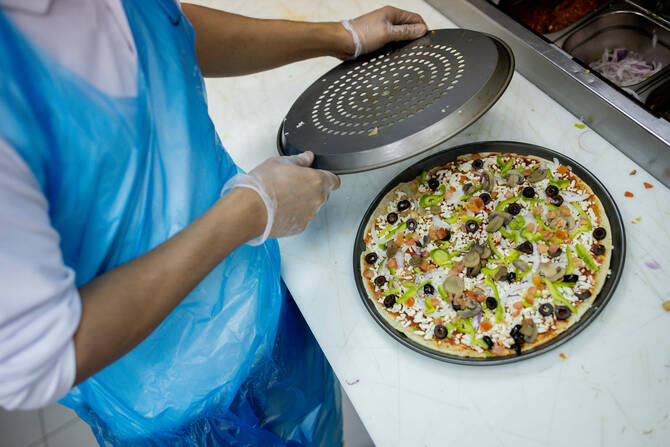

RIYADH: Pizza restaurant chains in Saudi Arabia are facing rising operational costs due to increases in raw material, transportation, and packaging prices, coupled with fierce competition from both local and international chains, according to investors in the sector who spoke to Al-Eqtisadiah.
They stated that years ago, pizza in Saudi Arabia was exclusively made and sold by specific global companies, leading to high prices.
However, the emergence and expanding market share of local brands sparked competition and led to a balancing of meal prices, prompting some international companies to exit.
Abdullah Al-Salama, chairman of the National Committee for Catering and Supply, explained that the size of the fast-food sector is estimated at around SR35 billion ($9.3 billion), equivalent to 30 percent of the overall market.
Pizza restaurants capture approximately 12 percent of this sector, a significant proportion considering the multitude of brands and diversity of tastes.
Al-Salama pointed out that operational costs in the sector rose over the past two years by between 10 percent and 20 percent due to increases in raw material, transportation, and packaging prices.
He added that many restaurants absorbed the increase and did not raise their prices significantly, with the upsurge passed on to the consumer not exceeding 8 percent in most cases.
Al-Salama believes the pizza sector still attracts investments ranging between SR300 and SR500 million annually, but it is no longer an open field for everyone. It now requires a deep understanding of the local market, precise operational management, and effective supply chains.
For his part, Chef Fahd Al-Kuraida, owner of ViVACi restaurant, which specializes in Neapolitan pizza in Jeddah, said that demand for pizza in Saudi Arabia remains strong, especially among groups seeking high-quality pizza, and that restaurants using Italian ingredients and naturally fermented sourdough are in high demand.
He clarified that the gross profit margin before operational costs ranges between 20 percent and 30 percent, while the net profit does not exceed 10 percent under the best circumstances.
He indicated that expansion in Riyadh represents a better growth opportunity due to the market’s strength and the momentum of economic activity.
Remarkable expansion in fast-food activity
Data from the Ministry of Commerce showed that the number of commercial registrations in the fast-food sector, which includes pizza restaurants, reached about 63,272 by the end of September.
The capital, Riyadh, leads with 21,094 registrations, followed by Makkah with 17,414, and the Eastern Province with 7,430.
More balanced pricing to expand customer base
Meanwhile, Khalid Al-Omran, founder of Maestro Pizza, explained to Al-Eqtisadiah that pizza’s share of the fast-food market in Saudi Arabia did not exceed 4 percent when the project was founded in 2013, compared to 24 percent in the US and 27 percent in Europe, which he considered a major investment opportunity.
He explained that the main difference between the local market and global markets was pricing, as a large pizza was sold locally for between SR55 and SR65, compared to SR25 to SR35 in the US. This prompted Maestro to adopt a more balanced pricing model to expand its customer base.
The pizza price war is now seen as competition among major restaurant chains. It began with marketing campaigns and highly competitive pricing and led to the unification of pizza prices across sizes to gain the largest market share.
Not entirely harmful, but not an ideal choice
With rising awareness of quality and experience, consumers are increasingly leaning toward brands that offer authentic ingredients and a distinctive character.
This enhances growth opportunities for the specialized segment of pizza restaurants in the coming years, especially in major cities that lead the economic and taste scene in Saudi Arabia.
From a health perspective, Clinical Nutrition Specialist Nivin Madani told Al-Eqtisadiah that pizza is not entirely harmful, but it is also not an ideal choice because it contains refined white flour, saturated fats, and ready-made sauces.
Over time, excessive consumption may increase the risk of weight gain, high cholesterol and blood pressure, insulin resistance, type 2 diabetes, and digestive problems due to its low fiber and high sodium content.
She added that it can be made a healthier choice by replacing white flour with whole wheat or oat flour, using low-fat cheese, adding a good amount of vegetables, and avoiding ready-made sauces and processed meats.