TEL AVIV: Israeli Prime Minister Benjamin Netanyahu appeared in court on Monday for the first time since asking the country’s president for a pardon in his long-running corruption trial, a move backed by close ally US President Donald Trump.
Opposition politicians have come out against the request, with some arguing that any pardon should be conditional on Netanyahu retiring from politics and admitting guilt. Others have said the prime minister must first call national elections, which are due by October 2026, before requesting any pardon.
Naftali Bennett, a former prime minister, said he would support ending the trial if Netanyahu were to agree to withdraw from politics “in order to pull Israel out of this chaos.”
“This way, we can put this behind us, unite and rebuild the country together,” said Bennett, who led a coalition government that won the 2021 election, ousting Netanyahu from office. Netanyahu won the election the next year to return to power.
Polls show Bennett as the most likely to head the next government if Netanyahu departed.
Indicted on bribery, fraud charges in 2020
Netanyahu, Israel’s longest-serving prime minister, was indicted back in 2019 on charges of bribery, fraud and breach of trust after years of investigations. His trial began in 2020.
The prime minister has repeatedly denied any wrongdoing and made no admission of guilt in his request for a pardon, with Netanyahu’s lawyers stating that he believed that the legal proceedings, if completed, would end in a complete acquittal.
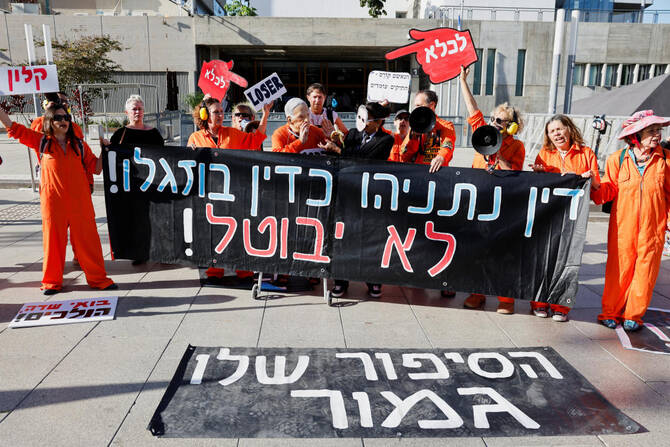
A small group of demonstrators gathered outside Monday’s Tel Aviv court hearing, some of them wearing orange prison-style jumpsuits and calling on Netanyahu to go to prison.
Ilana Barzilay, one of the demonstrators outside the court, said she believed it was unacceptable that Netanyahu asked for a pardon without pleading guilty or taking any responsibility.
In a letter to President Isaac Herzog that was released on Sunday, lawyers for Netanyahu said that frequent court appearances were hindering the prime minister’s ability to govern. A pardon would also be good for the country, they said.
Pardons in Israel have typically been granted only after legal proceedings have concluded and the accused has been convicted. There is no precedent for issuing a pardon mid-trial.
Trump sees Netanyahu’s case as ‘political’
Allies of Netanyahu’s right-wing coalition have backed his request, which came two weeks after Trump wrote to Herzog asking him to consider pardoning Netanyahu, calling the cases against him a “political, unjustified prosecution.”
In recent elections, Netanyahu’s rivals have made his legal cases a central campaign issue. Many polls indicate that his coalition, the most right-wing in Israel’s history, would struggle to win enough seats to form the next government.


![]()
Israel’s Netanyahu appears in court after pardon request backed by Trump

Short Url
https://arab.news/92c55
Israel’s Netanyahu appears in court after pardon request backed by Trump
- Demonstrators protest Netanyahu’s pardon request without admission of guilt
- Pardons in Israel typically granted post-conviction, setting no precedent for mid-trial
Latest updates


© 2026 SAUDI RESEARCH & PUBLISHING COMPANY, All Rights Reserved And subject to Terms of Use Agreement.