

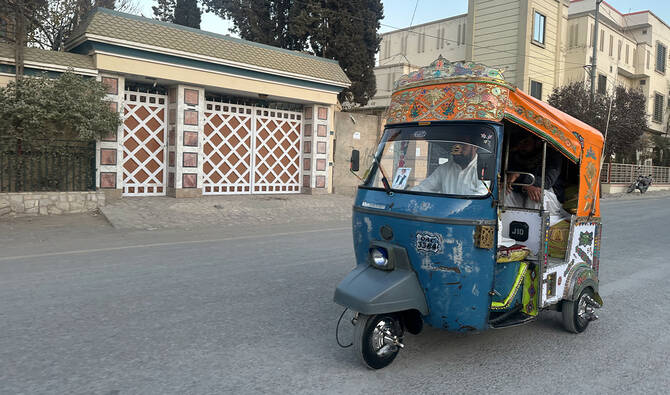

QUETTA: On a cold November afternoon in Quetta, 34-year-old Assadullah Khan eased a gleaming, Italian-made rickshaw onto the road, instantly drawing stares, smiles and requests for photos.
The three-wheeler, a two-stroke Vespa model from the 1980s, is believed to be the last of its kind still running in Pakistan’s sprawling, sparsely populated Balochistan province.
The rickshaw, with its hand-painted scenes and new cushioned seats, is far from a practical commuter vehicle today. But for Khan, who designs computerized rickshaw artwork on Quetta’s Nichari Road, it is a deeply personal project of memory and devotion.
“It was my father’s passion because he loved this rickshaw,” he told Arab News. “This rickshaw brings back my father’s memories because before he passed away, he advised me to take care of it and keep it rare.”
Vespa’s three-wheeled rickshaws, manufactured by the Italian company Piaggio, entered Pakistan in the early 1960s, part of a wave of motorized transport replacing horse-drawn tongas in South Asian cities. Their distinctive sputtering engines and hand-painted bodies became synonymous with urban life for decades.
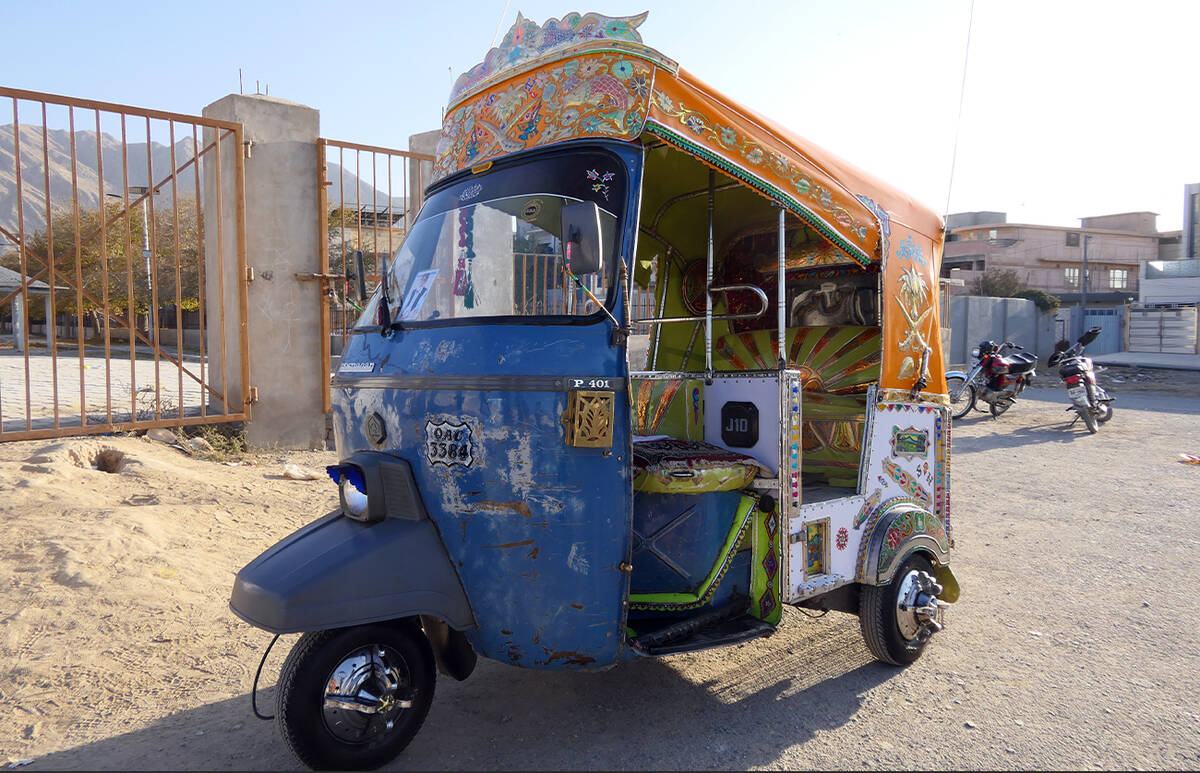
The Italian-made three wheeled rickshaw stands in Quetta, Pakistan, on November 28, 2025. (AN Photo)
The Balochistan provincial government, however, banned the two-stroke models in 2007, citing noise and air pollution. Around 2,800 of the Italian rickshaws were dismantled as authorities introduced cleaner, fuel-efficient four-stroke and later CNG-powered versions.
Khan’s father had purchased the 1980 model for Rs1.25 million (about $4,437). Since inheriting it, Khan has spent another Rs75,000 ($266) on restoration and decoration, including an intricate painting of a girl with a bow and arrow against a technicolor backdrop.
“My rickshaw [mostly] stays parked at home,” he said. “When I pass the streets of Quetta, people react with joy seeing the last Italian rickshaw. Some elderly people stop me, some take pictures to relive their memories with this faded ride.”
He keeps it running by changing the engine oil every six months.
POLLUTION CONCERNS AND NOSTALGIA
Two-stroke engines burn a mix of gasoline and oil, producing far more emissions and noise than modern engines. Balochistan authorities say the ban was essential in a province increasingly affected by air pollution.
“Reason behind dismantling the Italian rickshaw was pollution because they used to emit more pollution in the city than other vehicles,” Muhammad Ali, secretary of the Regional Transport Authority, told Arab News. “Now the government is encouraging rickshaw drivers to convert four-stroke rickshaws into electric ones.”
Pakistan has struggled with some of the world’s worst air quality in recent years. While Quetta fares better than megacities like Lahore and Karachi, the World Health Organization listed it among the planet’s most polluted cities in 2011.
But for those who drove the Italian rickshaws, or rode in them, the nostalgia runs deep.
“The government forced rickshaw owners to abolish their rickshaws worth Rs1.3 million ($4,600),” said Shah Murad Khan, president of the All-Quetta Rickshaw Union. “Those Italian rickshaws were durable and long-lasting because we have replaced the four-stroke rickshaws three times since they were [first] introduced.”
Quetta residents say the Italian rickshaws once symbolized the city, especially their elaborate artwork, tribal embellishments, and distinctive sound.

Four stroke Sazgar rickshaws are parked at a showroom in Quetta, Pakistan, on November 28, 2025. (AN Photo)
Syed Sajjad, a resident of Marriabad, was among those who stopped Khan to take photographs.
“I saw an Italian rickshaw in Europe which made me very happy,” he said. “When I returned from Europe in 2012, these Italian rickshaws had completely vanished.”
Khan’s rickshaw has attracted wide attention, including interest from across the border.
He recalled receiving a “lucrative offer” from Iran, where enthusiasts wanted to display the rickshaw inside a museum. He turned it down. Because for him, the rickshaw is more than a vintage vehicle: it is a promise fulfilled, a piece of family history preserved and a vivid reminder of a chapter of Pakistan’s urban life that has largely disappeared from the roads.
“You won’t find an Italian rickshaw anywhere else in Balochistan except mine,” he said proudly.


