

Two paramilitary soldiers, cop killed in separate suicide attacks in Pakistan

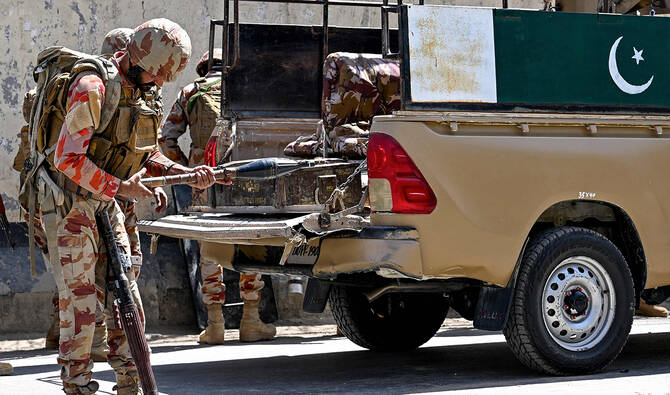
Security personnel stand armed beside a military vehicle at an explosion site outside the Frontier Corps (FC) headquarters in Quetta, Pakistan, on September 30, 2025. (AFP/File)
Short Url
Updated 01 December 2025
Follow

Two paramilitary soldiers, cop killed in separate suicide attacks in Pakistan

  • Suicide blast in southwestern Nokundi city targets paramilitary force’s headquarters, three militants killed
  • In second attack, suicide blast targets police vehicle in northwestern Lakki Marwat district, injuring three others

QUETTA/PESHAWAR: Two paramilitary soldiers and a police constable were killed on Monday in separate suicide attacks in Pakistan’s western provinces bordering Afghanistan, officials said as Islamabad grapples with a steep rise in militant attacks.

The first incident occurred on Sunday night when an attacker drove an explosive-laden vehicle into the headquarters of the paramilitary Frontier Corps (FC) force in southwestern Balochistan province’s Nokundi city. Nokundi is located in Chaghi district, which is also home to one of the largest untapped copper and gold deposits in the world, Reko Diq.

The second suicide attack took place in the northwestern Khyber Pakhtunkhwa (KP) province, where an attacker targeted a police van in the Lakki Marwat district.

“Reportedly three terrorists have been killed,” a Balochistan government official told Arab News on condition of anonymity, as he was not authorized to speak to media. “Two soldiers have been martyred and the injured are not known.”

An official said the Balochistan attack occurred around 8:20pm on Sunday, adding that the attackers opened an indiscriminate fire on paramilitary forces after the blast. Multiple explosions were also reported as FC personnel engaged the assailants. 

The Balochistan Liberation Front (BLF), an ethnic Baloch separatist group, claimed responsibility for the FC headquarters attack in Nokundi.

Balochistan has faced a separatist insurgency by ethnic Baloch militant groups for several decades. The most prominent of these is the Balochistan Liberation Army, which has stepped up attacks in recent years.

Islamabad describes these groups as proxies of Indian intelligence, branding them Fitnah-ul-Hindustan, or “India’s mischief.” New Delhi denies supporting the militants.

“Fighters of SOB, a subsidiary organization of BLF, have launched a massive attack on the central compound for foreign staff and engineers associated with Reko Diq and Saindak in Nokundi,” the BLF said in a statement. 

The group also released a photograph of a female suicide bomber, claiming she drove the vehicle that exploded at the entrance of the FC headquarters.

Balochistan, which borders Afghanistan and Iran, is strategically important due to its mineral wealth and its role as a transit hub for the China-Pakistan Economic Corridor (CPEC).

Separatist militants in the restive province have frequently targeted foreign nationals, particularly Chinese citizens, working on dams and other infrastructure projects across the country. They accuse Islamabad of exploiting the province’s natural resources and denying locals a share in its mineral wealth. Pakistan’s government and military deny the allegations.  

In the second incident, Lakki Marwat police spokesperson Shahid Marwat said the suicide blast took place near the Katto Khel stop in the district. 

“The blast occurred near Katto Khel stop, with Police Constable Illauddin succumbing to his injuries on the spot while Assistant Sub Inspector Haq Nawaz and two other officers were rushed to a nearby hospital for urgent medical attention,” Marwat told Arab News.

He said the police were working tirelessly to bring the culprits to justice, adding that a massive police operation had been launched with security forces determined to disrupt and dismantle militant networks in the province.

No group has claimed responsibility for the attack so far, but the restive KP province has seen a surge in violence by the Pakistani Taliban or Tehreek-e-Taliban Pakistan (TTP) after a fragile ceasefire with the state broke down in November 2022. 

The TTP has carried out some of the deadliest attacks against law enforcers and civilians since 2007 in a bid to impose its strict brand of Islamic law. 


Pakistan offers Kyrgyzstan Arabian Sea access as two states sign 15 cooperation accords

Updated 05 December 2025
Follow

Pakistan offers Kyrgyzstan Arabian Sea access as two states sign 15 cooperation accords

  • Pakistan and Kyrgyzstan sign MOUs spanning trade, energy, agriculture, ports, education, security cooperation
  • Kyrgyz president is on first visit to Pakistan in 20 years as both sides push connectivity and CASA-1000 power links

ISLAMABAD: Pakistan on Thursday offered Kyrgyzstan the shortest and most economical route to the Arabian Sea as the two countries signed 15 agreements and memoranda of understanding aimed at boosting cooperation across trade, energy, agriculture, education, customs data-sharing and port logistics.

The accords were signed during a visit to Islamabad by President Sadyr Zhaparov, the first by a Kyrgyz head of state to Pakistan in two decades, and part of Islamabad’s renewed push to link South Asia with landlocked Central Asian economies through ports, power corridors and transport routes.

For Pakistan, Kyrgyzstan offers access to hydropower through CASA-1000, a $1.2 billion regional electricity transmission project designed to carry surplus summer electricity from Kyrgyzstan and Tajikistan through Afghanistan into Pakistan. For Bishkek, Pakistan provides overland access to warm-water ports on the Arabian Sea, creating a shorter commercial route to global markets.

“President Asif Ali Zardari has reiterated Pakistan’s readiness to offer Kyrgyzstan the shortest and most economical route to the Arabian Sea,” Radio Pakistan reported after Zhaparov met the Pakistani president. 

The two leaders also discussed expanding direct flights to deepen business, tourism and people-to-people ties.

Zardari welcomed Kyrgyzstan’s completion of its segment of the CASA-1000 project and “reaffirmed Pakistan’s commitment to completing its part of the project, which is now at an advanced stage,” the state broadcaster said. 

Zhaparov thanked Islamabad for supporting Bishkek’s candidacy for a non-permanent UN Security Council seat and invited Zardari to visit Kyrgyzstan at a time of his convenience. Both sides expressed satisfaction with progress under the Quadrilateral Traffic in Transit Agreement, designed to facilitate road movement between Pakistan, Kyrgyzstan, Kazakhstan and China.

Earlier, both governments exchanged 15 sectoral cooperation documents covering commerce, mining, geosciences, power, agriculture, youth programs, the exchange of convicted persons, customs electronic data systems and a sister-city linkage between Islamabad and Bishkek.

According to APP, the MOUs were signed by ministers representing foreign affairs, commerce, economy, energy, power, railways, interior, culture, health and tourism. Agreements also covered cooperation between Pakistan’s Foreign Service Academy and the Diplomatic Academy of Kyrgyzstan, as well as collaboration between universities, youth ministries and cultural institutions.

“Our present mutual trade, comprising of about $15–16 million will be enhanced to $200 million in the next two years,” Prime Minister Shehbaz Sharif said after the agreements were signed, calling them “a framework for structured, result-oriented engagement and closer institutional linkages.”

Sharif said Pakistan was ready to serve as a maritime outlet for the landlocked Central Asian republic, offering access to Karachi, Port Qasim and Gwadar to help Kyrgyz goods reach regional and global markets.