

Egypt, Pakistan push wider defense, economic cooperation during high-level meetings

1 / 2
Pakistan’s Field Marshal Syed Asim Munir meets Egyptian Foreign Minister Dr. Badr Ahmed Mohamed Abdelatty (left) in Rawalpindi, Pakistan, on December 1, 2025. (ISPR)
2 / 2
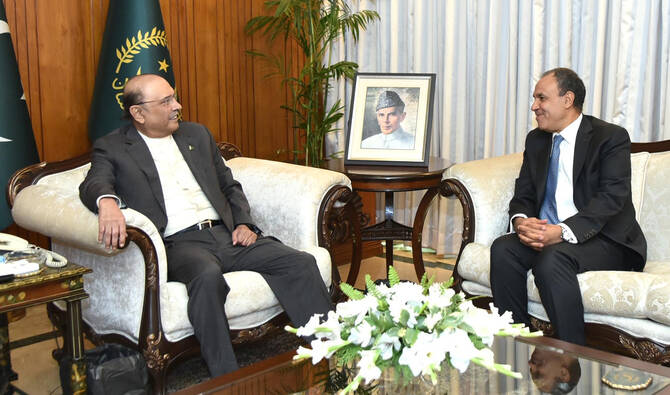
Pakistan President Asif Ali Zardari meeting with Egyptian Foreign Minister Dr. Badr Ahmed Mohamed Abdelatty (left) in Islamabad, Pakistan, on November 30, 2025. (PID)
Short Url
Updated 01 December 2025
Follow

Egypt, Pakistan push wider defense, economic cooperation during high-level meetings

  • Field Marshal Munir, Egyptian FM reaffirm commitment to deepen defense ties, strategic coordination
  • Cairo’s Elsewedy Electric explores expanded investment in Pakistan’s mining, IT, industrial sectors

KARACHI: Pakistan and Egypt this week expanded their bilateral engagements across defense, economic and investment domains as senior officials from both nations held a series of meetings in Islamabad and Cairo, according to official statements.

Egypt’s foreign minister, Dr. Badr Ahmed Mohamed Abdelatty, is in Pakistan for talks on security, trade and diplomatic ties, a visit that has included meetings with President Asif Ali Zardari, Deputy Prime Minister Ishaq Dar and Field Marshal Syed Asim Munir.

On Monday, Munir and Abdelatty discussed military-to-military cooperation, training programs and regional security, the Pakistani military said.

“The discussions reaffirmed the commitment of both sides to strengthen coordination and deepen the long-standing ties in defense and broader strategic domains,” the Inter-Services Public Relations (ISPR) said.

The Egyptian foreign minister conveyed Cairo’s continued interest in scaling up cooperation “across all spheres,” according to the ISPR, with both sides underscoring the need for sustained high-level exchanges amid shifting regional security dynamics.

Separately, Pakistan’s commerce minister Jam Kamal Khan met in Cairo on Monday with Eng. Ahmed Elsewedy, President and CEO of Elsewedy Electric, one of Egypt’s largest multinational industrial groups, to discuss deeper commercial engagement.

Khan briefed Elsewedy on “significant growth potential” in Pakistan’s mining sector, citing recent policy reforms, investor-friendly regulations and expanding public–private partnership avenues, a statement by the Pakistan Press Information Department said. He also highlighted opportunities in Pakistan’s rapidly growing technology and IT-services sector and invited Egyptian companies to explore digital partnerships.

Elsewedy Electric “expressed satisfaction with its current investment in Pakistan,” according to the PID statement, and conveyed interest in expanding cooperation, according to the Pakistani statement. Both sides agreed to continue talks aimed at boosting industrial and investment ties.

During a meeting with Abdelatty on Sunday, President Zardari had encouraged Egypt to step up investment in energy, logistics, construction, agriculture, mining and IT. Deputy PM Dar separately announced on the weekend that Pakistan and Egypt would establish a new business council, followed by a meeting of the Pakistan-Egypt Business Forum next year. A session of the Joint Ministerial Commission, dormant for 16 years, will also be revived to strengthen bilateral economic ties, Dar said.


Pakistan rice exports slump 40% as India’s return hits pricing power

Updated 24 February 2026
Follow

Pakistan rice exports slump 40% as India’s return hits pricing power

  • Statistics show non-Basmati shipments have fallen over 50 percent in July-January period
  • Government offers 9 percent tax drawback on premium Basmati exports to support sector

ISLAMABAD: Pakistan’s rice exports fell 40.5 percent to $1.31 billion in the first seven months of the fiscal year, official data showed on Tuesday, as India’s return to the global market squeezed Islamabad’s market share and pricing power.

According to the Pakistan Bureau of Statistics (PBS), non-Basmati exports dropped 50.8 percent to $827.8 million, with volumes falling to 2.0 million tons from 3.15 million tons a year ago. Basmati exports declined 6.62 percent to $477.7 million, with volumes easing to 436,484 tons from 487,278 tons.

The Ministry of National Food Security told a parliamentary committee in two separate meetings in December and January that India’s re-entry into the global rice market was a key factor behind the decline, saying increased Indian supplies had made Pakistani rice less competitive.

Officials told lawmakers that India benefits from free trade agreements and provides substantial support to its rice sector, putting additional pressure on Pakistani exporters.

In response, the Ministry of Commerce last month issued a notification under the “Drawback of Local Taxes and Levies for Rice Order, 2026,” allowing a rebate of 9 percent of the free-on-board (FOB) value for Basmati exports priced above $750 per metric ton.

The government said the measure, announced on January 23, aims to ease liquidity pressures on exporters and improve competitiveness.

While PBS data for July-January shows a 40.5 percent decline, figures from the Federal Board of Revenue (FBR) for July-December show an even steeper 47 percent drop to $973 million from $1.82 billion in the same period last year, reflecting a deficit of over $800 million.

Industry representatives say they are now focusing on market diversification to counter the slowdown.

“Currently Basmati is mainly exported to Middle East and EU. Non-Basmati is exported to Philippines, Indonesia, Malaysia and African countries,” Malik Faisal Jahangir, chairman of the Pakistan Rice Exporters Association, told Arab News last week.

“For the new markets for our non-basmati rice exports, we are looking to increase our volumes to China, Philippines, Indonesia and Bangladesh,” he added.