

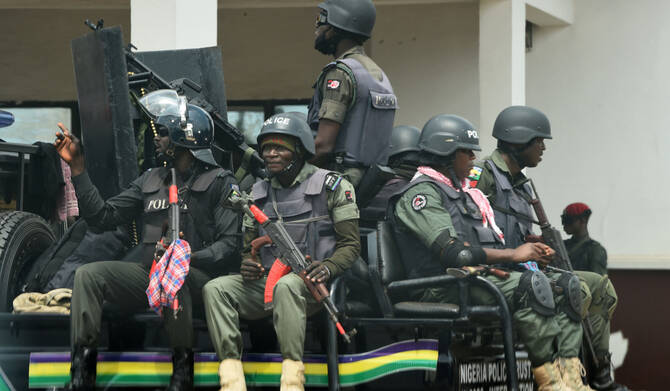

MINNA, Nigeria: Armed men have kidnapped 26 people including a pastor and a bride in two separate raids in Nigeria, the latest in a string of mass abductions to rock the west African country.
A gang of criminals abducted the clergyman along with 11 worshippers on Sunday after storming an out-of-the-way rural church in Ejiba, in central Nigeria’s Kogi State, the state’s information commissioner told AFP.
And in Sokoto State in the northeast a bride and 10 of her bridesmaids were among the 14 abducted in the night of Saturday to Sunday from the village of Chacho, a resident said.
In recent weeks, gangs have kidnapped hundreds of people for ransom across Nigeria, which has struggled to respond to the threat posed both by terrorist groups and criminals known locally as “bandits.”
The unrest has heaped pressure on the Nigerian government, with US President Donald Trump threatening military intervention in Africa’s most populous country over what he calls the killing of Christians by radical Islamists.
In response to the spate of kidnappings, President Bola Tinubu declared a nationwide emergency on Wednesday.
Kingsley Femi Fanwo, Kogi State’s information commissioner, blamed Sunday’s church raid on bandits, and urged isolated places of worship to “reconsider worshipping in crime prone areas for now until the situation gets better.”
“The police helicopter has arrived for land and air battle to free the abducted worshippers,” Fanwo told AFP.
“I just got confirmation that 12 people are missing, though they are still looking for some missing persons,” he added.
In the separate raid in Chacho, a baby, the baby’s mother and another woman were also taken among the 14 people kidnapped, local resident Aliyu Abdullahi told AFP.
- ‘Kidnap for ransom’ -
Abductions became more widespread in Nigeria after the terrorist group Boko Haram kidnapped 276 teenage girls in Chibok, in the northeast, sparking an international outcry.
Besides radical Islamists, bandit gangs have also sown violence across swathes of northwest and central Nigeria, where they carry out kidnappings for ransom, attack villages, kill their inhabitants and burn houses after looting them.
According to Abdullahi, Chacho had already been targeted in October by bandits, who kidnapped 13 people.
“We had to pay ransom to secure the freedom. Now, we are faced with the same situation,” he told AFP over the phone.
A Nigerian intelligence report seen by AFP confirmed the Chacho attack.
The report suggested that deals struck by neighboring states in the hopes of getting the bandits to agree to stop their activities may be partly responsible for an uptick in abductions in November.
Security experts argue that such agreement allow gangs to entrench themselves in their hideouts while continuing their raids elsewhere.
“As a result, some bandits may be moving into areas with less military pressure. This shift can lead to more mass kidnappings in places like Sokoto, leading to an increase in mass kidnap-for-ransom attacks,” the report added.
Following the rise in kidnappings and attacks, Trump threatened Nigeria at the start of November with military action, claiming that Nigerian Christians were being persecuted.
Nigeria has rejected that claim, insisting that the country’s various security crises have left more Muslims dead.
The religiously diverse country of 230 million people is the scene of long-brewing conflicts that have killed both Christians and Muslims, often indiscriminately.


