

Israel says killed four coming out of Gaza tunnels

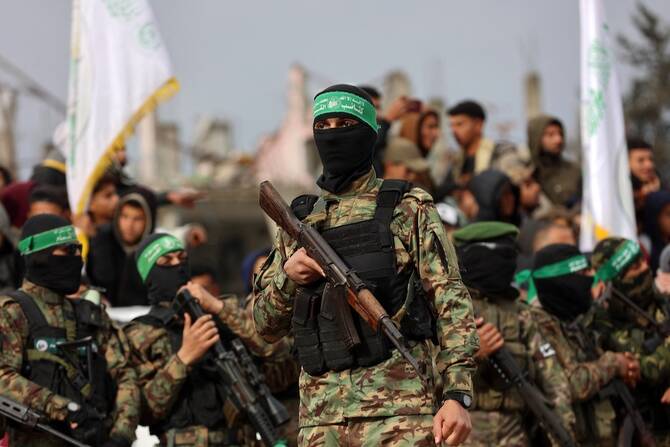
Above, Hamas fighters gather at the site of the handing over of two Israeli hostages in Rafah in the southern Gaza Strip on Feb. 22, 2025. (AFP file photo)
Short Url
Updated 30 November 2025
Follow

Israel says killed four coming out of Gaza tunnels

  • Killed Palestinians were coming out of tunnels in Rafah in the southern Gaza Strip

JERUSALEM: The Israeli army said on Sunday it had killed four Palestinian militants coming out of tunnels in Rafah in the southern Gaza Strip.

Dozens of Hamas fighters are holed up in southern Gaza’s tunnels, underneath areas controlled by the Israeli military.

Israeli troops continue operating in the eastern Rafah area, the military said in a statement.

Overnight “four terrorists who exited underground infrastructure in the area were identified. Guided by the Israeli Air Force, the troops eliminated the terrorists,” it said.

“IDF (Israeli army) troops in the Southern Command remain deployed in accordance with the ceasefire agreement and will continue to operate to remove any immediate threat.”

On Friday, Israel’s military said more than 30 fighters who had attempted to flee the tunnels had been killed.

Multiple sources said on Thursday that negotiations were underway regarding the fate of the fighters still in south Gaza’s tunnel network.

On Wednesday, Hamas called on mediating countries to pressure Israel to allow safe passage — the first time the Islamist group had publicly acknowledged the situation.

The US-brokered ceasefire between Israel and Hamas, with Egypt, Turkiye and Qatar as mediators, entered into force on October 10.

Under its terms, the Israeli army withdrew behind the so-called Yellow Line within the Gaza Strip, a boundary marked on the surface with yellow concrete blocks.

The Hamas militants are in tunnels located on the Israeli-controlled side of the Yellow Line.

A prominent Hamas member in Gaza said that the group estimated their number to be between 60 and 80.

The ceasefire remains fragile, with Israel and Hamas accusing each other of violating the terms, while the Gaza Strip remains in a deep humanitarian crisis.

The Gaza war was sparked by Hamas’s October 7, 2023 attack on Israel, which resulted in the deaths of 1,221 people.

Israel’s retaliatory assault on Gaza has killed at least 70,100 people, according to figures from the territory’s health ministry that the UN considers reliable.

The ministry says that since the ceasefire came into effect, 354 Palestinians have been killed by Israeli fire.


Algeria inaugurates strategic railway to giant Sahara mine

President Tebboune attended an inauguration ceremony in Bechar. (AFP file photo)
Updated 02 February 2026
Follow

Algeria inaugurates strategic railway to giant Sahara mine

  • The mine is expected to produce 4 million tons per year during the initial phase, with production projected to triple to 12 million tons per year by 2030
  • The project is financed by the Algerian state and partly built by a Chinese consortium

ALGEIRS: Algerian President Abdelmadjid Tebboune on Sunday inaugurated a nearly 1,000-kilometer (621-mile) desert railway to transport iron ore from a giant mine, a project he called one of the biggest in the country’s history.
The line will bring iron ore from the Gara Djebilet deposit in the south to the city of Bechar located 950 kilometers north, to be taken to a steel production plant near Oran further north.
The project is financed by the Algerian state and partly built by a Chinese consortium.
During the inauguration, Tebboune described it as “one of the largest strategic projects in the history of independent Algeria.”
This project aims to increase Algeria’s iron ore extraction capacity, as the country aspires to become one of Africa’s leading steel producers.
The iron ore deposit is also seen as a key driver of Algeria’s economic diversification as it seeks to reduce its reliance on hydrocarbons, according to experts.
President Tebboune attended an inauguration ceremony in Bechar, welcoming the first passenger train from Tindouf in southern Algeria and sending toward the north a first charge of iron ore, according to footage broadcast on national television.
The mine is expected to produce 4 million tons per year during the initial phase, with production projected to triple to 12 million tons per year by 2030, according to estimates by the state-owned Feraal Group, which manages the site.
It is then expected to reach 50 million tons per year in the long term, it said.
The start of operations at the mine will allow Algeria to drastically reduce its iron ore imports and save $1.2 billion per year, according to Algerian media.