

‘Blood and business cannot go together,’ Pakistan warns Afghanistan

1 / 2
Spokesperson of the Pakistan Armed Forces, Lt. Gen. Ahmed Sharif Chaudhry, speaks to Arab News Pakistan in Rawalpindi, Pakistan, on May 16, 2025. (AN photo)
2 / 2
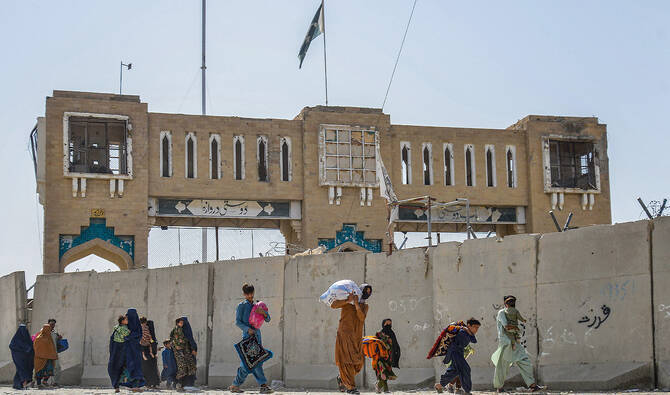
Afghan refugees deported from Pakistan arrive with their belongings at the zero point border crossing between Afghanistan and Pakistan in the Spin Boldak district of Kandahar province on October 19, 2025. (AFP)
Short Url
Updated 29 November 2025
Follow

‘Blood and business cannot go together,’ Pakistan warns Afghanistan

  • Pakistan closed border crossings for trade, movement of people in October after deadly clashes with Afghanistan
  • Pakistan-Afghanistan tensions surged this week again after Kabul accused Islamabad of carrying out strikes in its territory

ISLAMABAD: Pakistan’s military spokesperson has warned Afghanistan that trade and cross-border militancy “cannot go together,” accusing the Taliban-led government in Kabul of facilitating militant attacks in Pakistan. 

Pakistan closed all border crossings with Afghanistan on Oct. 12 following deadly clashes between the two states in which both sides claimed to have killed dozens of troops. Tensions between the neighbors persisted and reached a boiling point this week after Kabul accused Islamabad of conducting airstrikes inside its territory that killed 10 civilians. Pakistan’s military rejected the allegations as Kabul vowed it would retaliate at a time of its choosing. 

Pakistan’s army and civilian government accuse Kabul of facilitating cross-border attacks by extremist groups such as the Pakistani Taliban or the TTP. Kabul denies the allegations and says Pakistan’s security challenges are its internal problem. 

Pakistan’s military spokesperson Lt. Gen. Ahmad Sharif Chaudhry briefed journalists on Islamabad’s tensions with Kabul, border management with Afghanistan, India and the repatriation of illegal residents in Pakistan this Tuesday. 

“If we have restricted trade, it is not because we have a problem with trade itself. Our concern is that we say our security becomes paramount, our lives are more important,” Chaudhry told reporters in the briefing which was released by the military on Saturday. 

“Blood and business cannot go together.”

Chaudhry said since Nov. 4, Pakistan’s security forces have conducted 4,910 intelligence-based operations and killed 206 “terrorists.” He said a total of 1,873 “terrorists” were killed this year, which included 136 Afghan nationals. 

Chaudhry said 67,023 intelligence-based operations were conducted across Pakistan this year, out of which the northwestern Khyber Pakhtunkhwa (KP) province saw 12,857 and southwestern Balochistan witnessed 53,309 operations.

The military spokesperson rejected criticism that Pakistani security forces stationed alongside the border with Afghanistan had failed to contain smuggling and infiltration of militants. 

Chaudhry said the Pakistan-Afghanistan border terrain is located at an “extremely rugged and tough terrain.” He said the border located in KP province stretches over 1,229 kilometers with 20 crossing points, adding that border posts are located at a distance of 20–25 kilometers apart from each other.

“A border fence alone cannot be effective unless it is covered by observation and firepower,” he said. “Building forts every two to five kilometers and monitoring them via drone surveillance would require massive resources.”

He said controlling the movement of people from the border areas of both countries was a “major challenge” as there were villages on both sides of the countries, causing people to travel frequently between them. 

Chaudhry reiterated Islamabad’s oft-stated stance, urging Afghanistan to stop militants based in its country from carrying out attacks against Pakistan. 

“The Taliban regime has nurtured non-state actors, posing threats to multiple countries in the region,” he said.

“Pakistan demands that the Afghan Taliban behave like a proper state.”


Pakistan offers Kyrgyzstan Arabian Sea access as two states sign 15 cooperation accords

Updated 5 sec ago
Follow

Pakistan offers Kyrgyzstan Arabian Sea access as two states sign 15 cooperation accords

  • Pakistan and Kyrgyzstan sign MOUs spanning trade, energy, agriculture, ports, education, security cooperation
  • Kyrgyz president is on first visit to Pakistan in 20 years as both sides push connectivity and CASA-1000 power links

ISLAMABAD: Pakistan on Thursday offered Kyrgyzstan the shortest and most economical route to the Arabian Sea as the two countries signed 15 agreements and memoranda of understanding aimed at boosting cooperation across trade, energy, agriculture, education, customs data-sharing and port logistics.

The accords were signed during a visit to Islamabad by President Sadyr Zhaparov, the first by a Kyrgyz head of state to Pakistan in two decades, and part of Islamabad’s renewed push to link South Asia with landlocked Central Asian economies through ports, power corridors and transport routes.

For Pakistan, Kyrgyzstan offers access to hydropower through CASA-1000, a $1.2 billion regional electricity transmission project designed to carry surplus summer electricity from Kyrgyzstan and Tajikistan through Afghanistan into Pakistan. For Bishkek, Pakistan provides overland access to warm-water ports on the Arabian Sea, creating a shorter commercial route to global markets.

“President Asif Ali Zardari has reiterated Pakistan’s readiness to offer Kyrgyzstan the shortest and most economical route to the Arabian Sea,” Radio Pakistan reported after Zhaparov met the Pakistani president. 

The two leaders also discussed expanding direct flights to deepen business, tourism and people-to-people ties.

Zardari welcomed Kyrgyzstan’s completion of its segment of the CASA-1000 project and “reaffirmed Pakistan’s commitment to completing its part of the project, which is now at an advanced stage,” the state broadcaster said. 

Zhaparov thanked Islamabad for supporting Bishkek’s candidacy for a non-permanent UN Security Council seat and invited Zardari to visit Kyrgyzstan at a time of his convenience. Both sides expressed satisfaction with progress under the Quadrilateral Traffic in Transit Agreement, designed to facilitate road movement between Pakistan, Kyrgyzstan, Kazakhstan and China.

Earlier, both governments exchanged 15 sectoral cooperation documents covering commerce, mining, geosciences, power, agriculture, youth programs, the exchange of convicted persons, customs electronic data systems and a sister-city linkage between Islamabad and Bishkek.

According to APP, the MOUs were signed by ministers representing foreign affairs, commerce, economy, energy, power, railways, interior, culture, health and tourism. Agreements also covered cooperation between Pakistan’s Foreign Service Academy and the Diplomatic Academy of Kyrgyzstan, as well as collaboration between universities, youth ministries and cultural institutions.

“Our present mutual trade, comprising of about $15–16 million will be enhanced to $200 million in the next two years,” Prime Minister Shehbaz Sharif said after the agreements were signed, calling them “a framework for structured, result-oriented engagement and closer institutional linkages.”

Sharif said Pakistan was ready to serve as a maritime outlet for the landlocked Central Asian republic, offering access to Karachi, Port Qasim and Gwadar to help Kyrgyz goods reach regional and global markets.