

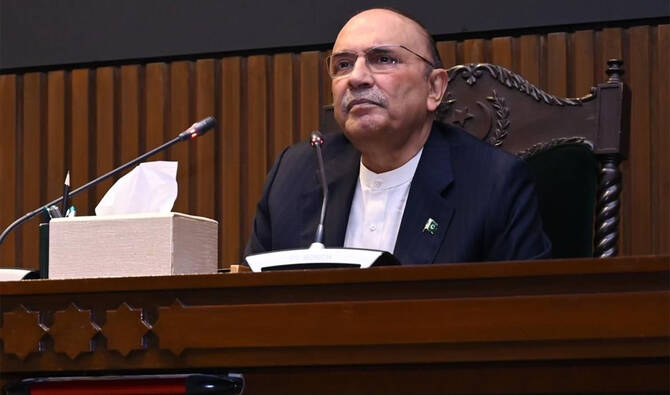

KARACHI: President Asif Ali Zardari on Saturday stressed the importance of national cohesion and an integrated policy to confront Pakistan’s security challenges, the military’s media wing said as Islamabad struggles to contain surging militancy in the country.
Pakistan has struggled to forge unity within its ranks when it comes to battling militancy, particularly regarding the northwestern Khyber Pakhtunkhwa (KP) province. The ruling party’s rival and former prime minister Imran Khan’s Pakistan Tehreek-e-Insaf (PTI) party is in power in the province and has criticized the government’s approach to battling militants there.
KP Chief Minister Sohail Afridi has blamed the center for the resurgence of “terrorism” in the province, accusing Islamabad of not providing the provincial government adequate resources to battle militancy and of not taking it into confidence regarding military operations. The federal government denies this and accuses the provincial government of being negligent toward rising miltiancy in KP.
“He [Zardari] underscored the importance of informed leadership, national cohesion and integrated policy formulation in confronting Pakistan’s contemporary security challenges,” the Inter-Services Public Relations, (ISPR) the military’s media wing, said in a statement.
Zardari was speaking to participants of the 27th National Security Workshop (NSW). The NSW is held annually at the National Defense University annually and brings together parliamentarians, senior civil and military officers and representatives from the country’s academia and civil society.
As per the ISPR, the NSW-27 focused on deepening participants’ understanding of the interplay among various elements of national power under the framework of national security.
“NDU’s National Security Workshop remains one of the country’s premier platforms for fostering national-level dialogue, enhancing institutional capacity, and promoting a whole-of-nation approach to national security,” the ISPR said.
Pakistan has been grappling with surging militancy in its western provinces bordering Afghanistan, KP and the southwestern Balochistan, in recent years.
This month saw suicide blasts in Pakistan’s capital Islamabad that killed 12 and another targeting the headquarters of a paramilitary force in northwestern Peshawar city. Three Frontier Constabulary personnel were killed in the Peshawar blast.
Islamabad has accused Kabul of not taking “decisive” action against militants it alleges operate from Afghan soil, charges the Afghan government denies.
Pakistan has also accused its traditional rival India of supporting separatist and extremist groups in launching attacks in the country’s Balochistan and KP provinces. India denies the allegations.


