ZIBQIN VALLEY, Lebanon: The Lebanese army has intensified its efforts in areas along the border with Israel, in the volatile area that witnessed the 14-month war between Israel and the Hezbollah militant group.
Parts of the zone south of the Litani River and north of the border with Israel were formerly a Hezbollah stronghold, off limits to the Lebanese national army and UN peacekeepers deployed in the area.
But since a ceasefire ended the Israel-Hezbollah war a year ago, Lebanon’s army has boosted its presence along the border to nearly 10,000 troops, closed 11 crossing points used for smuggling along the Litani River, and is dealing with huge amounts of unexploded ordnance, according to several senior army officers.
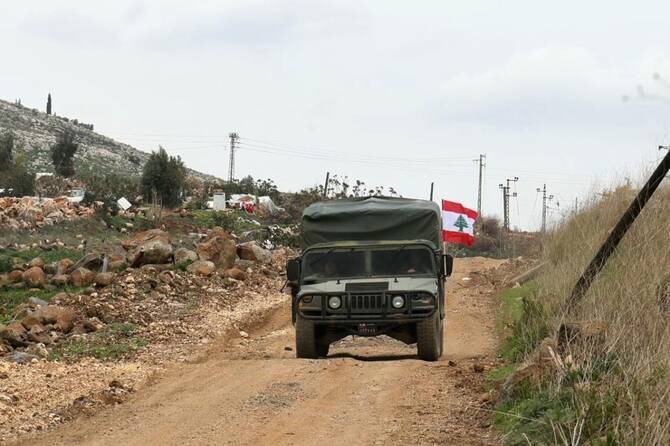
The army took dozens of journalists from local and international media outlets Friday on a tour of the rugged area along the border. Its troops could be seen in places where Hezbollah once had a heavy military presence.
Israel has carried out almost daily airstrikes since the November 2024 ceasefire, mainly targeting Hezbollah members but 127 civilians have also been killed, according to the office of the UN High Commissioner for Human Rights.
Hezbollah has only claimed responsibility for an attack on an Israeli military post since last November. The group maintains it no longer has an armed presence south of the Litani River, close to the border.
Hezbollah rejected disarmament plan
Hezbollah refuses to discuss full disarmament across Lebanon until Israel stops its attacks and withdraws from five hilltop points that it captured during the war and still holds.
The latest Israel-Hezbollah war began Oct. 8, 2023, a day after Hamas attacked southern Israel, after Hezbollah fired rockets into Israel in solidarity with Hamas. Israel launched a widespread bombardment of Lebanon for two months last year that severely weakened Hezbollah, followed by a ground invasion.
In August, the Lebanese government voted in favor of a US-backed plan to disarm Hezbollah. Hezbollah rejected the plan.
In recent weeks, Israel has said that Hezbollah is working on rebuilding its capabilities in south Lebanon.
“The Lebanese army is making tremendous efforts during this critical period in the history of the region,” said Brig. Gen. Nicolas Thabet, Lebanese army commander in the sector south of the Litani River.
The journalists were taken Friday to Zibqin Valley, where Hezbollah once had rocket launchers, tunnels and posts hidden in the bushy region. There was no presence of the militant group and its former posts were either struck or now controlled by Lebanese troops.
A nearly 100-meter (328 feet) tunnel inside a mountain, used by Hezbollah in the past, contained what appeared to be a small medical clinic, a ventilation system, power cables, water tankers and large amounts of canned food.
Zibqin Valley is where munitions in an arms depot exploded in August, killing six army experts who were dismantling them.
“We will not abandon our goals no matter what the difficulties are,” said Thabet, adding that “the army is making major sacrifices” in one of “the most dangerous parts of the Middle East.”
Weapons and tunnels discovered
Army officers told journalists that there have been 5,198 violations by Israel since the ceasefire, including 657 airstrikes. They added that 13,981 housing units were destroyed by the war, in addition to the damage done to infrastructure in border villages.
They said that some of the weapons and ordnance they found were dismantled or ,detonated while others have been put in storage. Weapons that can be used are taken by the army, they said.
The officers added that the army now has 200 posts south of Litani River, in addition to 29 fixed checkpoints, and it operates patrols around the clock.
On Sept. 5, the army strengthened its efforts in the region after the government’s decision to disarm Hezbollah. Since then, troops have discovered 74 tunnels, 175 rocket launchers and 58 missiles.
Thabet said the army does not enter homes to search them without a judicial order and only do so if they witness illegal activities as they’re taking place.


Lebanese army boosts its presence along border with Israel, dismantling Hezbollah posts
https://arab.news/gnxx2
Lebanese army boosts its presence along border with Israel, dismantling Hezbollah posts

- Its troops could be seen in places where Hezbollah once had a heavy military presence
- “The Lebanese army is making tremendous efforts during this critical period in the history of the region,” said Brig. Gen. Nicolas Thabet


UN nuclear watchdog says it’s unable to verify whether Iran has suspended all uranium enrichment
VIENNA: Iran has not allowed the United Nations nuclear watchdog to access nuclear facilities affected by the 12-day war in June, according to a confidential report by the watchdog circulated to member states and seen Friday by The Associated Press.
The report from the International Atomic Energy Agency stressed that therefore it “cannot verify whether Iran has suspended all enrichment-related activities,” or the “size of Iran’s uranium stockpile at the affected nuclear facilities.”
The IAEA report on Friday warned that due to the continued lack of access to any of Iran’s four declared enrichment facilities, the agency “cannot provide any information on the current size, composition or whereabouts of the stockpile of enriched uranium in Iran.”
The report stressed that the “loss of continuity of knowledge over all previously declared nuclear material at affected facilities in Iran needs to be addressed with the utmost urgency.”
Iran long has insisted its program is peaceful, but the IAEA and Western nations say Tehran had an organized nuclear weapons program up until 2003.
Highly enriched material should be verified regularly
According to the IAEA, Iran maintains a stockpile of 440.9 kilograms (972 pounds) of uranium enriched up to 60 percent purity — a short, technical step away from weapons-grade levels of 90 percent.
That stockpile could allow Iran to build as many as 10 nuclear bombs, should it decide to weaponize its program, IAEA director general Rafael Grossi warned in a recent interview with the AP. He added that it doesn’t mean that Iran has such a weapon.
Such highly enriched nuclear material should normally be verified every month, according to the IAEA’s guidelines.
The IAEA also reported that it had observed, through the analysis of commercially available satellite imagery, “regular vehicular activity around the entrance to the tunnel complex at Isfahan.”
The facility in Isfahan, some 350 kilometers (215 miles) southeast of Tehran, was mainly known for producing the uranium gas that is fed into centrifuges to be spun and purified.
Israel has struck buildings at the Isfahan nuclear site, among them a uranium conversion facility. The US also struck Isfahan with missiles during the war last June.
The IAEA also reported that through the analysis of commercially available satellite imagery, it has observed “activities being conducted at some of the affected nuclear facilities, including the enrichment facilities at Natanz and Fordow,” but it added that “without access to these facilities it is not possible for the Agency to confirm the nature and the purpose of the activities.”
The confidential IAEA report also said Friday that Iran did provide access to IAEA inspectors “to each of the unaffected nuclear facilities at least once since the military attacks of June 2025, with the exception of Karun Nuclear Power Plan, which is in the early stages of construction and does not contain nuclear material.”
IAEA joined Geneva talks between Iran and US
The IAEA reported on Friday that Grossi attended negotiations between the US and Iran on Feb. 17 and Feb. 26 in Geneva at which he “provided advice on issues relevant to the verification of Iran’s nuclear program.” The report said that those negotiations are “ongoing.”
The Trump administration has held three rounds of nuclear talks this year with Iran under Omani mediation. Thursday’s round of talks in Geneva ended without a deal, leaving the danger of another Mideast war on the table as the US has gathered a massive fleet of aircraft and warships in the region.
Oman’s Foreign Minister Badr Al-Busaidi said technical talks involving lower-level representatives would continue next week in Vienna, the home of the IAEA. The agency is likely to be critical in any deal.
The US is seeking a deal to limit Iran’s nuclear program and ensure it does not develop nuclear weapons.
Iran says it is not pursuing weapons and has so far resisted demands that it halt uranium enrichment on its soil or hand over its stockpile of highly enriched uranium.
Similar talks last year between the US and Iran about Iran’s nuclear program broke down after Israel launched what became a 12-day war on Iran, that included the US bombing Iranian nuclear sites.
Before the June war, Iran had been enriching uranium up to 60 percent purity.