Israeli raid on village in southern Syria kills 13

1 / 2
A wounded man receives medical treatment at Al-Mowasat Hospital in Damascus, following an operation by Israeli forces in the Syrian village of Beit Jin on Friday. (AFP)
2 / 2
A man sits on rubble at a damaged site following an Israeli raid on Friday in Beit Jin, Syria. (Reuters)
Short Url
Updated 28 November 2025
Follow

Israeli raid on village in southern Syria kills 13

  • Syrian foreign ministry condemns operation as a 'war crime' and accuses Israel of wanting to 'ignite the region'
  • Israeli military claims it arrested suspected members of the Jamaa Islamiya group

DUBAI: At least 13 people were killed and 24 injured by Israeli forces during a raid on the southern Syrian village of Beit Jin overnight, according to the Syrian News Agency, SANA. 

The Syrian foreign ministry condemned the operation as a "war crime" and accused Israel of wanting to "ignite the region". 

"We were asleep when we were woken up at three in the morning by gunfire," wounded resident Iyad Taher told AFP at al-Mouwassat hospital in the Syrian capital.
"We went outside to see what was happening and saw the Israeli army in the village, soldiers and tanks. Then they withdrew, the air force came, and the shells started falling. I was hit by shrapnel in the neck."

A local official told AFP that Israeli forces raided the village to capture three men, sparking clashes.
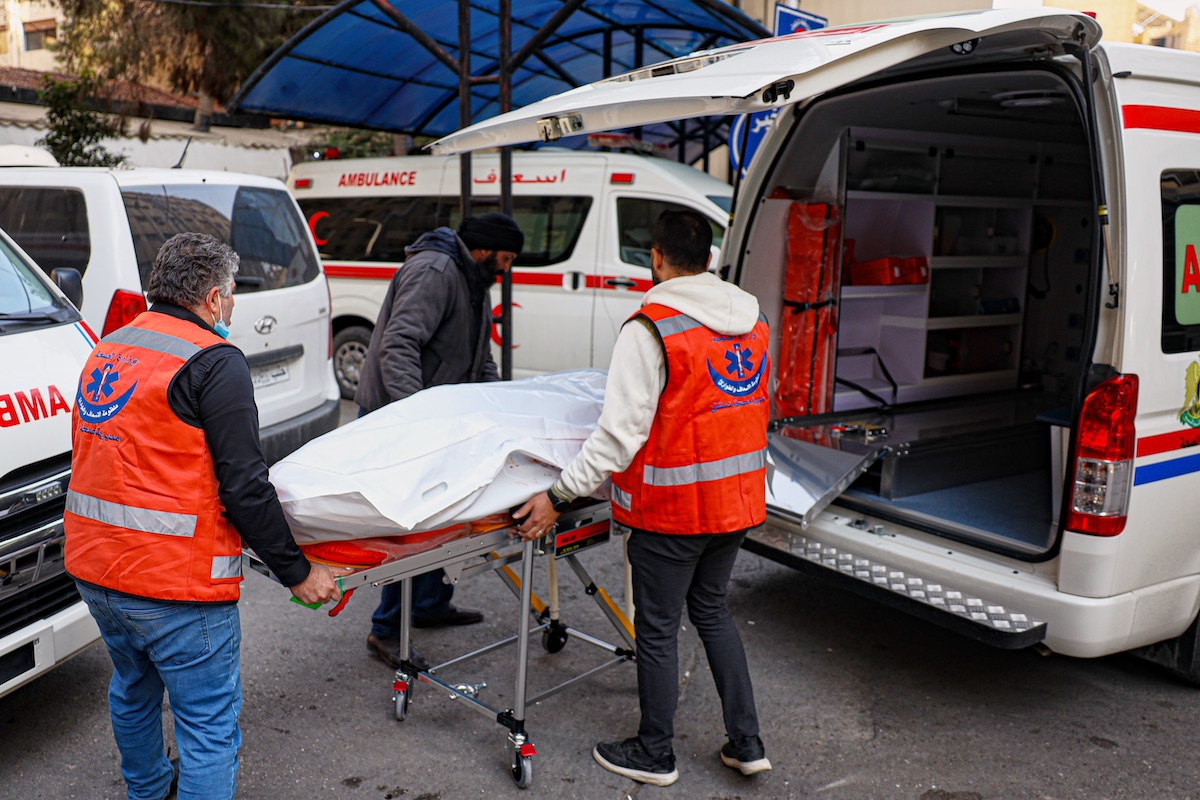


The body of one of the victims of an Israeli forces raid in the southern Syrian village of Beit Jin is brought to Al-Mowasat Hospital in Damascus on Friday. (AP)

“Following the clashes, the Israeli occupation forces shelled the area with artillery and drones,” village official Abdul Rahman Al-Hamrawi said.
At the hospital, Ahmad Kamal told AFP he and others “opened fire on the Israeli patrol to defend ourselves and stop them from taking us. My brother was killed, and I was wounded.”
Israeli troops claimed that they had arrested suspected members of the Jamaa Islamiya group, which is based in neighbouring Lebanon and allied with Palestinian armed group Hamas, during the overnight operation.  
According to the IDF, troops came under fire and returned fire with air support, leaving six soldiers wounded.
The army claimed all targeted suspects were detained and several militants were killed and added that troops remain deployed in the area. 
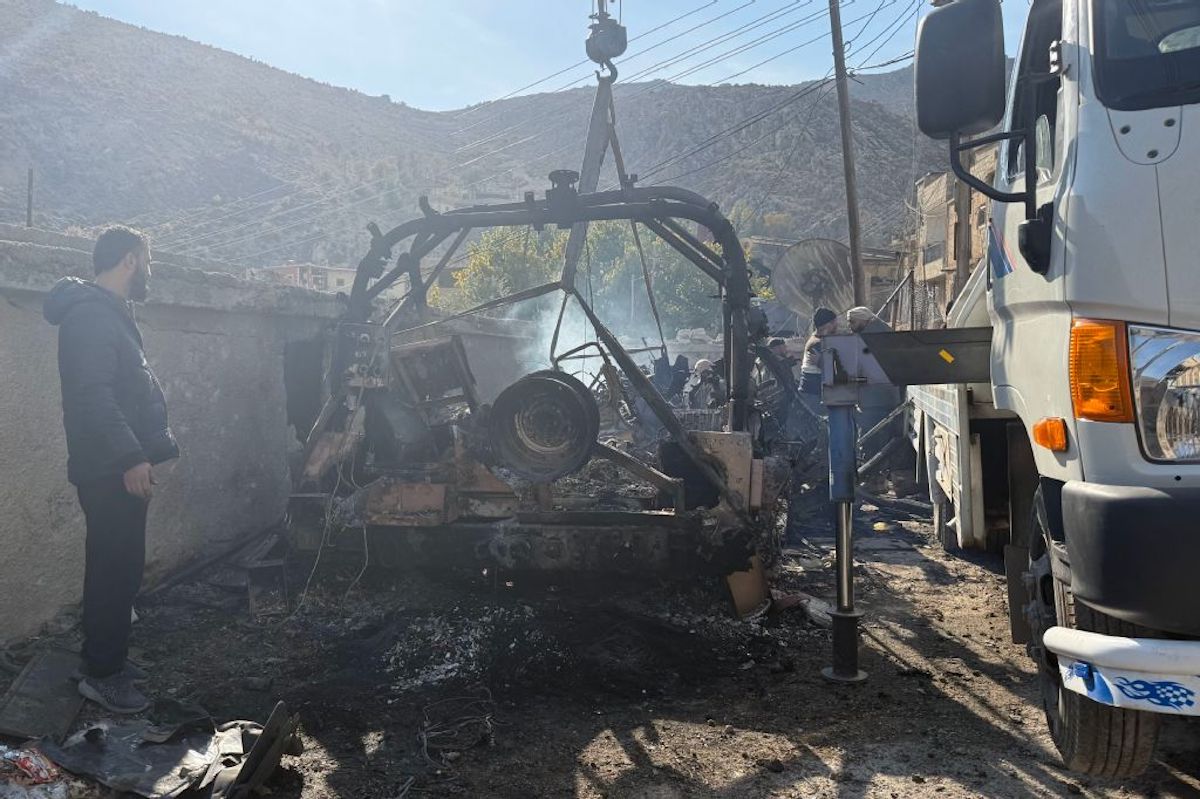


A crane removes a burnt Israeli Humvee from a street in the southern Syrian village of Beit Jin on Friday. (AFP)

Israel has carried out frequent strikes across Syria in 2025, hitting targets on the outskirts of Damascus and in the country’s south in what it says are efforts to disrupt threats against Israel and to protect the Druze community near the frontier.
Israel has said it is acting against armed groups it views as hostile, while Syrian authorities say the strikes have killed soldiers.

After the fall of Syrian leader Bashar Assad in December 2024 and the arrival of the new Islamist leadership in Damascus, Israel has carried out hundreds of strikes in Syria.
Israel sent troops into the UN-patrolled buffer zone, which has separated Israeli and Syrian forces on the Golan Heights since 1974.
Israel has occupied Syria's Golan Heights since 1967, annexing it in 1981 in a move not recognised by the international community.
In a resolution passed on November 6, the UN Security Council reaffirmed its strong backing for Syria's "sovereignty, independence, territorial integrity and national unity".
During the summer, high-level contacts between Israeli and Syrian officials took place, with the help of Paris and Washington.

United Nations Deputy Special Envoy for Syria Najat Rochdi condemned Israel’s attack, calling it “a grave and unacceptable violation of Syria’s sovereignty and territorial integrity.”

With Agencies

US presses missile issue as new Iran talks to open in Geneva

Updated 37 min 13 sec ago
Follow

US presses missile issue as new Iran talks to open in Geneva

  • New round of negotiations in Geneva comes after the US carried out a massive military build-up in the region
  • Iran’s president reiterates Tehran is not seeking nuclear weapons in line with policy

GENEVA: The United States and Iran are set to hold indirect talks in Switzerland on Thursday aiming to strike a deal to avert fresh conflict and bring an end to weeks of threats.
The new round of negotiations in Geneva comes after the US carried out a massive military build-up in the region and President Donald Trump repeatedly threatened to strike Iran if a deal is not reached.
In his State of the Union address on Tuesday, Trump accused Iran of “pursuing sinister nuclear ambitions.”
He also claimed Tehran had “already developed missiles that can threaten Europe and our bases overseas, and they’re working to build missiles that will soon reach the United States of America.”
The Iranian foreign ministry called these claims “big lies.”

Iran president says ahead of US talks not seeking nuclear weapon ‘at all’

TEHRAN: Iran’s President Masoud Pezeshkian reiterated on Thursday that Tehran was not seeking nuclear weapons in line with the policy set by the country’s supreme leader.

“Our Supreme Leader has already stated that we will not have nuclear weapons at all,” Pezeshkian said in a speech.

“Even if I wanted to move in that direction, I could not — from a doctrinal standpoint, I would not be permitted.” — AFP


The maximum range of Iran’s missiles is 2,000 kilometers according to what Tehran has publicly disclosed. However the US Congressional Research Service estimates they top out at about 3,000 kilometers — less than a third of the distance to the continental United States.
The dispute between the countries mostly revolves around Iran’s nuclear program, which the West believes is aimed at building an atomic bomb but Tehran insists is peaceful.
However the US has also been pushing to discuss Iran’s ballistic missile program, as well as Tehran’s support for armed groups hostile toward Israel.
Secretary of State Marco Rubio warned that Iran must also negotiate on its missile program, calling Tehran’s refusal to discuss ballistic weapons “a big, big problem” on the eve of the talks.
He followed up by saying “the president wants diplomatic solutions.”
Iran has taken anything beyond the nuclear issue off the negotiating table and has demanded that the US sanctions crippling its economy be part of any agreement.
‘Neither war nor peace’
Iranian President Masoud Pezeshkian said on Wednesday he had a “favorable outlook for the negotiations” that could finally “move beyond this ‘neither war nor peace’ situation.”
Foreign Minister Abbas Araghchi, who is leading the Iranian delegation at the talks, has called them “a historic opportunity,” adding that a deal was “within reach.”
In a foreign ministry statement that followed a meeting with his Oman counterpart, Araghchi said the success of the US negotiations depend “on the seriousness of the other side and its avoidance of contradictory behavior and positions.”


The US will be represented by envoy Steve Witkoff and Jared Kushner, who is married to Trump’s daughter Ivanka.
The two countries held talks earlier this month in Oman, which is mediating the negotiations, then gathered for a second round in Geneva last week.
A previous attempt at negotiations collapsed when Israel launched surprise strikes on Iran last June, beginning a 12-day war that Washington briefly joined to bomb Iranian nuclear sites.
In January, fresh tensions between the US and Iran emerged after Tehran engaged in a bloody crackdown on widespread protests that have posed one of the greatest challenges to the Islamic republic since its inception.
Trump has threatened several times to intervene to “help” the Iranian people.
Emile Hokayem, senior fellow for Middle East security at the International Institute for Strategic Studies, said that “the region seems to expect a war at this point.”
In January, there was “a big push by a number of Middle Eastern states to convince the US not to” strike Iran.
“But there’s a lot of apprehension at this point, because the expectation is that this time” a war would be “bigger” than the one in June.
Tehran residents who spoke to AFP were divided as to whether there would be renewed conflict.
Homemaker Tayebeh noted that Trump had “said that war would be very bad for Iran.”
“There would be famine and people would suffer a lot. People are suffering now, but at least with war, our fate might be clear,” the 60-year-old said.