- 10th Pakistan–Russia Intergovernmental Commission reviews cooperation in energy, trade, education, disaster response
- Sides sign protocol, three MoUs covering media, standards regulation, competition law, information ministry says
ISLAMABAD: Pakistan and Russia on Thursday concluded the 10th session of their Intergovernmental Commission (IGC) in Islamabad, signing a set of new cooperation agreements and reaffirming plans to deepen collaboration in energy, trade, education, science and disaster-management, according to a statement from Pakistan’s Press Information Department (PID).
The annual Pakistan–Russia Intergovernmental Commission is the main institutional mechanism that manages bilateral economic and technical cooperation between the two countries. The forum has taken on new importance as Pakistan seeks to diversify its foreign partnerships amid domestic economic challenges and shifting geopolitical alignments. Russia, facing sweeping Western sanctions after its 2022 invasion of Ukraine, has since expanded outreach to non-Western partners, including in South Asia, Central Asia and the Middle East, to rebuild trade routes, secure energy markets and strengthen diplomatic ties.
Despite modest bilateral trade at still under $1 billion, Pakistan and Russia have in recent years explored cooperation in energy supplies, steel manufacturing, transport logistics, higher education and humanitarian response.
In 2023, Islamabad began test shipments of discounted Russian crude under a new payment arrangement to manage foreign exchange constraints, and officials have since discussed long-term frameworks for importing crude, LNG and refined products. While volumes remain limited and logistical challenges persist, Russian energy imports have become a notable feature of Pakistan’s wider push to secure cheaper fuel.
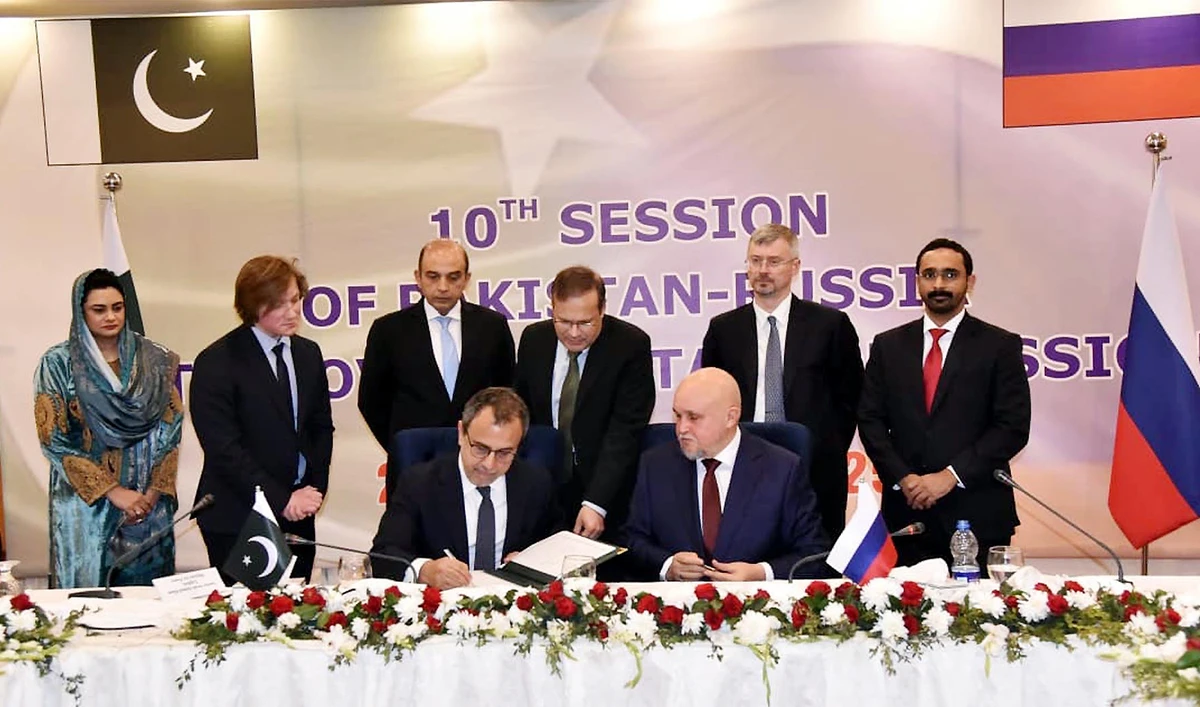
“The two sides reaffirmed their commitment to a broad, forward-looking partnership that supports the socio-economic development of Pakistan and the Russian Federation and contributes to regional stability and connectivity,” the PID said in a statement after the conclusion of the 10th IGC session held from Nov. 25–27 in Islamabad and co-chaired by Pakistan’s energy minister Sardar Awais Ahmad Khan Leghari and Russian Energy Minister Sergei Tsivilev.
Both countries expressed satisfaction over discussions to enhance bilateral trade, diversify exports and strengthen business-to-business engagement. They also agreed to advance pilot cargo movement along agreed corridors and “confirmed their intention to operationalize a pilot train,” seen as a step toward improving regional logistics.
The statement noted “positive engagement in the oil and gas sectors, opportunities in LNG and LPG supply frameworks, and the importance of technical collaboration,” alongside potential cooperation in hydropower, renewable energy and flood-resilience technologies.
The two sides also highlighted collaboration in pharmaceuticals, including insulin localization, metallurgy, heavy machinery and mining. Educational cooperation is set to expand, with plans to finalize agreements on mutual recognition of degrees, joint research and academic mobility, and to establish Russian language centers in Islamabad and Karachi.
Pakistan’s National Disaster Management Authority and Russia’s Ministry of Emergency Situations agreed to explore cooperation in early-warning systems, emergency response and resilience building.
At the end of the session, the two sides signed the official protocol of the 10th IGC, along with three new memoranda: An MoU between the Associated Press of Pakistan and Russia’s SPUTNIK News Agency; An MoU between Pakistan Standards and Quality Control Authority and Russia’s Federal Agency for Technical Regulation and Metrology; and an MoU between the Competition Commission of Pakistan and Russia’s Federal Antimonopoly Service.
The statement said these instruments “will contribute meaningfully to enhancing institutional cooperation and facilitating bilateral economic activity.”
The 11th session of the Pakistan–Russia Intergovernmental Commission will be held in Russia in 2026 on mutually agreed dates.