

UNHCR urges Islamabad to allow Afghans with special protection needs to stay in Pakistan

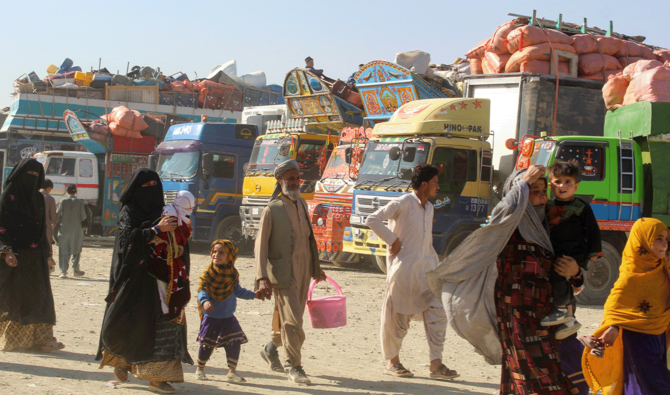
Afghan refugees arrive near the Pakistan-Afghanistan border in Chaman on October 30, 2025, ahead of their departure for Afghanistan. (AFP/File)
Short Url
Updated 27 November 2025
Follow

UNHCR urges Islamabad to allow Afghans with special protection needs to stay in Pakistan

  • Afghan deportations follow a nationwide crackdown launched by Islamabad in 2023 targeting foreigners living illegally in Pakistan
  • UNHCR says many of these Afghans require legal assistance, documentation and community-based protection services for their safety

ISLAMABAD: The UN refugee agency on Thursday urged Pakistan to allow Afghans with special protection needs to remain in the country, warning that their forced return to Afghanistan could expose them to harm.

The deportations follow a nationwide crackdown launched by Islamabad in 2023 targeting foreigners living illegally in Pakistan. Most of these foreigners were Afghans who had fled to Pakistan over the past four decades to escape war, political unrest and economic hardship.

Pakistan, which has been facing a surge in militancy in recent years, said at the time that many Afghan nationals had been involved in attacks and other offenses. Human rights groups criticized the policy as collective punishment, warning it would uproot families with no safety net across the border.

Significant protection needs for Afghans persist inside Pakistan, especially for individuals at heightened risk due to their profiles, past affiliations, or vulnerabilities, according to the United Nations High Commissioner for Refugees (UNHCR).

“Many require legal assistance, documentation, and community-based protection services to ensure their safety and dignity,” the UN agency said. 

“UNHCR urges the Government of Pakistan to ensure that Afghans with specific protection needs are exempted from the provisions of the Illegal Foreigner Repatriation Plan (IFRP) and allowed to remain safely in the country. Doing so would uphold Pakistan’s long-standing tradition of hospitality and protection, which has safeguarded millions over decades.”

Nearly one million Afghans have returned from Pakistan to Afghanistan so far this year, according to the UN agency. As winter sets in and temperatures fall across the region, thousands more Afghans, including refugees and asylum-seekers, continue to return to Afghanistan under mounting pressure, despite the country’s grave humanitarian situation. 

“In the right circumstances, this would be something to celebrate,” Philippa Candler, a UNHCR representative in Pakistan, said in a statement. “But under the current conditions, it raises more concerns than solutions.”

In Afghanistan, nine in ten people live in poverty, and the combined impact of economic crisis, unemployment and weakened public services is leaving families exposed. Over 2.2 million people have returned from Pakistan and Iran in 2025 with little to rebuild their lives, while recent earthquakes have deepened their hardship. 

With the governments’ support declining, the UNHCR said it is calling on individual and private donors to help deliver life-saving assistance in Afghanistan and other hard-hit regions to help vulnerable families stay warm, safe and supported through the harsh months. 

“However, with winter intensifying and humanitarian resources severely strained, the gap between needs and available support is widening rapidly,” it said.

“Without sustained and expanded assistance, the sustainability of returns from both Iran and Pakistan remains in question. If returnees cannot reintegrate effectively, onward movement becomes inevitable.”


Pakistan president meets UAE counterpart, explores trade, investment opportunities

Updated 27 January 2026
Follow

Pakistan president meets UAE counterpart, explores trade, investment opportunities

  • Asif Ali Zardari is in UAE on four-day visit to strengthen bilateral ties, review bilateral cooperation
  • Both sides discuss regional, international developments, reaffirm commitment to promote peace

ISLAMABAD: President Asif Ali Zardari met his UAE counterpart Sheikh Mohammed bin Zayed Al-Nahyan in Abu Dhabi on Tuesday during which both sides explored new opportunities in trade, investment, energy and other sectors, Zardari's office said. 

Zardari arrived in Abu Dhabi on Monday evening with a high-level delegation on a four-day official visit to the UAE to review trade, economic and security cooperation. 

"The leaders discussed ways to further deepen the longstanding and brotherly relations between Pakistan and the UAE," a statement from Zardari's office said about his meeting with the UAE president. 

"They reviewed the full spectrum of bilateral cooperation and explored new opportunities in trade, investment, energy, infrastructure, technology, and people-to-people exchanges, highlighting the significant potential for expanding economic and strategic partnership.

Zardari highlighted the significance of Al-Nayhan's visit to Pakistan last month, the statement said, expressing appreciation for the UAE's continued support for strengthening bilateral ties.

It said both sides also exchanged views on a range of regional and international developments, reaffirming their commitment to promoting peace, stability and sustainable development.

The meeting was also attended by Pakistan's First Lady Aseefa Bhutto-Zardari, the Pakistani president's son Bilawal Bhutto-Zardari, who is also the chairman of the Pakistan Peoples Party, Interior Minister Mohsin Naqvi and Pakistan's ambassador to the UAE. 

ZARDARI MEETS AD PORTS CEO

Zardari earlier met AD Ports Group CEO Captain Mohamed Juma Al-Shamisi to discuss the group's investment initiatives in Karachi. 

"Both sides agreed that the expansion and modernization of port infrastructure would strengthen trade flows and support Pakistan’s broader economic development and country’s seaborne trade," the President's Secretariat said in a statement.

It added that Zardari described the AD Ports Group's long-term investment and expanding role in Pakistan's maritime and logistics sector as a key pillar of Pakistan–UAE economic cooperation.

Pakistan and the UAE maintain close political and economic relations, with Abu Dhabi playing a pivotal role in supporting Islamabad during periods of financial stress through deposits, oil facilities and investment commitments. 

The UAE is Pakistan's third-largest trading partner, after China and the United States, and a key destination for Pakistani exports, particularly food, textiles and construction services.

The Gulf state is also home to more than 1.5 million Pakistani expatriates, one of the largest overseas Pakistani communities in the world, who contribute billions of dollars annually in remittances, a crucial source of foreign exchange for Pakistan’s economy.

Beyond trade and labor ties, Pakistan and the UAE have steadily expanded defense and security cooperation over the years, including military training, joint exercises and collaboration in counter-terrorism and regional security matters.