Pakistan vaccinates over 13 million children against polio as immunization drive enters final days

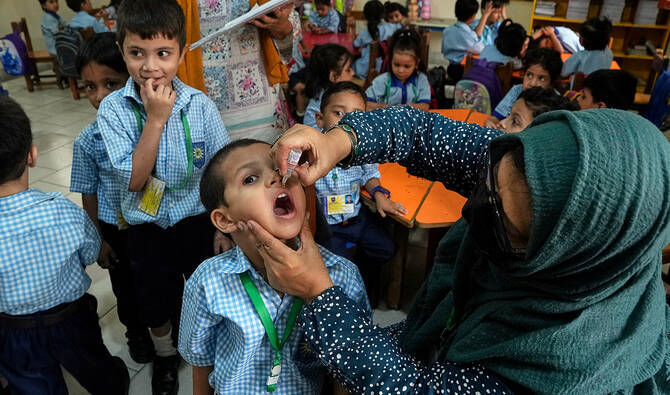
A health worker administers a polio vaccine to a child in a school in Karachi, Pakistan, on September 1, 2025. (AP/File)
Short Url
Updated 27 November 2025
Follow

Pakistan vaccinates over 13 million children against polio as immunization drive enters final days

  • Over 35 million children targeted for measles–rubella vaccination as 90 high-risk districts receive polio drops
  • Authorities urge parents to ensure children vaccinated as Pakistan remains one of two countries with polio

KARACHI: Pakistan has entered the final days of a nationwide immunization campaign aiming to protect more than 35 million children against measles, rubella and polio, with health officials reporting that over 13.6 million children have already received polio drops in the first nine days of the drive.

The campaign, running from Nov. 17–29, is one of Pakistan’s largest child-health efforts this year, combining measles–rubella vaccination with intensified polio coverage in high-risk areas.

Pakistan is one of only two countries in the world, other than Afghanistan, where wild poliovirus remains endemic, making repeated vaccination essential to prevent outbreaks. Measles and rubella have also surged in recent years due to low routine immunization rates, population mobility and misinformation, prompting authorities to merge the campaigns and widen coverage across schools, madrassas, health facilities and temporary vaccination centers nationwide.

“In the first nine days, more than 13.6 million children have been given polio drops,” the National Emergency Operations Center (EOC) said, adding that 35.4 million children were being administered the measles–rubella vaccine, while 19.4 million children in 90 high-risk districts were receiving polio drops.

Of the 13.6 million children who have received polio drops so far, over 4.1 million were in Punjab, 4.6 million in Sindh, 3.1 million in Khyber Pakhtunkhwa, 1.2 million in Balochistan, 250,000 in Islamabad and 99,000 in Gilgit-Baltistan, according to official figures.

Pakistan has so far reported 30 polio cases this year. It recorded 74 cases in 2024, a sharp rise from six in 2023 and just one in 2021.

A spokesperson for the EOC said vaccines were being provided at government health centers, schools, madrassas and temporary vaccination sites.

Urging parents to ensure participation in the final days of the drive, the EOC appealed: 

“Parents are requested to make sure their children receive polio drops in this and every future polio campaign,” calling protection against the virus a “national responsibility.”

Health officials say sustained nationwide coverage is crucial as Pakistan continues efforts to interrupt wild poliovirus transmission and curb recurring measles outbreaks. The government has deployed thousands of vaccinators, surveillance teams and mobile health units to reach remote and underserved communities.

Polio is a highly infectious and incurable disease that can cause lifelong paralysis. The only effective protection is through repeated doses of the Oral Polio Vaccine for every child under five during each campaign, alongside timely completion of all routine immunizations.

The South Asian natioon’s efforts to eliminate poliovirus have been hampered by parental refusals, widespread misinformation and repeated attacks on anti-polio workers by militant groups. In remote and volatile areas, vaccination teams often operate under police protection, though security personnel themselves have also been targeted and killed in attacks.


Pakistan secures $3 million to protect marine biodiversity, reform fisheries

Updated 6 sec ago
Follow

Pakistan secures $3 million to protect marine biodiversity, reform fisheries

  • Global Environment Facility funding will help improve monitoring of coastal and marine ecosystems
  • Fisheries contribute about 1 percent to Pakistan’s GDP but are a critical livelihood source in coastal areas

KARACHI: Pakistan has secured $3 million in funding from the Global Environment Facility (GEF) to conserve marine biodiversity and shift toward sustainable and regenerative fisheries management, Maritime Affairs Minister Muhammad Junaid Anwar Chaudhry said on Saturday.

The funding, drawn from the GEF Trust Fund, will support a project aimed at strengthening fisheries governance, reducing environmental damage and improving monitoring of coastal and marine ecosystems. Of the total amount, $1.2 million will finance biodiversity interventions, while $1.8 million will address land degradation linked to coastal and marine areas.

“Our sector faces overfishing, high post-harvest losses, and illicit practices that strain marine environments,” Chaudhry said in a statement. “With 701 boats in tuna fishing, mostly artisanal with some semi-industrial, unselective methods and poor onboard storage lead to waste and lost market opportunities.”

“Pakistan, a key player in the Indian Ocean Tuna Commission (IOTC) and aligned with G16 like-minded coastal states, struggles with unreliable data, weak regulations, and over 70 unofficial landing sites that hinder monitoring, control and policy-making,” he added.

The minister said the program would focus on data collection, policy reform, infrastructure upgrades, capacity building and improved market access, while advancing commitments such as reducing fishing effort, expanding Marine Protected Areas and cutting bycatch.

GEF, which finances environmental initiatives under major global conventions including the UN Framework Convention on Climate Change (UNFCCC) and the Convention on Biological Diversity (CBD), supports projects in biodiversity, climate change, international waters and land degradation.

Fisheries contribute about 1 percent to Pakistan’s GDP but are a critical source of livelihoods in coastal areas.

Chaudhry said the initiative was designed to modernize the fisheries sector, improve the livelihoods of fisherfolk and align Pakistan’s marine management practices with national and international environmental commitments.