

Pakistan’s gold market still 90% informal as $54 billion Reko Diq output nears — report

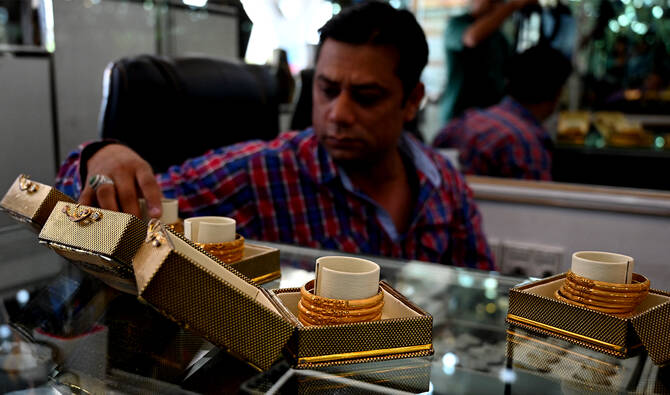
In this pictures taken on April 22, 2019, a Pakistani jeweller checks gold bangles at his shop in Rawalpindi. (AFP/File)
Short Url
Updated 27 November 2025
Follow

Pakistan’s gold market still 90% informal as $54 billion Reko Diq output nears — report

  • UN-backed study warns Pakistan’s weak, informal gold market cannot absorb upcoming 17.9m oz from Reko Diq gold mines 
  • Calls for setting up Gold and Gemstone Authority to prevent Reko Diq’s incoming gold supply from being lost to informal economy

KARACHI: Pakistan’s gold sector remains overwhelmingly informal, with an estimated 90 percent of all gold trade occurring outside formal channels, leaving the country unprepared to manage the huge supply expected from the Reko Diq gold-copper project unless sweeping reforms are introduced, according to a new UNDP-supported competition assessment.

The ‘Competition Assessment Study of the Gold Market in Pakistan 2025’ report, released by the Competition Commission, says the country is on the verge of a major shift: the Reko Diq mine is projected to produce 17.9 million ounces of gold worth around $54 billion, a level of output that could transform Pakistan’s domestic supply. But the report warns the existing market is highly fragmented, dominated by unregulated dealers, hampered by weak oversight, and distorted by smuggling and price manipulation.

Pakistan currently consumes 60–90 tons of gold a year, most of it imported, exposing the market to global price swings and currency pressures. With no centralized regulator, no mandatory hallmarking system, and limited refining capacity, the sector “remains largely informal, opaque and inconsistent in enforcement,” the study notes. These structural weaknesses have made consumer protection, quality control and price transparency difficult to enforce.

“Without urgent reforms, Reko Diq’s output risks being absorbed into the same inefficient system, perpetuating informality, price distortions, and missed export potential,” the report said. 

The study says Pakistan’s gold trade is constrained by “the absence of a unified regulatory framework,” with key institutions withholding essential market and import data. Daily price setting is still driven by informal sarafa market associations, while most gold transactions evade documentation, tax compliance and quality checks.

To prevent Reko Diq’s incoming gold supply from being lost to the informal economy, the report calls for a Pakistan Gold and Gemstone Authority (PGGA) to centralize regulation, implement nationwide hallmarking and assaying, and introduce digital traceability tools such as blockchain. It also proposes a “gold banking” model to formalize household gold and improve financial inclusion.

The study warns that unless Pakistan modernizes its gold governance, the country risks allowing one of its largest-ever resource windfalls to disappear into informal networks rather than contribute to exports, investment, and fiscal stability. It notes that aligning reforms with the Reko Diq production timeline would allow Pakistan to “formalize 50+ tons of annual gold supply” and potentially develop into a regional refining hub.


Pakistan, global crypto exchange discuss modernizing digital payments, creating job prospects 

Updated 05 December 2025
Follow

Pakistan, global crypto exchange discuss modernizing digital payments, creating job prospects 

  • Pakistani officials, Binance team discuss coordination between Islamabad, local banks and global exchanges
  • Pakistan has attempted to tap into growing crypto market to curb illicit transactions, improve oversight

ISLAMABAD: Pakistan’s finance officials and the team of a global cryptocurrency exchange on Friday held discussions aimed at modernizing the country’s digital payments system and building local talent pipelines to meet rising demand for blockchain and Web3 skills, the finance ministry said.

The development took place during a high-level meeting between Finance Minister Muhammad Aurangzeb, Pakistan Virtual Assets Regulatory Authority (PVARA) Chairman Bilal bin Saqib, domestic bank presidents and a Binance team led by Global CEO Richard Teng. The meeting was held to advance work on Pakistan’s National Digital Asset Framework, a regulatory setup to govern Pakistan’s digital assets.

Pakistan has been moving to regulate its fast-growing crypto and digital assets market by bringing virtual asset service providers (VASPs) under a formal licensing regime. Officials say the push is aimed at curbing illicit transactions, improving oversight, and encouraging innovation in blockchain-based financial services.

“Participants reviewed opportunities to modernize Pakistan’s digital payments landscape, noting that blockchain-based systems could significantly reduce costs from the country’s $38 billion annual remittance flows,” the finance ministry said in a statement. 

“Discussions also emphasized building local talent pipelines to meet rising global demand for blockchain and Web3 skills, creating high-value employment prospects for Pakistani youth.”

Blockchain is a type of digital database that is shared, transparent and tamper-resistant. Instead of being stored on one computer, the data is kept on a distributed network of computers, making it very hard to alter or hack.

Web3 refers to the next generation of the Internet built using blockchain, focusing on giving users more control over their data, identity and digital assets rather than big tech companies controlling it.

Participants of the meeting also discussed sovereign debt tokenization, which is the process of converting a country’s debt such as government bonds, into digital tokens on a blockchain, the ministry said. 

Aurangzeb called for close coordination between the government, domestic banks and global exchanges to modernize Pakistan’s payment landscape.

Participants of the meeting also discussed considering a “time-bound amnesty” to encourage users to move assets onto regulated platforms, stressing the need for stronger verifications and a risk-mitigation system.

Pakistan has attempted in recent months to tap into the country’s growing crypto market, crack down on money laundering and terror financing, and promote responsible innovation — a move analysts say could bring an estimated $25 billion in virtual assets into the tax net.

In September, Islamabad invited international crypto exchanges and other VASPs to apply for licenses to operate in the country, a step aimed at formalizing and regulating its fast-growing digital market.