Hong Kong’s deadliest blaze in decades kills at least 94, scores missing

1 / 4
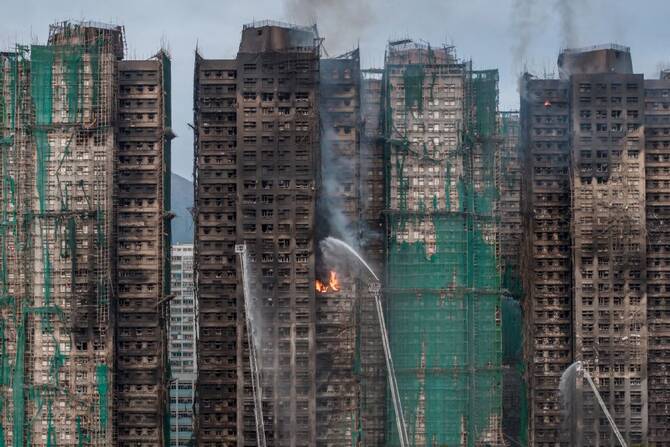
People shelter at an evacuation center on Thursday, after a deadly fire broke out at Wang Fuk Court housing complex, in Hong Kong. (Reuters)
2 / 4
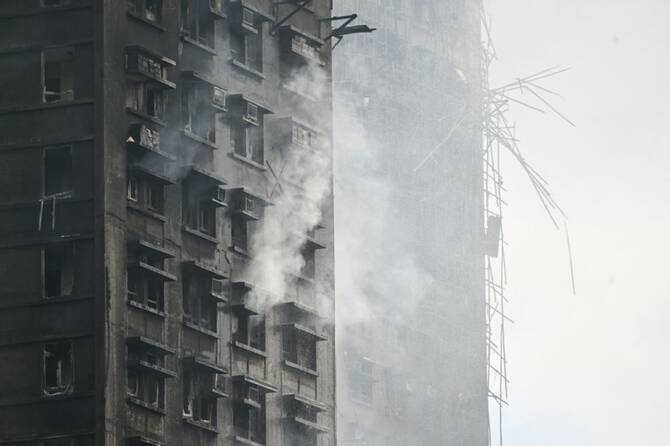
Smoke rises from apartments after a major fire swept through several blocks at the Wang Fuk Court residential estate in Hong Kong's Tai Po district on Thursday. (AFP)
3 / 4
An apartment still smoulders after a major fire swept through several apartment blocks at the Wang Fuk Court residential estate in Hong Kong's Tai Po district, Hong Kong. (AFP)
4 / 4
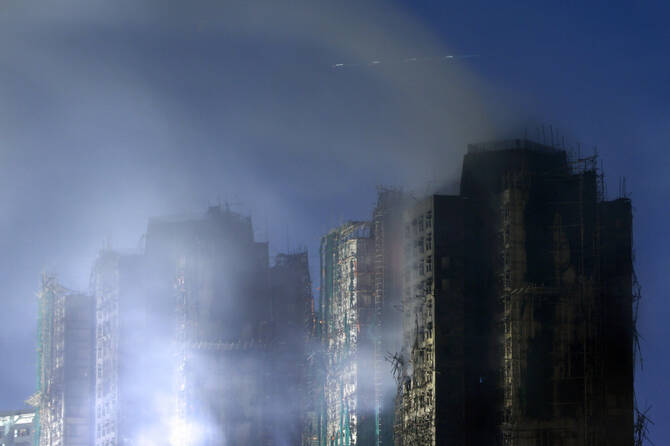
A plane flies overhead as smoke rises from a deadly fire, which broke out yesterday at Wang Fuk Court housing complex, in Hong Kong, China November 27, 2025. (REUTERS)
Short Url
Updated 28 November 2025
Follow

Hong Kong’s deadliest blaze in decades kills at least 94, scores missing

  • Fire contained to four of the sprawling complex’s almost 2,000 units, more than 36 hours after the blaze broke out on the eight-building estate
  • Anti-corruption body investigating renovation work after police arrest three men on suspicion of negligently leaving foam packaging at the fire site

HONG KONG: Firefighters searched the last of the housing estate flats torched by Hong Kong’s worst fire in decades on Friday, with the death toll rising to at least 94 overnight and scores still missing.
Authorities said the fire had been contained to four of the sprawling complex’s almost 2,000 units, more than 36 hours after the blaze broke out on the eight-building estate.
Firefighters will conduct search and rescue operations in response to 25 remaining requests for help and break into all flats on the estate by 9 am (0100 GMT), said deputy director of fire services Derek Armstrong Chan.

More than 50 people were still hospitalized, with 12 in critical condition and 28 in serious condition. Scores remain missing, although the exact number has not been updated since early Thursday.
“The fire spread so quickly. I saw one hose trying to save several buildings, and I felt it was far too slow,” said a man surnamed Suen.
An AFP reporter at the scene on Friday saw that the fire at Wang Fuk Court had weakened significantly, but sparks and thick smoke still occasionally burst forth from the structure.
Firefighters continued to douse the building with water to cool the structure and prevent embers from re-igniting.
Authorities have begun investigating what sparked the blaze — the financial hub’s worst in almost 80 years — including the presence of bamboo scaffolding and plastic mesh wrapped around the structures as part of a major renovation.


This photograph taken on August 22, 2023 shows a building covered in netting and bamboo scaffolding at the North Point area of the Eastern District in Hong Kong. (AFP)

Hong Kong’s anti-corruption body said Thursday it had launched a probe into renovation work at the complex, hours after police said they had arrested three men on suspicion of negligently leaving foam packaging at the fire site.
Residents of Wang Fuk Court, located in Hong Kong’s northern district of Tai Po, told AFP that they did not hear any fire alarms and had to go door-to-door to alert neighbors to the danger.
“Ringing doorbells, knocking on doors, alerting the neighbors, telling them to leave — that’s what the situation was like,” resident Suen said.

‘Cannot describe it’ 

Of the 94 people confirmed dead as of 6:00 am local time (22:00 GMT Thursday), one was a 37-year-old firefighter and two were Indonesians working as migrant domestic workers.
It is Hong Kong’s deadliest fire since 1948, when an explosion followed by a fire killed at least 135 people.
But the toll could yet rise, with city leader John Lee saying in the early hours of Thursday that 279 people were unaccounted for.
Firefighters said later that they had made contact with some of those people and authorities have not updated the figure since.

On Thursday, police at a nearby community center hoping to identify victims showed photos of bodies pulled from the fire to people seeking missing loved ones.
“If the faces are unrecognizable, there are personal items for people to identify,” said a woman surnamed Cheung who was looking for her relatives.
“I cannot describe my feelings. There were children,” she said.
Deadly fires were once a regular scourge in densely populated Hong Kong, especially in poorer neighborhoods, but improved safety measures have made them far less common.
Hong Kong authorities will immediately inspect all housing estates undergoing major work following the disaster, city leader Lee said Thursday.
The city’s number-two official Eric Chan told a news conference Thursday it was “imperative to expedite the full transition to metal scaffolding.”
Hong Kong’s government said it was setting up a HK$300 million (38.5 million US dollars) fund to help victims of the fire.
City authorities said they had opened nine shelters and were organizing temporary accommodation and emergency funds for those who had lost their homes.
Activities around Hong Kong’s legislative elections, set to take place on December 7, have been suspended.

Hellish scenes 

Sections of charred scaffolding fell from the burning apartment blocks in hellish scenes late on Wednesday, as flames inside apartments sometimes belched out through windows into a night sky that glowed orange.
Fire services said the wind and drifting debris likely spread the fire from one building to another.
Some of the residents in adjacent blocks who had been evacuated as a precaution were allowed back into their homes on Thursday afternoon.
Crowds moved by the tragedy gathered near the complex to organize aid for displaced residents and firefighters, part of a spontaneous effort in a city that has some of the world’s most densely packed and tallest residential blocks.
Volunteers distributed clothes and lunch boxes at the open-air podium of a nearby mall, while a few people gave out flyers with information about missing people.
“It’s truly touching,” said Stone Ngai, 38, one of the organizers of an impromptu aid station.
“The spirit of Hong Kong people is that when one is in trouble, everyone lends support... It shows that Hong Kong people are full of love.”


What Bangladesh’s election means for India, China and Pakistan ties

Bangladesh Nationalist Party supporters gather for a rally ahead of the upcoming national election, in Sylhet on Jan. 22, 2026.
Updated 08 February 2026
Follow

What Bangladesh’s election means for India, China and Pakistan ties

  • Bangladeshis will vote on Feb. 12, almost two years after the 2024 student-led uprising
  • After nearly 2 years of tensions, experts expect a thaw with India under elected government

DHAKA: As Bangladesh prepares to hold its first elections since the 2024 ouster of Sheikh Hasina, its longest-serving prime minister, the outcome will define Dhaka’s relations with the most important regional powers — China, India, and Pakistan.

Nearly 128 million Bangladeshis will head to the polls on Feb. 12 to bring in new leadership after an 18-month rule of the current caretaker administration.

The interim government, led by Nobel laureate Muhammad Yunus, took control following a student-led uprising that ended 15 years in power of Hasina and her Awami League party.

The two main parties out of the 51 competing for power are the Bangladesh Nationalist Party and Jamaat-e-Islami. The Awami League, which for decades has had close ties with India, was excluded from the election ballot over its role in the deadly crackdown on the 2024 student-led protests, in which 1,400 people were killed.

While Bangladesh’s relationship India has deteriorated since the fall of Hasina, who has been in self-exile in New Delhi, the period of diplomatic strain is expected to ease when the new government takes office.

“Whoever comes to power in Bangladesh, due to domestic pressure in the country, relationships with India need a resetting,” Humayun Kabir, former ambassador to the US, told Arab News.

“It’s anticipated that India will also engage with the new government, but they will protect their interests, and we also have to do the same. It’s most likely that the India-Bangladesh relationship will be normalized under the new, elected, government.”

Since 2024, India has suspended key transshipment access that allowed Bangladeshi exports to go via Indian ports and airports. It also put on hold most normal visa services for Bangladeshis, who were among its largest groups of medical tourists.

From Hasina’s heavy pro-India orientation, the interim government has tried to rebalance Bangladesh’s foreign policy toward the two other key regional players — China and Pakistan — who at the same time are India’s main rivals. 

If New Delhi regains its importance, it should not deal a blow to the newly expanded relations with Pakistan, with whom Bangladesh has recently increased exchanges, especially economic, and last month resumed direct flights — after a 14-year gap.

Since the relations have been expanded under the caretaker government, Prof. Delwar Hossain from the International Relations Department at Dhaka University forecast that they would only further improve, no matter who comes to power, and there is no likelihood of a sudden change.

“For Pakistan, any political coalition — whether BNP or Jamaat — will be positive. The BNP has a long history of having good relations with Pakistan during their rule ... Jamaat also has a strong and very positive influence in Pakistan,” he said.

“For Pakistan, the new regime or new government is not the issue. The issue is what the (India) policy of the new government would be and to what extent it would actually support Pakistan’s view.”

Both the BNP and Jamaat have repeatedly said they wanted friendly relations with India, and Hossain expected that they would, at the same time, continue the balanced approach introduced by the caretaker administration.

“India is a reality as a neighbor. At the same time, India is also showing interest in mending relations or adopting a more cooperative approach after the vote, with the government that will be elected ... I think there will be pragmatism from both sides,” he said.

“I don’t see there is a long-term threat to Bangladesh-India relations ... When China and Pakistan were trying to create a trilateral cooperative system or some kind of coalition — China, Bangladesh and Pakistan — we have seen that Bangladesh opted out. It seems that Bangladesh is going to continue its policy of maintaining a balance among these great powers.”

Bangladesh’s relations with China have not changed since the ouster of Hasina, whose government signed several economic agreements with Beijing. Yunus’s administration has continued this cooperation, and China was among the very few countries he officially visited during his term.

During the visit, he secured about $2.1 billion in Chinese investments, loans and grants, including funding for infrastructure like Mongla Port and a special economic zone in Chattogram — Bangladesh’s largest port. China has also eased visa rules for Bangladeshi businesspeople, medical travelers and tourists.

According to Munshi Faiz Ahmed, Bangladesh’s former ambassador to Beijing, China’s importance for Bangladesh cannot be substituted by any other country, especially as over the past few years it has emerged not only as its key investor, but also the largest trade partner.

In the fiscal year 2024-25, Bangladesh’s trade with China was over $21.3 billion, according to National Board of Revenue data. With India, it was about $11.5 billion.

The trade — especially import — dependence on Beijing started long before the regime change. In terms of trade volume, China overtook India already in 2018.

“Even when people thought that we had very close relations with India, our relations with China continued to grow in terms of trade and commerce ... Our trade with China has surpassed India’s, and China is a much bigger investor in Bangladesh’s development projects,” Ahmed said.

“Bangladesh will continue to cooperate with China for a long time to come because what China can provide, no other country can.”