WEST PALM BEACH, Florida: President Donald Trump said Wednesday that he is barring South Africa from participating in the Group of 20 summit next year at his Miami-area club and will stop all payments and subsidies to the country over its treatment of a US government representative at this year’s global meeting.
Trump chose not to have an American delegation attend the recent summit hosted by South Africa, saying he did so because white Afrikaners were being violently persecuted. It is a claim that South Africa, which was mired for decades in racial apartheid, has rejected as baseless.
The Republican president, in a social media post, said South Africa had refused to hand over its G20 hosting responsibilities to a senior representative of the US Embassy when the summit ended over the weekend.
“Therefore, at my direction, South Africa will NOT be receiving an invitation to the 2026 G20, which will be hosted in the Great City of Miami, Florida next year,” Trump posted on Truth Social.
“South Africa has demonstrated to the World they are not a country worthy of Membership anywhere,” he said, “and we are going to stop all payments and subsidies to them, effective immediately.”
In some ways, Trump views next year’s G20 summit as personal, given that he announced it will be at his golf club in Doral, Florida.
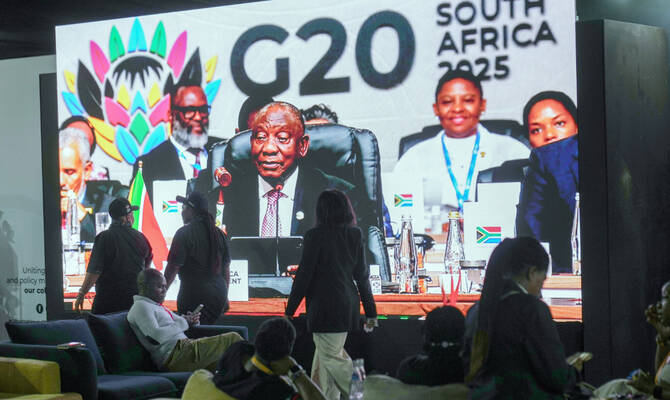
This year’s summit in Johannesburg, the first held in Africa, was boycotted by the United States, a G20 founding member and the world’s biggest economy. The meeting’s declaration, giving more attention to issues that affect developing countries, went unsigned by Washington, and the Trump administration expressed its opposition to South Africa’s agenda, especially the parts that focus on climate change.
On Monday, the US took over the rotating presidency of the G20, leaving the long-term impact of the South African declaration unclear.
By tradition, the host country hands over a symbolic wooden gavel to the nation taking over the G20 presidency. But there was no American official on hand to receive it from South African President Cyril Ramaphosa because of the boycott.
The US wanted to send a representative from its embassy. South Africa refused, saying it was an insult for Ramaphosa to hand over to what it called a junior official.
Trump has claimed that white Afrikaner farmers in South Africa are being killed and that their land is being seized. The South African government and others, including some Afrikaners themselves, say Trump’s claims are the result of misinformation.
South Africa has been a target for Trump since he returned to office at the start of the year, with his administration casting the country as anti-American because of its diplomatic ties with China, Russia and Iran.
Last month, the Trump administration announced it would restrict the number of refugees admitted annually to the US to 7,500, with most of the spots reserved for white South Africans. Trump had suspended the refugee program on his first day in office in January. Since then only a trickle have entered the country, mostly white South Africans. In May, the administration welcomed a group of 59 white South Africans as refugees.
Afrikaners are South Africans who are descended mainly from Dutch but also French and German colonial settlers who first came to the country in the 17th century.
Afrikaners were at the heart of the apartheid system of white minority rule from 1948-1994, leading to decades of hostility between them and South Africa’s Black majority. But Afrikaners are not a homogenous group, and some fought against apartheid. There are an estimated 2.7 million Afrikaners in South Africa’s population of 62 million.


![]()

Trump says he’s barring South Africa from participating in next year’s G20 summit near Miami
Short Url
https://arab.news/6dmmj
Trump says he’s barring South Africa from participating in next year’s G20 summit near Miami
- This year’s summit in Johannesburg, the first held in Africa, was boycotted by the United States, a G20 founding member and the world’s biggest economy


Latest updates


© 2026 SAUDI RESEARCH & PUBLISHING COMPANY, All Rights Reserved And subject to Terms of Use Agreement.