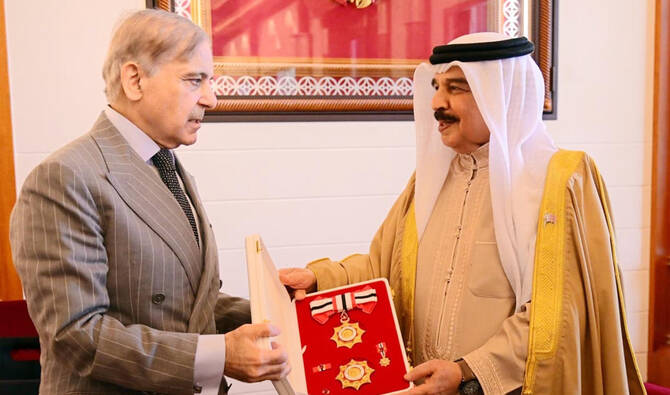

ISLAMABAD: Bahrain’s King Hamad bin Isa Al Khalifa on Wednesday awarded the Order of Bahrain (First Class) to Pakistani Prime Minister Shehbaz Sharif during a meeting in Manama, where the two leaders reaffirmed their historic partnership and reviewed political, economic and defense cooperation, the Prime Minister’s Office (PMO) said.
Pakistan and Bahrain established diplomatic ties in 1971 and maintain close economic, labor and defense cooperation. Bahrain hosts more than 120,000 Pakistanis, making it an important source of remittances for Islamabad.
Economic engagement between the two nations has accelerated this year following the Pakistan–Bahrain Investment Summit, where firms signed $13 million worth of contracts, and with the Pakistan–GCC Free Trade Agreement now at an advanced stage of finalization.
“The King of Bahrain conferred upon Prime Minister Muhammad Shehbaz Sharif the Order of Bahrain (first class), which is the highest award given by Bahrain to Heads of States and governments,” Sharif’s office said after he met Hamad.
The monarch highlighted a historic connection between the two countries, noting that the Kingdom of Bahrain “had the privilege of being represented at a legal forum by none other than Quaid-e-Azam Muhammad Ali Jinnah,” the founder of Pakistan, who served as Bahrain’s lawyer.
Both sides reviewed the “encouraging momentum” in bilateral ties and agreed to enhance cooperation across political, economic, defense and cultural domains. The PMO said Sharif expressed appreciation for Bahrain’s support, including the establishment of the King Hamad University for Nursing and Allied Medical Sciences in Islamabad and the pardon of Pakistani prisoners.
Earlier in the day, Sharif held separate talks with Bahrain’s Crown Prince and Prime Minister Salman bin Hamad Al Khalifa, where he proposed raising bilateral trade from over $550 million to $1 billion within three years, backed by progress on the Pakistan–GCC Free Trade Agreement and relaxed visa rules.
“Economic cooperation was a key focus,” Sharif’s office said about the meeting with the crown prince.
“The Prime Minister highlighted the potential to increase bilateral trade, currently over $550 million, to $1 billion within three years, supported by the Pakistan–GCC Free Trade Agreement … and recently eased visa requirements.”
Sharif invited Bahraini investors to explore opportunities in food security, IT, construction, mines and minerals, health care, renewable energy and tourism. He also proposed enhancing port-to-port connectivity between Karachi or Gwadar and Bahrain’s Khalifa Bin Salman Port to improve cargo movement and Gulf maritime integration.
The PMO said the two sides also discussed academic cooperation, governance reforms and support for Pakistani expatriates, noting:
“Sharif welcomed further collaboration in higher education, technical training, and digital governance, building on the King Hamad University initiative, and thanked Bahrain for facilitating the release and repatriation of Pakistani nationals.”
Defense cooperation was another area of expansion, with both governments looking to deepen collaboration in training, cybersecurity, defense production and information sharing.
The humanitarian crisis in Gaza was a major part of the conversation with the two leaders agreeing that the establishment of “peace and stability was long overdue for the people of Gaza who have suffered for decades.”
The PMO said the crown prince meeting “concluded with confidence that the discussions will translate into tangible outcomes and further elevate Pakistan–Bahrain relations across strategic, economic, security and people-to-people domains.”