UK’s unpopular Labour government tries to fight back with tax-raising budget

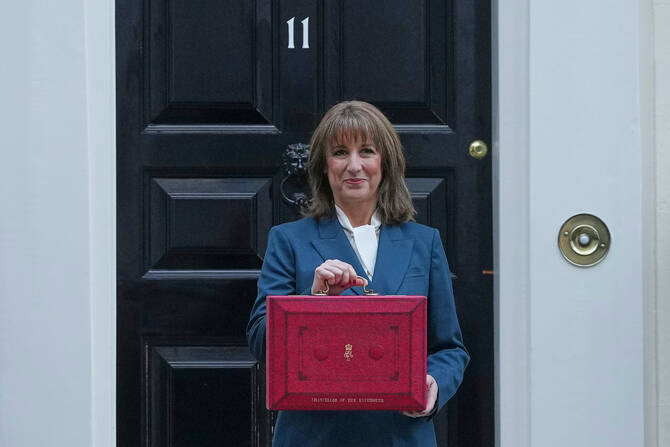
Britain's Chancellor of the Exchequer Rachel Reeves poses on the doorstep of 11 Downing Street with her ministerial red box before heading to the House of Commons. (AP)
Short Url
Updated 26 November 2025
Follow

UK’s unpopular Labour government tries to fight back with tax-raising budget

  • Entire contents of the budget were leaked half an hour before Treasury chief Rachel Reeves delivered her statement
  • Chancellor acknowledges some of the budget’s tax hikes broke the spirit of her party's election pledge

LONDON: Britain’s unpopular center-left Labour government sought to seize the political narrative Wednesday with a tax-raising budget that it hopes will boost economic growth by fostering a stable debt outlook, reduce child poverty and ease cost-of-living pressures.
But the entire contents of the budget were leaked half an hour before Treasury chief Rachel Reeves delivered the budget statement in the House of Commons, in a sign of the chaos that has engulfed the government during weeks of mixed messaging and political infighting.
The government was elected in a landslide victory in July 2024 on a promise not to raise taxes on income for working people. Reeves acknowledged some of the budget’s $34 billion in tax hikes, largely to increase the buffer available to the government in the event of any future shocks, broke the spirit of that pledge and would face criticism.
But, she said, “I have yet to see a credible or a fairer alternative plan for working people.
“These are my choices — the right choices for a fairer, a stronger, and a more secure Britain,” she said.
The biggest change in terms of money raised is freezing the thresholds at which earners pay Britain’s different income tax levels for a further three years from 2028, meaning as wages rise, more people fall into higher tax brackets.
Other measures included a mansion tax over $2.6 million, changes to the capital gains tax regime, higher gambling taxes, a new levy on electric car use and a cut to tax-free provisions for private pensions.
To much applause from Labour lawmakers, Reeves also abolished a much-hated cap on benefits paid out to families with more than two children. She also announced measures to ease the financial pressure on households, by freezing rail fares and cutting levies on household energy bills.

A budget repeat

Overall, the budget was strikingly similar to Reeves’ first budget a little more than a year ago, even though she insisted at the time that it would be the one and only big tax-raising budget in this parliamentary term, which is due to run to 2029.
Unfortunately for Reeves, the UK economy, the world’s sixth-largest, isn’t doing as well as she hoped, with many critics blaming her decision last year to slap taxes on business. Though there were signs that the economy was improving in the first half of the year, when it was the fastest-growing among the Group of Seven leading industrialized nations, it has faltered again.
False dawns have been a regular feature of the UK economy since the global financial crisis of 2008-2009. If the economy had kept growing at precrisis levels, it would be nearly a quarter bigger than it is now. That’s a lot of lost activity — and a lot of lost tax revenue going into the Treasury’s coffers.
In addition to the long-term costs of the financial crisis, Britain’s public finances, like those of other nations, have been further squeezed by the costs of the COVID-19 pandemic, the Russia-Ukraine war and US President Donald Trump’s global tariffs. The UK bears the extra burden of Brexit, which has knocked billions off the economy since the country left the European Union in 2020.
Meanwhile, Reeves had to deal with various spending commitments aimed at easing the cost of living as inflation remains stubbornly high, including making up for a series of about-faces on planned welfare cuts.
Helen Miller, director of the Institute for Fiscal Studies, said Reeves should be commended for more than doubling the buffer available to the government to 22 billion pounds.
“By providing greater insulation against economic turbulence, the additional buffer will reduce the risk of playing out this year on repeat in 2026,” she said.

Chaotic backdrop

The budget followed weeks of messy mixed messaging and political acrimony that continued into the minutes before Reeves stood in the House of Commons.
On Nov. 4, Reeves made a speech to prepare the public and markets for a hike in income tax rates, which would break a key election promise. After an outcry among Labour lawmakers, and a better-than-expected update on the public finances, she reversed course, opting for a smorgasbord of smaller revenue-raising measures.
Then, the entire fiscal forecast from the independent watchdog the Office for Budget Responsibility, including details of the budgets’ main measures, was published online half an hour before Reeves’ statement.
Reeves said the early release was “deeply disappointing and a serious error” by the budget watchdog.
The OBR blamed a “technical error” for the leak, saying it went “live on our website too early this morning.” It said it will report to all relevant authorities, including the Treasury, as to what happened.

High political stakes

The budget is a high-stakes moment for Reeves and Prime Minister Keir Starmer, who is facing mounting concern from Labour lawmakers over his dire poll ratings. Opinion polls consistently put Labour well behind the hard-right Reform UK party led by Nigel Farage.


How decades of deforestation led to catastrophic Sumatra floods

Updated 9 sec ago
Follow

How decades of deforestation led to catastrophic Sumatra floods

  • At least 1.4m hectares of forest in flood-affected provinces were lost to deforestation since 2016
  • Indonesian officials vow to review permits, investigate companies suspected of worsening the disasters

JAKARTA: About a week after floods and landslides devastated three provinces in Indonesia’s Sumatra island, Rubama witnessed firsthand how the deluge left not only debris and rubble but also log after log of timber.

They were the first thing that she saw when she arrived in the Beutong Ateuh Banggalang district of Aceh, where at least two villages were wiped out by floodwaters.

“We saw these neatly cut logs moving down the river. Some were uprooted from the ground, but there are logs cut into specific sizes. This shows that the disaster in Aceh, in Sumatra, it’s all linked to illegal forestry practices,” Rubama, empowerment manager at Aceh-based environmental organization HAKA, told Arab News.

Monsoon rains exacerbated by a rare tropical storm caused flash floods and triggered landslides across Aceh, North Sumatra, and West Sumatra in late November, killing 969 people and injuring more than 5,000 as of Wednesday, as search efforts continue for 252 others who remain missing.

In the worst-hit areas, residents were cut off from power and communication for days, as floodwater destroyed bridges and torrents of mud from landslides blocked roads, hampering rescue efforts and aid delivery to isolated villages.

When access to the affected regions gradually improved and the scale of the disaster became clearer, clips of washed-up trunks and piles of timber crashing into residential areas circulated widely online, showing how the catastrophic nature of the storm was compounded by deforestation.

“This is real, we’re seeing the evidence today of what happens when a disaster strikes, how deforestation plays a major role in the aftermath,” Rubama said.

For decades, vast sections of Sumatra’s natural forest have been razed and converted for mining, palm oil plantations and pulpwood farms.

Around 1.4 million hectares of forest in Aceh, North Sumatra and West Sumatra were lost to deforestation between 2016 and 2025 alone, according to Indonesian environmental group WALHI, citing operations by 631 permit-holding companies.

Deforestation in Sumatra stripped away natural defenses that once absorbed rainfall and stabilized soil, making the island more vulnerable to extreme weather, said Riandra Purba, executive director of WALHI’s chapter in North Sumatra.

Purba said the Sumatra floods should serve as a “serious warning” for the government to issue permits more carefully.

“Balancing natural resource management requires a sustainable approach. We must not sacrifice natural benefits for the financial benefit of a select few,” he told Arab News.

“(The government) must evaluate all the environmental policies in the region … (and) implement strict monitoring, including law enforcement that will create a deterrent effect to those who violate existing laws.”

In Batang Toru, one of the worst-hit areas in North Sumatra where seven companies operate, hundreds of hectares had been cleared for gold mining and energy projects, leaving slopes exposed and riverbeds choked with sediment.

When torrential rains hit last month, rivers in the area were swollen with runoff and timber, while villages were buried or swept away.

As public outrage grew in the wake of the Sumatra floods, Indonesian officials, including Environment Minister Hanif Faisol Nurofiq, have moved to review existing permits and investigate companies suspected of worsening the disaster. 

“Our focus is to ensure whether company activities are influencing land stability and (increasing) risks of landslides or floods,” Nurofiq told Indonesian magazine Tempo on Saturday.

Sumatra’s natural forest cover stood at about 11.6 million hectares as of 2023, or about 24 percent of the island’s total area, falling short of the 30 to 33 percent forest coverage needed to maintain ecological balance.

The deadly floods and landslides in Sumatra also highlighted the urgency of disaster mitigation in Indonesia, especially amid the global climate crisis, said Kiki Taufik, forest campaigner at Greenpeace Indonesia. 

Over two weeks since floods and landslides inundated communities in Sumatra, a few villages remain isolated and over 800,000 people are still displaced. 

“This tropical cyclone, Senyar, in theory, experts said that it has a very low probability of forming near the equator, but what we have seen is that it happened, and this is caused by rapid global warming … which is triggering hydrometeorological disasters,” Taufik told Arab News.

“The government needs to give more attention, and even more budget allocation, to mitigate disaster risks … Prevention is much more important than (disaster) management, so this must be a priority for the government.”