

Pakistan, Qatar eye strategic tech partnership to expand startup financing, deepen digital cooperation

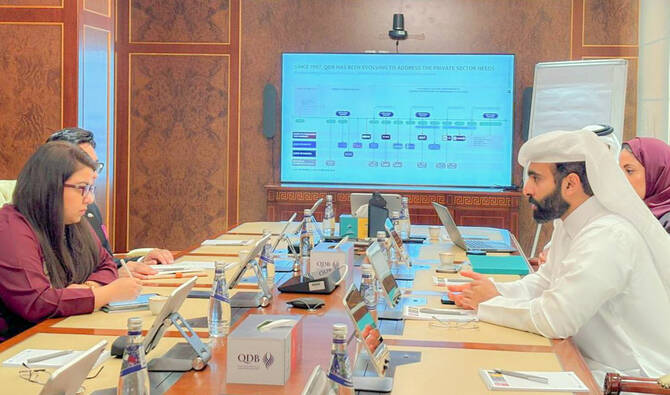
Pakistani IT minister Shaza Fatima Khawaja, meeting with Qatar Development Bank CEO Abdulrahman Al Sowaidi (right) in Doha, Qatar, on November 26, 2025. (IT Ministry)
Short Url
Updated 26 November 2025
Follow

Pakistan, Qatar eye strategic tech partnership to expand startup financing, deepen digital cooperation

  • Pakistan IT chief meets Qatar Development Bank CEO to discuss financing, incubation, investment opportunities for Pakistani startups
  • Both sides agree to deepen cooperation in AI, cloud services, cybersecurity, digital skills and cross-incubation programs

ISLAMABAD: Pakistan has opened talks with Qatar on creating a strategic technology partnership that would expand financing, incubation and investment opportunities for its startups, with IT minister Shaza Fatima Khawaja saying on Wednesday the Qatar Development Bank could play a central role in supporting Pakistan’s digital economy.

Pakistan has one of the world’s youngest tech workforces but faces significant barriers in early-stage funding, international market access and institutional support for digital skills. Meanwhile, Gulf economies including Qatar are rapidly expanding their investments in artificial intelligence, cloud infrastructure, cybersecurity and SME innovation as part of long-term diversification agendas.

As Pakistan seeks to integrate more deeply with these regional tech ecosystems, partnerships with development institutions such as Qatar Development Bank are viewed as critical for unlocking capital, training and cross-border incubation opportunities for Pakistani founders.

“A detailed discussion was held on new opportunities for financing, incubation and investment for Pakistani tech startups,” according to a statement released by the Pakistani IT ministry after Khawaja met Qatar Development Bank CEO Abdulrahman Al Sowaidi in Doha on Wednesday for wide-ranging discussions on strengthening support for Pakistan’s technology sector.

Khawaja told the delegation QDB could play a transformative role in Pakistan’s digital economy and “become a strategic partner for Pakistan’s IT and tech SMEs.”

The talks also covered advanced technology fields where both countries aim to expand cooperation, including artificial intelligence, cloud computing, cybersecurity and digital transformation. The ministry said the two sides also discussed expanding joint innovation and skills development efforts, adding that innovation and digital skill-building programs between Qatar and Pakistan were an important part of the conversation. Khawaja further proposed broadening institutional collaboration to support mobility and training, stating that she had suggested “enhancing institutional cooperation for talent, training and startup exchange programs.”

The meeting also touched on areas critical to industrial modernization, including cooperation on industrial digitalization, IoT testing environments and cross-incubation programs. Industrial digitalization refers to adopting digital tools such as automation and analytics across manufacturing, while IoT testing environments are specialized facilities where connected devices and sensors are evaluated for performance and security. Cross-incubation programs allow startups to access incubation facilities in both countries, enabling mentorship and market entry.

The ministry concluded that the discussion marked a meaningful step toward deepening the technological relationship between Qatar and Pakistan, describing the engagement as “an important step toward further strengthening the bilateral tech partnership.”


Pakistan’s president defends ongoing strikes in Afghanistan, urges Kabul to dismantle militants

Updated 02 March 2026
Follow

Pakistan’s president defends ongoing strikes in Afghanistan, urges Kabul to dismantle militants

  • Afghanistan on Thursday launched attacks in retaliation for Pakistani airstrikes the previous Sunday
  • Pakistan’s military says it is only targeting Afghan military installations to avoid civilian casualties

ISLAMABAD: Pakistan’s president on Monday defended his country’s ongoing military strikes in neighboring Afghanistan, saying Islamabad tried all forms of diplomacy before targeting militants operating from Afghan territory, and called on the Taliban government in Kabul to disarm groups responsible for attacks in Pakistan.

Pakistan earlier said it is in “open war” with Afghanistan, alarming the international community. The border area remains a stronghold for militant organizations including Al-Qaeda and the Daesh (Islamic State) group.

“(The Afghan Taliban) must choose to dismantle the terror groups that survive on conflict and its war economy,” Asif Ali Zardari said during a speech to lawmakers, adding that “no state accepts serial attacks on its soil.”

Afghanistan on Thursday launched attacks in retaliation for Pakistani airstrikes the previous Sunday. Since then, Pakistan has carried out operations along the border, with Information Minister Attaullah Tarar claiming the killing of 435 Afghan forces and the capture of 31 Afghan positions.

Kabul has denied such claims.

In Afghanistan, the deputy government spokesman Hamdullah Fitrat said Pakistan’s military fired mortar shells at a refugee camp in eastern Kunar province, killing three children and injuring three others.

Afghanistan’s defense ministry said Afghan forces carried out strikes targeting a Pakistani military facility near Paktia province, causing “substantial losses and heavy casualties.”

Pakistan’s military did not respond to questions. It has said Pakistan is only targeting Afghan military installations to avoid civilian casualties.

Pakistan has witnessed a surge of violence in recent months and blames it on the outlawed Pakistani Taliban, known as Tehreek-e-Taliban Pakistan or TTP. It operates both inside Pakistan and from Afghan territory.
Islamabad accuses Afghanistan’s Taliban government of providing safe havens for the TTP, which Kabul denies.

The latest cross-border fighting ended a ceasefire brokered by Qatar and Turkiye in October. The two sides failed to reach a permanent agreement during talks in Istanbul.

Zardari reiterated Pakistan’s call for talks, saying, “We have never walked away from dialogue.”

The Pakistani leader again accused Afghanistan of acting as a proxy for India by sheltering militant groups.

“Stop being used by another country as a battlefield for their ambitions,” he said.

Zardari cited a recent report from the United Nations Security Council’s monitoring team that described the presence of militant groups in Afghanistan as an extra-regional threat.