

UK ban on pro-Palestine group branded ‘authoritarian’ as appeal begins

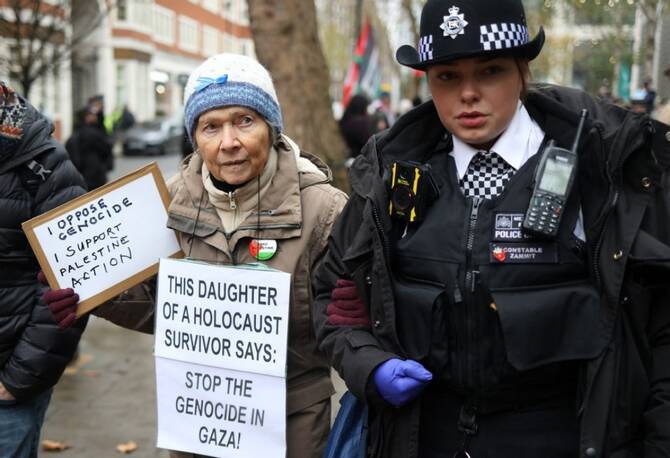
Police remove a protester for taking part in a demonstration in support Palestine Action" outside Britain's Home Office in London, UK. (AFP)
Short Url
Updated 26 November 2025
Follow

UK ban on pro-Palestine group branded ‘authoritarian’ as appeal begins

  • It was the first time a “direct action, civil disobedience organization that does not advocate for violence” had been proscribed as terrorist, Husain told Court
  • Ammori’s lawyers say the ban has led to pro-Palestinian protesters being questioned by police

LONDON: The British government’s ban on pro-Palestinian campaign group Palestine Action as a terrorist organization amounted to an authoritarian restriction on protest, lawyers representing a co-founder seeking to overturn the ban argued on Wednesday.
Palestine Action was proscribed in July, putting it on a par with Islamic State or Al-Qaeda and making it a crime to be a member, which carries a maximum sentence of 14 years in prison. Since then, more than 2,000 people have been arrested for holding signs in support of the group.
The group had increasingly targeted Israel-linked defense companies in Britain with “direct action,” often blocking entrances, or spraying red paint, particularly focusing on Israel’s largest defense firm Elbit Systems.
Britain’s Home Office (interior ministry) argues the group’s escalating actions, culminating in a June break-in at the RAF Brize Norton air base when activists damaged two planes, amount to terrorism.
But lawyers representing Huda Ammori, who co-founded Palestine Action in 2020, say the move flies in the face of Britain’s long history of direct action protests and is “so extreme as to render the UK an international outlier.”
It was the first time a “direct action, civil disobedience organization that does not advocate for violence” had been proscribed as terrorist, Ammori’s lawyer Raza Husain told London’s High Court.
He compared the response to the group to that of other civil disobedience campaigns, such as Rosa Parks, the late US civil rights figure who refused to give up her seat on a segregated bus in 1955, and the suffragette movement which campaigned for women’s right to vote in the early 20th century.

GROUP’S ACTIONS ESCALATED AMID WAR IN GAZA
Lawyers representing the Home Office said in court filings that the right to freedom of expression does not protect “speech and activity in support of a proscribed organization that commits serious property damage.”
Palestine Action has frequently targeted defense companies. It stepped up its actions during the Gaza war, with six members arrested on suspicion of plotting to disrupt the London Stock Exchange in January 2024.
Six people went on trial last week for aggravated burglary, criminal damage and violent disorder over a raid on Elbit, with one charged with causing grievous bodily harm by hitting a police officer with a sledgehammer. They deny the charges.
Ammori’s lawyers say the ban has led to pro-Palestinian protesters being questioned by police at demonstrations without expressing support for Palestine Action.
The British government argues proscription only prevents support for Palestine Action and has not prevented people from protesting “in favor of the Palestinian people or against Israel’s actions in Gaza.”
The case is due to conclude next week, with a ruling at a later date.


A Hong Kong court upholds the convictions of about a dozen activists in national security case

Updated 2 sec ago
Follow

A Hong Kong court upholds the convictions of about a dozen activists in national security case

HONG KONG: A Hong Kong court Monday dismissed all appeals arising from the city’s biggest case brought under a Beijing-imposed national security law.
The pro-democracy advocates who lodged the challenges were among 47 activists charged in 2021 with conspiracy to commit subversion for their involvement in an unofficial primary election. The mass prosecution involving some of the best-known activists crushed much of the city’s once-thriving pro-democracy movement that reached a height with massive anti-government protests in 2019.
Forty-five of the defendants were sentenced to between four years and 10 years in 2024, with their punishments drawing criticism from foreign governments and rights groups.
Eleven activists who appealed their convictions lost their bids. They included former lawmakers Leung Kwok-hung, Lam Cheuk-ting, Raymond Chan and Helena Wong.
All appeals over sentences, brought by 10 of them and another activist, were also dismissed by the Court of Appeal.
Lawrence Lau, a pro-democracy former district councilor, was one of two activists acquitted in the case. Judges upheld his acquittal following an appeal from the prosecution.
A primary led to convictions
Riding on the 2019 protests, the pro-democracy camp had been looking to make gains in the 2020 legislative election. The unofficial primary was meant to shortlist pro-democracy candidates for the official election.
During the trial, prosecutors said the activists aimed to paralyze Hong Kong’s government and force the city’s leader to resign by aiming to win a legislative majority and using it to block government budgets indiscriminately.
Judges at the appellate court ruled that the plan was unlawful under the meaning of the security law, saying it was conceived and advocated by legal scholar Benny Tai — whom the lower court described as the mastermind — as a “constitutional mass destruction weapon” for the purpose of toppling the city’s constitutional order.
Critics said the activists’ convictions illustrated how authorities crushed dissent following the 2019 protests. The Beijing and Hong Kong governments insist the national security law was necessary for the city’s stability.
Leung’s wife, Chan Po-ying, also an activist but unrelated to the case, said the ruling was not based on facts, arguing the defendants’ acts were in line with the city’s mini-constitution, the Basic Law.
“It already presumed these people had intended to subvert the state’s power,” she said.
Amnesty International Hong Kong Overseas spokesperson Fernando Cheung said the ruling reflected the grave state of human rights in Hong Kong.
“By failing to overturn these wrongful convictions and sentences today, the court has missed a critical opportunity to correct this mass injustice,” he said.
Some finished serving their terms
The case involved democracy advocates across the spectrum, including Tai, who got a 10-year prison term, and former student leader Joshua Wong, whose sentence was four years and eight months.
Nearly 20 activists in the case have been released from prison over the past year. Among them were former district councilors Jimmy Sham and Lester Shum. Sham and Lee Yue-shun, another acquitted activist, chatted with Lau before Monday’s hearing.
As those who were still in prison left the courtroom, some waved at their families and supporters.
Some residents stayed outside the court building in line since Saturday to secure a seat in the courtroom. Retiree Margaret Chan arrived Monday morning, hoping to show her support to those she considered to be innocent.
Seeing some activists released from prison relieved her. “They have survived it,” she said.