NEW DELHI: Hours after police in Indian-controlled Kashmir released shopkeeper Bilal Ahmed Wani but kept his son in custody in this month’s deadly New Delhi blast investigation, Wani set himself on fire, members of his family said.
The 55-year-old dry fruit seller was treated at three hospitals but died a day later. His relatives, who spoke on condition of anonymity as they feared reprisals from authorities for talking to media, said stress and humiliation over the detentions drove him to self-immolation. Police said Wani died due to “self-inflicted burn injuries.”
The Nov. 10 explosion near New Delhi’s historic Red Fort killed at least 10 people and wounded 32 others. Indian investigators quickly focused on Kashmir, launching sweeping raids, detaining suspects and questioning thousands for possible links to what authorities called a “heinous terror incident.” Hundreds still remain in custody.
The blast occurred hours after police in Indian-controlled Kashmir said they had dismantled a suspected militant cell operating from the region to the outskirts of New Delhi. Officers initially arrested at least seven people, including two Kashmiri doctors, and seized a large quantity of bombmaking material in Faridabad, a city near the capital.
On Nov. 14, some of the explosives seized in Faridabad and brought to a police station in Kashmir’s Srinagar city detonated, killing at least nine people. Authorities were still investigating the police station blast but the region’s top police officer, Nalin Prabhat, ruled out any sabotage, indicating mishandling of the explosive material may have caused the explosion.
Crackdown drove man to despair, relatives say
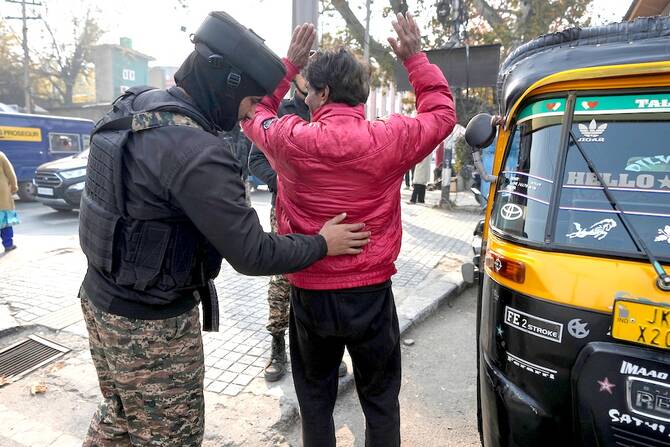
The New Delhi blast set off a sweeping security crackdown in Kashmir, marked by raids, mass questioning and dozens of detentions.
Police detained Wani’s eldest son, student Jasir Bilal Wani, on Nov. 14. A day later, authorities held Wani, his younger son and his brother, who is a physics lecturer. Wani and the younger son were released that evening, and his brother was freed after Wani’s death.
Wani’s relatives said the men were innocent and accused authorities of using them as scapegoats.
They said Wani returned home a day later, distraught and broken. The next morning, he walked outside, doused himself with gasoline and set himself ablaze, relatives said. He was rushed to a nearby hospital, which referred him to a larger medical facility before being transferred to the main hospital in Srinagar where he died, they said.
There have been security crackdowns in the region before, especially during periods of mass public uprising. But the ongoing crackdown is notably severe, topped only by restrictions imposed in 2019, when India revoked the special status for Indian-controlled Kashmir, which had given the region a degree of autonomy.
Fear in the medical community
India’s National Investigation Agency said the car used in the New Delhi blast was registered to a Kashmiri man and identified the suspected suicide bomber as Umar Un Nabi, a doctor.
Government forces demolished his family home in Kashmir’s southern Pulwama district, officials said. Troops have previously blown up houses of suspects they accuse of aiding militants fighting Indian rule in Kashmir.
The agency said last week that Wani’s son “worked closely with the terrorist Umar Un Nabi to plan the terror carnage,” alleging he provided technical support by modifying drones and attempting to make rockets. He remains in custody.
Authorities have also intensified a crackdown on what police call a “white-collar terror ecosystem of radicalized professionals and students,” increasing scrutiny of several Kashmiri doctors. Police said such individuals have maintained contact with “foreign handlers based in Pakistan and other countries.”
Security officials have reportedly sought details about doctors’ personal backgrounds, professional networks and ideological leanings, prompting anxiety and fear within the medical community. Several doctors, speaking on condition of anonymity because they feared reprisals for talking to the media, described the scrutiny as unprecedented and intrusive.
Avinash Mohananey, a former Indian intelligence officer who served in Kashmir and Pakistan, said that the module, regardless of what authorities call it, involved educated people and reflects deep anger that has been building beneath the surface for a long time.
Mohananey said Kashmiris feel a deep, underlying anger because their political aspirations remain unmet and that the region’s people “feel disempowered and humiliated.”
A groundswell of anger
Militants in the Indian-controlled portion of Kashmir have been fighting New Delhi’s rule since 1989. India insists the Kashmir militancy is Pakistan-sponsored terrorism. Pakistan denies the charge, and many Kashmiris consider it a legitimate freedom struggle.
India and Pakistan each administer a part of Kashmir, but both claim the territory in its entirety.
Praveen Donthi, a senior analyst with the International Crisis Group, said the political disenfranchisement following India’s 2019 decision “is fueling a groundswell of quiet anger and a resurgence of militancy.”
Since then authorities in the region have increased their crackdown on pro-freedom groups, the free press and rights activists. In New Delhi’s effort to shape what it calls “Naya Kashmir,” or a “new Kashmir,” the territory’s people have been largely silenced, with their civil liberties curbed, as India has shown no tolerance for any form of dissent.
Donthi said the crackdown following the New Delhi blast “is adding to the existing sense of pervasive insecurity and vulnerability, which is unlikely to help address the alienation and anger, but rather to fan them further.”
“A moderate approach by New Delhi to the region would be far more effective in preventing any further cycle of violence,” he said.


![]()

India intensifies crackdown in disputed Kashmir after New Delhi bombing
Short Url
https://arab.news/4d8ne
India intensifies crackdown in disputed Kashmir after New Delhi bombing
- The Nov. 10 explosion near New Delhi’s historic Red Fort killed at least 10 people and wounded 32 others
- Indian investigators quickly focused on Kashmir, launching sweeping raids, detaining suspects and questioning thousands


Latest updates


© 2026 SAUDI RESEARCH & PUBLISHING COMPANY, All Rights Reserved And subject to Terms of Use Agreement.