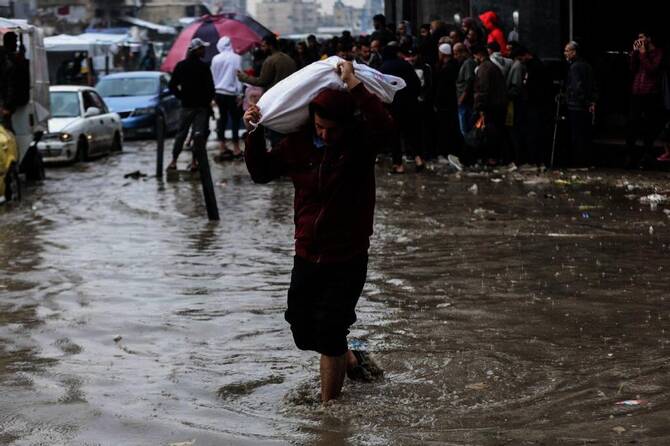
DEIR AL-BALAH, Gaza Strip: Children and families in Gaza scooped muddy water from their tents on Tuesday, trying to protect the few belongings that remain after two years of war.
Winter’s heavy rains have left displaced Palestinians splashing in water that reaches their ankles, and blaming both Israel and Hamas for the misery that remains despite a ceasefire.
“All tents were destroyed,” said Assmaa Fayad in Deir Al-Balah in central Gaza, whose shelter was damaged in Tuesday’s latest downpour. “Where is Hamas? Where are the people to see this rain and how our children are drowning?“
A Hamas spokesperson, Hazem Qassem, lashed out in a message on Telegram: “All the world’s efforts to alleviate the disaster have failed because of the Israeli siege.”
Aid organizations worry that the rainy winter months will make the stark situation worse, with ongoing shortages of humanitarian supplies. They are scrambling to mitigate the flooding and restore infrastructure devastated by the fighting.
Nearly all of Gaza’s over 2 million people were forced from their homes during the war. Most have been living in tents or shelters, some of them built over destroyed homes, with no proper sewage facilities. For toilets, they depend on cesspits dug near tents that overflow in heavy rainfall.
Rain-soaked mattresses
Reham Al-Hilu was among those assessing the damage in Deir Al-Balah, one of the areas hardest hit by the rains. Her wood and metal shelter collapsed overnight, and she said her head was injured.
“Rainwater flooded the mattresses,” she said. “As you can see, everything is soaked — the clothes, everything — and my children are all soaked.”
The United Nations humanitarian office last week said the downpours have damaged at least 13,000 tents like Al-Hilu’s, and “destroyed what little shelter and belongings thousands of Palestinians in Gaza had left.”
The office said aid organizations had begun preparing for winter in October, when the ceasefire between Israel and Hamas took effect, transporting materials like winterized tents into Gaza. Aid groups were able to distribute over 3,600 tents, 129,000 tarpaulins and 87,000 blankets earlier this month, the UN office said.
But the office said efforts have been hampered by the slow entry of aid. It said deliveries into the territory continue to be “severely constrained by Israeli authorities’ restrictions on the entry of shelter supplies.”
“Lifesaving humanitarian aid must enter Gaza without obstruction and at scale,” UN Secretary General António Guterres said on Tuesday.
The Israeli defense body responsible for the entry of aid, COGAT, said it worked on “a dedicated response to the winter.”
“The effort is ongoing — additional winter-related requests by international organizations have already been approved, and entry will take place in the coming days,” the agency wrote Tuesday on X.
Roads become rivers
Roadways in Deir Al-Balah turned into shallow rivers of murky water. One man waded across carrying a young daughter in each arm.
Some families knelt on the ground, trying to soak up the water with pieces of cloth.
While daily fighting has stopped in Gaza, Israel continues to strike parts of the territory in response to what it says are violations by Hamas. Both sides have accused each other of violating ceasefire conditions.
And many displaced Palestinians remain crowded into the rough half of Gaza’s territory that Israeli forces don’t control.

‘Everything is soaked’: Winter rains in Gaza bring new misery for Palestinians
Short Url
https://arab.news/g6vsz
‘Everything is soaked’: Winter rains in Gaza bring new misery for Palestinians
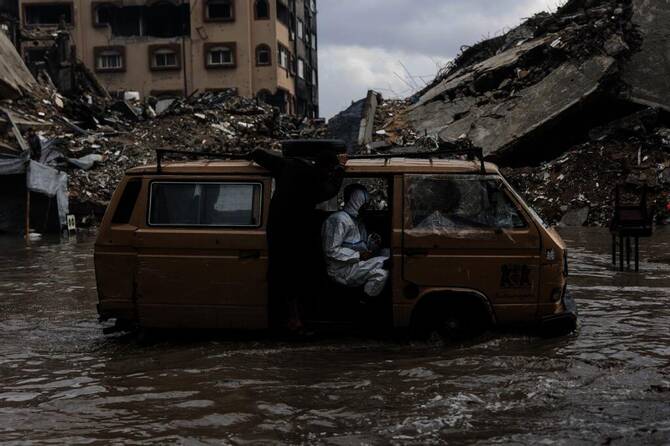
- Winter’s heavy rains have left displaced Palestinians splashing in water that reaches their ankles, and blaming both Israel and Hamas for the misery
- Aid organizations worry that the rainy winter months will make the stark situation worse
After wins abroad, Syria leader must gain trust at home
BEIRUT: One year after ousting Bashar Assad, Ahmed Al-Sharaa has restored Syria’s international standing and won sanctions relief.
But analysts warn the former jihadist still needs to secure trust on the home front.
Sectarian bloodshed in the country’s Alawite and Druze minority heartlands — alongside ongoing Israeli military operations — have shaken Syria as President Sharaa tries to lead the country out of 14 years of war.
“Syria has opened a new chapter that many once thought impossible,” said Nanar Hawach, senior Syria analyst at the International Crisis Group, citing relaunched diplomatic ties and foreign investment.
But he added: “International rehabilitation means little if all Syrians don’t feel safe walking their own streets.”
US President Donald Trump has taken a particular shining to the 43-year-old, a surprise political victory for a former militant who once had a US bounty on his head due to his ties to Al-Qaeda.
Sharaa has toured capitals from the Gulf to Europe to Washington since his Islamist alliance toppled Assad on December 8 last year, ending more than half a century of the family’s iron-fisted rule.
Washington and the UN Security Council have removed him from their respective “terrorism” and sanctions lists, and a delegation from the world body visited Damascus for the first time this week.
The United States, the European Union and Britain have lifted major economic sanctions on Syria, and Damascus has announced investment deals for infrastructure, transport and energy.
Sharaa has even visited Russia, whose military pounded his forces during the war and which is now home to an exiled Assad.
“Sharaa won abroad, but the real verdict comes at home,” Hawach said.
- ‘Real accountability’ -
Critics say Syria’s temporary constitution fails to reflect the country’s ethnic and religious diversity and concentrates power in the hands of a president appointed for a five-year transition.
The new authorities have disbanded armed factions, including Islamist and militant fighters, but absorbed most into the new-look army and security forces, including some foreign fighters.
And some government forces or their allies have been implicated in outbreaks of sectarian violence.
The Alawite community massacres in March, killed more than 1,700 people, according to the Syrian Observatory for Human Rights.
And clashes in July in south Syria’s Druze-majority Sweida province left more than 2,000 dead, including hundreds of Druze civilians.
Authorities have announced investigations into the bloodshed and have arrested and put some suspects on trial.
Nicholas Heras, from the New Lines Institute, said Sharaa “has twice failed as a leader of national reconciliation” — during the violence against the Alawites and the Druze.
Heras told AFP questions remain over “the extent to which he personally wants to rein in the militant Islamist militias that played the strongest role in bringing him to power in Damascus.”
Sharaa’s position, he said, remains precarious “because he does not command a unified security apparatus that can enforce the rules made by his government.”
- ‘Terrifying’ -
Gamal Mansour, a researcher at the University of Toronto, said “factional leaders who are essentially warlords” have taken up official roles, contributing to a “crisis of trust” among minorities.
However, “most Syrians believe Sharaa is the only option that provides guarantees,” he said, calling the prospect of a power vacuum “terrifying.”
Just keeping the country together is a major task, with some on the coast and in Sweida urging succession and the Kurds seeking decentralization, which Damascus has rejected.
A Kurdish administration in the northeast has agreed to integrate its institutions into the central government by year-end but progress has stalled.
Adding to pressures is neighboring Israel, which has repeatedly bombed Syria and wants to impose a demilitarised zone in the south.
Israel’s forces remain in a UN-patrolled buffer zone on the occupied Golan Heights and conduct regular incursions deeper into Syria despite the two sides holding direct talks.
On Monday, Trump told Israel to avoid destabilising Syria and its new leadership.
In October, committees selected new members of parliament, but the process excluded areas outside government control and Sharaa is still to appoint 70 of the 210 representatives.
lar/lg/dc
But analysts warn the former jihadist still needs to secure trust on the home front.
Sectarian bloodshed in the country’s Alawite and Druze minority heartlands — alongside ongoing Israeli military operations — have shaken Syria as President Sharaa tries to lead the country out of 14 years of war.
“Syria has opened a new chapter that many once thought impossible,” said Nanar Hawach, senior Syria analyst at the International Crisis Group, citing relaunched diplomatic ties and foreign investment.
But he added: “International rehabilitation means little if all Syrians don’t feel safe walking their own streets.”
US President Donald Trump has taken a particular shining to the 43-year-old, a surprise political victory for a former militant who once had a US bounty on his head due to his ties to Al-Qaeda.
Sharaa has toured capitals from the Gulf to Europe to Washington since his Islamist alliance toppled Assad on December 8 last year, ending more than half a century of the family’s iron-fisted rule.
Washington and the UN Security Council have removed him from their respective “terrorism” and sanctions lists, and a delegation from the world body visited Damascus for the first time this week.
The United States, the European Union and Britain have lifted major economic sanctions on Syria, and Damascus has announced investment deals for infrastructure, transport and energy.
Sharaa has even visited Russia, whose military pounded his forces during the war and which is now home to an exiled Assad.
“Sharaa won abroad, but the real verdict comes at home,” Hawach said.
- ‘Real accountability’ -
Critics say Syria’s temporary constitution fails to reflect the country’s ethnic and religious diversity and concentrates power in the hands of a president appointed for a five-year transition.
The new authorities have disbanded armed factions, including Islamist and militant fighters, but absorbed most into the new-look army and security forces, including some foreign fighters.
And some government forces or their allies have been implicated in outbreaks of sectarian violence.
The Alawite community massacres in March, killed more than 1,700 people, according to the Syrian Observatory for Human Rights.
And clashes in July in south Syria’s Druze-majority Sweida province left more than 2,000 dead, including hundreds of Druze civilians.
Authorities have announced investigations into the bloodshed and have arrested and put some suspects on trial.
Nicholas Heras, from the New Lines Institute, said Sharaa “has twice failed as a leader of national reconciliation” — during the violence against the Alawites and the Druze.
Heras told AFP questions remain over “the extent to which he personally wants to rein in the militant Islamist militias that played the strongest role in bringing him to power in Damascus.”
Sharaa’s position, he said, remains precarious “because he does not command a unified security apparatus that can enforce the rules made by his government.”
- ‘Terrifying’ -
Gamal Mansour, a researcher at the University of Toronto, said “factional leaders who are essentially warlords” have taken up official roles, contributing to a “crisis of trust” among minorities.
However, “most Syrians believe Sharaa is the only option that provides guarantees,” he said, calling the prospect of a power vacuum “terrifying.”
Just keeping the country together is a major task, with some on the coast and in Sweida urging succession and the Kurds seeking decentralization, which Damascus has rejected.
A Kurdish administration in the northeast has agreed to integrate its institutions into the central government by year-end but progress has stalled.
Adding to pressures is neighboring Israel, which has repeatedly bombed Syria and wants to impose a demilitarised zone in the south.
Israel’s forces remain in a UN-patrolled buffer zone on the occupied Golan Heights and conduct regular incursions deeper into Syria despite the two sides holding direct talks.
On Monday, Trump told Israel to avoid destabilising Syria and its new leadership.
In October, committees selected new members of parliament, but the process excluded areas outside government control and Sharaa is still to appoint 70 of the 210 representatives.
lar/lg/dc
© 2025 SAUDI RESEARCH & PUBLISHING COMPANY, All Rights Reserved And subject to Terms of Use Agreement.