

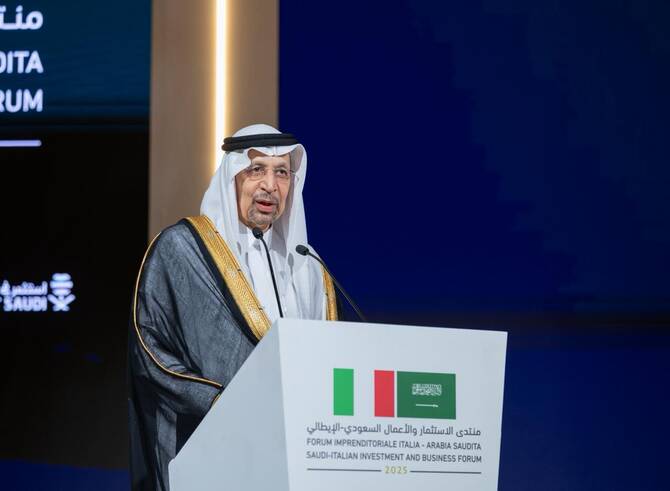
Saudi-Italian forum opens in Riyadh with 22 deals to deepen investment ties

In his keynote address, Saudi Minister of Investment Khaled Al-Falih said the relationship between the two countries is strengthening across multiple sectors, highlighting the shift toward high-value industries. AN Photo
Short Url
Updated 25 November 2025
Follow

Saudi-Italian forum opens in Riyadh with 22 deals to deepen investment ties

RIYADH: Saudi Arabia and Italy signaled a new phase of economic collaboration as the Saudi-Italian Investment and Business Forum opened in Riyadh, bringing together senior officials and major private-sector leaders to expand bilateral investment. 

During the forum, Saudi and Italian entities signed 22 investment agreements spanning multiple sectors including communications and information technology, import and export, as well as tourism, healthcare and sports.

In his keynote address, Saudi Minister of Investment Khaled Al-Falih said the relationship between the two countries is strengthening across multiple sectors, highlighting the shift toward high-value industries. 

“When I look at the audience, I see that most of the participants are Italians, and their participation reflects the depth and seriousness of our shared ambition,” said the minister of investment.

He referenced the deep diplomatic relations between Saudi Arabia and Italy, established over several decades on a foundation of trust and ambition.

“Our economic relations with Italy have developed, driven by our partnership in investment, trade, energy, industry, and culture,” he said, setting the tone for business discussions focused on accelerating capital flows and sectoral cooperation.   

He added that Italy occupies a special place in the history of Saudi diplomacy, as “it was one of the first countries to establish official relations with the Kingdom in the early 1930s.”


The Saudi-Italian Investment Forum is held in Riyadh from Nov. 25 to 26, aiming to expand economic and strategic relations between the two nations across sectors, including sustainable energy, transportation, and infrastructure. AN Photo

Al-Falih pointed to growing opportunities in non-traditional industries as the Kingdom broadens its diversification agenda. “We look forward to boosting cooperation in the fields of tourism, design, fashion, furniture, films, and heritage preservation,” he added.  

Technology cooperation also featured prominently, with the minister noting plans to expand joint work in advanced innovation fields. He stated that Saudi Arabia is moving to enhance collaboration by “expanding the scope of work in artificial intelligence to include developers and research centers,” underscoring efforts to build a knowledge-driven economy.  

He further emphasized that Italy’s partnership plays a strategic role in supporting national programs tied to security, industrial growth, and emerging fields. The collaboration actively “supports Saudi strategies in sectors such as defense, space, and cybersecurity,” he added. 

The forum drew more than 1,500 participants and over 600 Italian companies, with the attendance of several Saudi ministers, officials and investors. Among the attendees were Italy’s Deputy Prime Minister and Minister of Foreign Affairs Antonio Tajani, as well as Matteo Zoppas, president of the Italian Trade Agency.


Matteo Zoppas, President of the Italian Trade Agency. AN Photo

“We brought here more than a thousand investors, buyers, clients, I would say agents of commerce, with our aim to develop the export of Italian products to Saudi Arabia and not only to this area, of course,” Zoppas told Arab News.

He said the main focus areas include healthcare, digitalization, pharmaceuticals, furniture, and sports.

“It is very important for this forum because it is where we initiate the relations between the companies and local operators,” he said.

“We are coming here, and we are bringing within these projects technologies that can be helpful for the Kingdom,” Zoppas added.

He noted Italy’s export performance in recent years: “The export has been increasing over the past several years by 80 percent, more than 35 percent in the last two years.”

“The path is already in place; you need to help this path increase because you have a lot of investment projects. So we need to intercept these investment projects and try to give you the best technologies you can find in the world,” Zoppas said.

The forum served as a platform to review bilateral economic cooperation and explore promising investment opportunities within sectors aligned with Vision 2030.

Trade between the Kingdom and Italy has expanded in recent years, with Italian investments rising 15 percent in 2024 to reach SR6.3 billion. This growth — concentrated in priority sectors such as infrastructure, energy and digital technologies — was accompanied by a 91 percent increase in licenses issued to Italian companies.

According to Saudi Arabia Business Startup, in 2023, Saudi exports to Italy reached around $5 billion, while imports from Italy totaled almost $6 billion, reflecting strong demand for Italian machinery, pharmaceuticals, and advanced engineering solutions.

Last year, 63 investment licenses were granted to Italian companies in the manufacturing, construction, and renewable energy sectors, representing a 110 percent increase over the previous year.

Earlier this year, the Public Investment Fund and SACE, an Italian insurance and financial group owned by the Ministry of Economy and Finance, signed a memorandum of understanding worth $3 billion to support Italian companies in strategic projects in Saudi Arabia.

This year in AlUla, the two countries signed an additional 26 MoUs across sectors including renewable energy, culture, and tourism, aimed at strengthening collaboration and supporting the Kingdom’s diversification agenda.  

 The forum highlighted Saudi Arabia’s expanding investment landscape and opportunities for foreign firms, with a focus on long-term partnerships, public-private engagement, and sustainable sectoral development across both nations. 

Both sides framed the event as a catalyst for increasing mutual investment flows and formalizing strategic alliances that will reshape economic cooperation in the coming years. 


Red Sea’s oxygen balance under strain, experts warn

Updated 13 February 2026
Follow

Red Sea’s oxygen balance under strain, experts warn

  • Scientists say warming waters, nutrient runoff and coastal development could quietly erode coral resilience

RIYADH: The Red Sea may not have dead zones, but its fragile ecosystem is vulnerable to oxygen depletion — a quiet decline that can undermine coral health and disrupt marine life.

Sea dead zones are hypoxic or low-oxygen pockets that form most often when nutrient pollution — especially nitrogen and phosphorus from farm runoff and wastewater — fuels blooms that ultimately strip oxygen from the water.

Experts say the risk is not inevitable, but it depends on earlier detection and tighter control of the conditions that drain oxygen from coastal waters.

A sea that relies on its own “breathing” is also a sea shaped by geography.

FASTFACT

DID YOU KNOW?

  • The Red Sea is naturally low in oxygen because of its warm waters and high salinity — making it especially vulnerable to further oxygen decline.
  • The Red Sea’s narrow Bab Al-Mandab strait limits deepwater exchange, meaning the basin largely depends on its own internal circulation to ‘replenish’ oxygen.
  • Saudi Arabia’s coastline features steep underwater drop-offs, allowing deep, oxygen-poor water to move closer to coral reefs near shore.

Matheus Paiva, a senior oceanographer, told Arab News that “the Red Sea’s shallow Bab Al-Mandab choke point limits deepwater exchange,” meaning oxygen replenishment depends heavily on internal overturning circulation.

He said this circulation is driven as surface waters flow north, cool, become denser and sink, helping ventilate deeper layers through vertical mixing.

Paiva said the Saudi coastline’s underwater topography makes the risk more immediate close to shore.

Coral reefs along Saudi Arabia’s Red Sea coast, where scientists say warm, salty waters and limited deep-water exchange can leave ecosystems vulnerable to low-oxygen stress. (Unsplash.com)

“Unlike regions with wide, gradual shelves, our coast features narrow fringing reefs that drop sharply into deep water via steep underwater cliffs and canyons,” he said.

“This ‘step-and-drop’ topography brings deep oxygen-poor water close to shore.”

Paiva said warming at the surface can intensify stratification and reduce vertical mixing. He said that can allow low-oxygen water to creep upslope and affect shallower reef zones.

How oxygen gets consumed faster than it’s replaced is where human pressure can tip the balance.

Carlos Duarte, executive director or the Coral Research and Development Accelerator Program at KAUST, told Arab News that the Red Sea’s baseline conditions create vulnerability. “Because of its warm waters and high salinity, the Red Sea is inherently low in oxygen and, therefore, vulnerable to processes that decline oxygen further.”

He said algal blooms and heat waves raise biological oxygen demand, linking low oxygen to coral mortality.

Duarte said human-driven nutrient and organic inputs can intensify these declines.

He said poorly managed urban development and aquaculture operations can contribute nutrient and organic loads that fuel algal blooms.

Coral reefs along Saudi Arabia’s Red Sea coast, where scientists say warm, salty waters and limited deep-water exchange can leave ecosystems vulnerable to low-oxygen stress. (Unsplash.com)

Duarte said that as bloom material decomposes, it strips oxygen from the water and can lead to hypoxia.

The Red Sea’s celebrated clarity reflects a naturally nutrient-poor system. “The risk is amplified because the Red Sea is naturally oligotrophic. It is nutrient-poor and crystal clear,” Paiva said.

He added that wastewater releases and heavy rain events that trigger flash floods can push large nutrient loads into coastal waters in a short time.

In turn, those pulses can threaten biodiversity and the marine environment that underpins tourism investments along the Kingdom’s Red Sea coast.

Seeing low oxygen coming — rather than reacting after the fact — is the promise of new monitoring and analytics.

Paiva said high-accuracy oxygen data still relies on direct measurements collected during vessel surveys.

Carlos Duarte, executive director or the Coral Research and Development Accelerator Program at KAUST.

“We still depend heavily on classic vessel surveys,” he said. Teams deploy multiparameter sondes to profile the water column and collect water samples to establish a baseline.

“This ‘water-truthing’ remains the industry standard for high-accuracy data,” he said.

Saeed Al-Zahrani, general manager for Saudi Arabia at NetApp, said continuous data can help teams intervene earlier. “Oxygen depletion is rarely sudden; it tends to build over time when conditions line up,” he said.

Al-Zahrani said AI can flag anomalies, learn what “normal” looks like in specific locations, and generate short-horizon risk forecasts.

He added that it creates a decision window — guidance on when to increase sampling, where to focus response efforts, and when to tighten controls around discharges.

Coastal development that reduces oxygen risk starts, Duarte said, with what never reaches the sea.

Duarte said Saudi Arabia’s west coast investments have an advantage compared with older coastal destinations: the opportunity to design sustainability into projects from the outset rather than trying to retrofit after degradation becomes evident.

Duarte said nutrient control is a direct lever to reduce oxygen-depletion risk. “Achieve circular economies where organic products and nutrients are recycled and reused in the system to avoid discharging nutrients to the marine environment,” he said.

Al-Zahrani said wastewater and environmental systems produce huge volumes of information, but fragmentation can slow decisions.

He said connecting data in near real time can help detect problems earlier and anticipate load spikes tied to rainfall, tourism peaks, or industrial activity.

Reef resilience depends on reducing stress before heat and low oxygen overlap.

Duarte told Arab News: “Coral reefs are extremely vulnerable to oxygen depletion.” He added that it can contribute to bleaching and mortality in a warmer ocean.

He said marine heat waves can worsen oxygen stress by reducing oxygen solubility and limiting ventilation of subsurface waters, while increasing oxygen demands of organisms.

Duarte said reducing nutrient inputs and managing reefs to avoid excessive growth of seaweed can build resistance.

He also said models that account for how waves and currents interact with reef topography — work he said is being developed at KAUST — can help guide restoration toward sites more likely to remain oxygenated during heat stress.