


TUNIS: Human Rights Watch on Monday called for charges against migrant aid workers accused of assisting irregular migration into Tunisia to be dropped, denouncing it as part of a broader crackdown on NGOs.
The accused work for the Tunisian Refugee Council (TRC), an aid organization that partnered with the UN refugee agency, UNHCR, to screen asylum applications in the North African country.
Tunisian rights groups have also condemned the trial, which resumed on Monday, saying it criminalized helping refugees and migrants. Lawyers have insisted that the TRC had worked legally to help asylum seekers.
Human Rights Watch called on the authorities to “drop the unfounded charges” and “stop criminalizing the legitimate work of independent groups.”
The defendants include TRC head Mustapha Djemali, an 81-year-old Tunisian-Swiss national, and project manager Abderrazek Krimi.
Both have been detained for more than a year and a half pending trial.
Three other employees charged in the case have not been held in custody.
All five are charged with “sheltering” migrants and “facilitating illegal entry” into Tunisia, according to a lawyer.
“The TRC carried out essential protection work in support of refugees and asylum seekers, operating legally with international organizations accredited in Tunisia,” the group added in a statement.
“Targeting an organization with abusive legal action criminalizes crucial assistance work and leaves asylum seekers without the support they desperately need.”
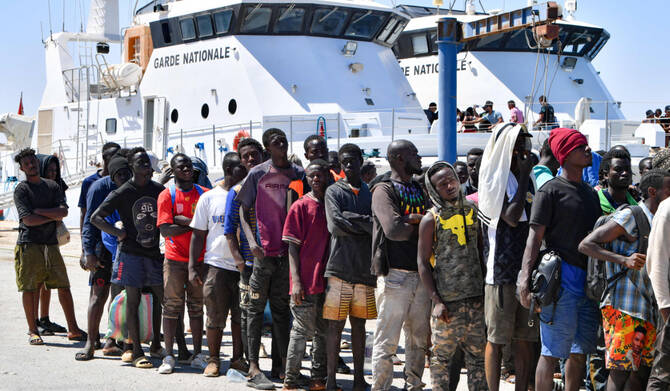
Migration is a sensitive issue in Tunisia, a key transit point for tens of thousands seeking to reach Europe each year.
The defendants were arrested in May 2024 along with about a dozen humanitarian workers, including members of French group Terre d’Asile and anti-racist organization Mnemty, who are awaiting trial.
In February 2023, President Kais Saied said “hordes of illegal migrants,” many from sub-Saharan Africa, posed a demographic threat to the Arab-majority country.
His speech triggered a series of racially motivated attacks as thousands of sub-Saharan African migrants in Tunisia were pushed out of their homes and jobs.
Thousands were repatriated or attempted to cross the Mediterranean, while others were expelled to the desert borders with Algeria and Libya, where at least a hundred died that summer.
This came as the European Union boosted efforts to curb arrivals, including a 255-million-euro ($290-million) deal with Tunis.


