

Nigeria announces renewed US security partnership

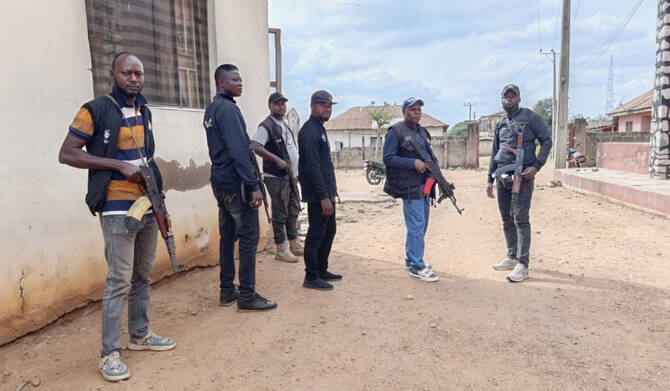
Police officers providing security hold weapons outside the Christ Apostolic Church during a Sunday service held for those killed and kidnapped in an attack by gunmen on November 18, in the town of Eruku, Kwara state, Nigeria, November 23, 2025. (REUTERS)
Short Url
Updated 24 November 2025
Follow

Nigeria announces renewed US security partnership

  • Nigeria has faced militancy in the northeast that has killed more than 40,000 people and displaced around 2 million since it broke out in 2009

LAGOS: Nigerian authorities announced Monday the country had strengthened its “security partnership” with the US, while again rejecting accusations of targeted persecution against Christians in the West African country.
The announcement follows US President Donald Trump’s threats of military intervention in early November over allegations that militants were “killing the Christians and killing them in very large numbers” in Nigeria.
A Nigerian delegation, including the National Security Adviser, Nuhu Ribadu, visited Washington last week to meet with senior US officials to discuss their concerns, according to a statement from Nigeria on Monday.

FASTFACTS

• A Nigerian delegation visited Washington last week to meet with senior US officials to discuss their concerns, according to a statement from Nigeria on Monday.

• While meeting with US officials, Nigerian authorities said they ‘refuted allegations of genocide’ against Christians, ‘emphasising that violent attacks affect families and communities across religious and ethnic lines.’

“Following these engagements, the US government affirmed its readiness to deepen security cooperation with Nigeria,” said the statement from Bayo Onanuga, special adviser to the Nigerian President Bola Tinubu.
He specified that the cooperation includes enhanced intelligence support, expedited processing of defense equipment requests and the “potential provision of excess defense articles.”
While meeting with US officials, Nigerian authorities said they “refuted allegations of genocide” against Christians, “emphasising that violent attacks affect families and communities across religious and ethnic lines,” according to the statement.
“The delegation strongly rejected wrongful framing of the situation, saying such would only divide Nigerians and distort the realities on the ground,” it added.
On Friday, the US Department of Defense said the two parties discussed ways to end violence against Christians and strengthen the fight against militants that has plagued much of the region.
Nigeria has faced militancy in the northeast that has killed more than 40,000 people and displaced around 2 million since it broke out in 2009.
The violence has spilt over into neighboring Niger, Chad and Cameroon, prompting the creation of a regional military force to fight the militants.
Nigeria has also faced violence led by “bandit” gangs in the northwest that commit kidnappings, village raids and killings.
Separately, Nigeria’s president on Sunday reassigned VIPs’ police bodyguards to core policing duties and ordered tens of thousands of new officers to be recruited due to a security crisis, his office said.
Tinubu “has ordered the withdrawal of police officers currently providing security for Very Important Persons,” said a statement from his office, adding that “many parts of Nigeria” are not adequately policed.
It said Tinubu also approved the recruitment of 30,000 additional police officers.
“In view of the current security challenges facing the country, President Tinubu is desirous of boosting police presence in all communities.”
A report published last month by the European Union Agency for Asylum said more than 100,000 of the estimated 371,000-strong force, were “assigned to the protection of politicians and VIPs, rather than to tasks serving the general population.”
“This shortage in manpower, as well as corruption and insufficient resources have resulted in delayed responses to crimes and numerous communities being left without protection,” said the report.


Palestinian protester, detained for nearly a year, says ‘inhumane’ jail conditions prompted seizure

Updated 5 sec ago
Follow

Palestinian protester, detained for nearly a year, says ‘inhumane’ jail conditions prompted seizure

A Palestinian woman who has been held in an immigration jail for nearly a year after she attended a protest in New York City said she suffered a seizure after fainting and hitting her head last week, an episode she linked to “filthy” and “inhumane” conditions inside the privately run detention facility.
Leqaa Kordia, 33, was hospitalized for three days following the seizure, which she said was the first of her life. She has since returned to the Prairieland Detention Facility in Texas, where she has been held since March.
In a statement released through her lawyers on Thursday, Kordia said she was shackled the entire time she was hospitalized and prevented from calling family or meeting with her lawyers.
“For three days in the emergency room, my hands and legs were weighed down by heavy chains as they drew my blood and gave me medications,” Kordia said. “I felt like an animal. My hands are still full of marks from the heavy metal.”
Her doctors, she said, told her the seizure may have been the result of poor sleep, inadequate nutrition and stress. Her lawyers previously warned that Kordia, a devout Muslim, had lost 49 pounds (22 kilograms) and fainted in the shower, in part because the jail had denied her meals that comply with religious requirements.
“I’ve been here for 11 months, and the food is so bad it makes me sick,” the statement continued. “At Prairieland, your daily life — whether you can have access to the food or medicine you need or even a good night’s sleep — is controlled by the private, for-profit business that runs this facility.”
Department of Homeland Security spokesperson Tricia McLaughlin didn’t immediately respond to a request for comment from The Associated Press, but said in a statement to The New York Times that Kordia wasn’t being mistreated and was receiving proper medical care.
A resident of New Jersey who grew up in the West Bank, Kordia was among around 100 people arrested outside Columbia University during protests at the school in 2024.
The charges against her were dismissed and sealed. But information about her arrest was later given to the Trump administration by the New York City police department, which said it was told the records were needed as part of a money laundering investigation.
Last year, Kordia was among the first pro-Palestinian protesters arrested in the Trump administration’s crackdown on noncitizens who had criticized Israel’s military actions in Gaza. She is the only one who remains jailed.
She has not been accused of a crime and has twice been ordered released on bond by an immigration judge. The government has challenged both rulings, an unusual step in cases that don’t involve serious crimes, which triggers a lengthy appeals process.
Kordia was taken into custody during a March 13 check-in with US Immigrations and Customs Enforcement. At the time, federal officials touted her arrest as part of the sweeping crackdown on pro-Palestinian campus activists, pointing to her 2024 arrest outside of Columbia as proof of “pro-Hamas” activities.
Kordia said she joined the demonstration after Israel killed scores of her relatives in Gaza, where she maintains deep personal ties. “My way of helping my family and my people was to go to the streets,” she told The Associated Press in October.
Federal officials have accused Kordia of overstaying her visa, while casting scrutiny on payments she sent to relatives in the Middle East. Kordia said the money was meant to help family members whose homes were destroyed in the war or were otherwise suffering.
An immigration judge later found “overwhelming evidence” that Kordia was telling the truth about the payments. Attorneys for Kordia say she was previously in the US on a student visa, but mistakenly surrendered that status after applying to remain in the country as the relative of a US citizen.
In her statement on Thursday, Kordia said the detention facility was “built to break people and destroy their health and hope.”
“The best medicine for me and everyone else here is our freedom,” she added.