MANILA: Philippine President Ferdinand Marcos Jr. refused to respond on Monday to an allegation by his estranged sister, a senator, that he has been a longtime drug addict whose cocaine dependence has undermined his governance, saying with a somber tone that he didn’t want to discuss a family rift in public.
Communications Undersecretary Claire Castro has said that Sen. Imee Marcos’ accusations against her own brother before a huge religious rally in Manila last week were “a web of lies,” and may have been a desperate attempt to distract ongoing investigations into a corruption scandal that may implicate her opposition allies in the Senate.
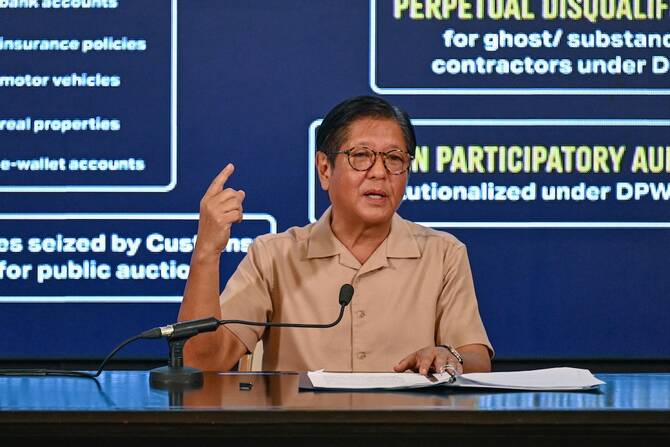
Aides have said in the past that Marcos Jr. had tested negative for cocaine and methamphetamine. When asked to respond to his elder sister’s allegations, the president briefly paused and then said in a televised news conference: “It’s anathema to talk about family matters generally in public. We do not like to show our dirty linen in public.”
The president suggested that something was troubling her sister. “The lady that you see talking on TV is not my sister and that view is shared by our cousins, friends, that it’s not her,” he said without elaborating.
“That’s why we are worried, we are very worried about her. I hope she feels better soon,” the president said. When asked if he plans to talk to her, Marcos said that he and his sister “no longer travel in the same circles, political or otherwise.”
Marcos, 68, and his sister are children of then dictator Ferdinand Marcos Sr., who was overthrown in an army-backed but largely peaceful “people power” uprising in 1986 after an authoritarian era that was notorious for human rights and political repression and plunder. The dictator died in exile in Hawaii in 1989. His family returned to the Philippines in 1991 and slowly regained a political foothold.
Marcos Jr. won the presidency in 2022 with a landslide margin in one of the greatest political comebacks in the Philippines.
In a speech Monday night before a huge rally by a religious group in a Manila park, Imee Marcos said that her brother’s drug addiction allegedly started when their father was still a president and has continued to this day. She claimed it has affected his health and ability to govern.
Imee Marcos is a high-profile ally of her brother’s harsh critic and predecessor, Rodrigo Duterte.
Duterte was arrested on an International Criminal Court warrant in March and flown to and detained in the Netherlands for alleged crimes against humanity over his brutal anti-drug crackdowns that left thousands of mostly poor suspects dead. Duterte has denied any wrongdoing.
Duterte’s family and allies, including Imee Marcos, have blamed Marcos Jr. for what they claim was the ex-president’s illegal arrest and detention by the global court. Duterte’s daughter, Vice President Sara Duterte, is also one of the most vocal critics of the current president but is a close ally of Imee Marcos.


![]()

Philippine president refuses to discuss family matters in public after sister’s drug allegation
Short Url
https://arab.news/9t2hv
Philippine president refuses to discuss family matters in public after sister’s drug allegation
- Presidential sister says Ferdinand Marcos Jr. has been a longtime drug addict whose cocaine dependence has undermined his governance


Latest updates


© 2026 SAUDI RESEARCH & PUBLISHING COMPANY, All Rights Reserved And subject to Terms of Use Agreement.