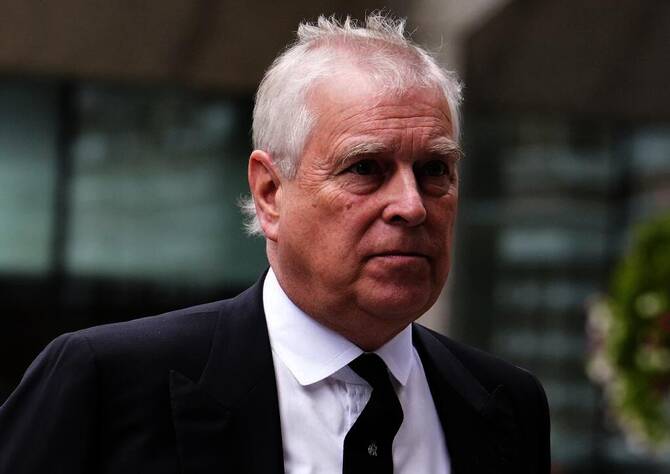
LONDON: Pressure is increasing for the former Prince Andrew to give evidence to a US congressional committee investigating the convicted sex offender Jeffrey Epstein after Britain’s prime minister suggested he should testify.
Keir Starmer declined to comment directly about King Charles III’s disgraced younger brother, but told reporters traveling with him for the Group of 20 summit in Johannesburg that as a “general principle” people should provide evidence to investigators.
“I don’t comment on his particular case,’’ Starmer said. “But as a general principle I’ve held for a very long time is that anybody who has got relevant information in relation to these kind of cases should give that evidence to those that need it.’’
The former prince, now known as Andrew Mountbatten-Windsor, has so far ignored a request from members of the House Oversight Committee for a “transcribed interview” about his “long-standing friendship” with Epstein. Andrew was stripped of his royal titles and honors last month as the royal family tried to insulate itself from criticism about his relationship with Epstein.
Starmer’s comments came after Rep. Robert Garcia of California, the committee’s ranking Democrat, and Rep. Suhas Subramanyam, a Democrat from Virginia, said Andrew “continues to hide” from serious questions.
“Our work will move forward with or without him, and we will hold anyone who was involved in these crimes accountable, no matter their wealth, status or political party,” they said in a statement released on Friday. “We will get justice for the survivors.”

UK leader suggests former Prince Andrew should testify in US investigation into Jeffrey Epstein
Short Url
https://arab.news/4vpyh
UK leader suggests former Prince Andrew should testify in US investigation into Jeffrey Epstein
- Pressure is increasing for the former Prince Andrew to give evidence to a US congressional committee
Why Somali migrants may still aim for US despite travel restrictions
MOGADISHU: Somali migrant Mohamed Abdi Awale endured horrors on an ill-fated journey across Africa to seek a better life in the West — but he’s determined to try again one day, even aiming for the US despite increasing restrictions.
Awale is one of 165 Somali migrants recently repatriated after being detained in Libya, where the International Organization for Migration says those caught on journeys to Europe face “unacceptable and inhumane conditions.”
Awale undertook a more than 5,000-kilometer (3,100-mile) journey, leaving Somali capital Mogadishu to cross Kenya, Uganda, South Sudan and Sudan.
He was captured by smugglers near the Sudan-Libyan border and taken to the Sahara oasis town of Kufra, where captors filmed him being tortured in a bid to extract a ransom from his family.
“Torture became normal,” Awale said. “If you failed to pay, they beat you until you fainted. Some people lost their minds. Others didn’t survive.”
Unable to afford the ransom, his mother, Hawo Elmo Rage, turned to social media, pleading with Somalis at home and abroad to help her save her son.
“They told me to send the money or they would take his life,” Rage said. She ultimately raised $17,000, enough to free him.
Awale was released from Kufra and put in a car bound for the Mediterranean coast with other migrants. After their vehicle broke down, the group trekked for more than two weeks, facing starvation and dehydration.
“I thought we would die there,” Awale said.
The group was then detained outside of Tripoli, and Awale spent a month in prison in the coastal town of Sirte and another two months in detention in Tripoli before his repatriation to Somalia in November.
Awale became one of hundreds of thousands of Somalis that have fled the country in more than three decades of civil war, according to UNHCR, the UN refugee agency, which estimates that another 3.5 million people are displaced within Somalia itself.
While most Somali refugees live in neighboring countries like Kenya, according to UNHCR, many like Awale have been inspired to seek a future in the West. Awale said that he dreamed of moving to the US since he was a child.
“I want him to stay,” his mother said. “But I know he wishes for a better life. I pray God gives him a safe future— not the dangerous one he found.”
Changes to immigration policy this year under Trump administration changed the calculus of migrants like Awale. US President Donald Trump banned travel to the US by citizens of Somalia and 11 other countries in June — so Awale set his sights on Europe.
Awale remains hopeful that he will reach the US one day, despite anti-Somali sentiment from the White House and a further tightening of immigration restrictions for Somalis.
The White House also announced this week that it was pausing all immigration applications for people from 19 countries, including Somalia.
“My dream was America, but I felt like Trump closed that door,” Awale said. “Maybe after Trump’s term ends.”
Awale is one of 165 Somali migrants recently repatriated after being detained in Libya, where the International Organization for Migration says those caught on journeys to Europe face “unacceptable and inhumane conditions.”
Awale undertook a more than 5,000-kilometer (3,100-mile) journey, leaving Somali capital Mogadishu to cross Kenya, Uganda, South Sudan and Sudan.
He was captured by smugglers near the Sudan-Libyan border and taken to the Sahara oasis town of Kufra, where captors filmed him being tortured in a bid to extract a ransom from his family.
“Torture became normal,” Awale said. “If you failed to pay, they beat you until you fainted. Some people lost their minds. Others didn’t survive.”
Unable to afford the ransom, his mother, Hawo Elmo Rage, turned to social media, pleading with Somalis at home and abroad to help her save her son.
“They told me to send the money or they would take his life,” Rage said. She ultimately raised $17,000, enough to free him.
Awale was released from Kufra and put in a car bound for the Mediterranean coast with other migrants. After their vehicle broke down, the group trekked for more than two weeks, facing starvation and dehydration.
“I thought we would die there,” Awale said.
The group was then detained outside of Tripoli, and Awale spent a month in prison in the coastal town of Sirte and another two months in detention in Tripoli before his repatriation to Somalia in November.
Awale became one of hundreds of thousands of Somalis that have fled the country in more than three decades of civil war, according to UNHCR, the UN refugee agency, which estimates that another 3.5 million people are displaced within Somalia itself.
While most Somali refugees live in neighboring countries like Kenya, according to UNHCR, many like Awale have been inspired to seek a future in the West. Awale said that he dreamed of moving to the US since he was a child.
“I want him to stay,” his mother said. “But I know he wishes for a better life. I pray God gives him a safe future— not the dangerous one he found.”
Changes to immigration policy this year under Trump administration changed the calculus of migrants like Awale. US President Donald Trump banned travel to the US by citizens of Somalia and 11 other countries in June — so Awale set his sights on Europe.
Awale remains hopeful that he will reach the US one day, despite anti-Somali sentiment from the White House and a further tightening of immigration restrictions for Somalis.
The White House also announced this week that it was pausing all immigration applications for people from 19 countries, including Somalia.
“My dream was America, but I felt like Trump closed that door,” Awale said. “Maybe after Trump’s term ends.”
© 2025 SAUDI RESEARCH & PUBLISHING COMPANY, All Rights Reserved And subject to Terms of Use Agreement.


