

Pakistan condemns Indian minister’s ‘revisionist’ remarks about Sindh province

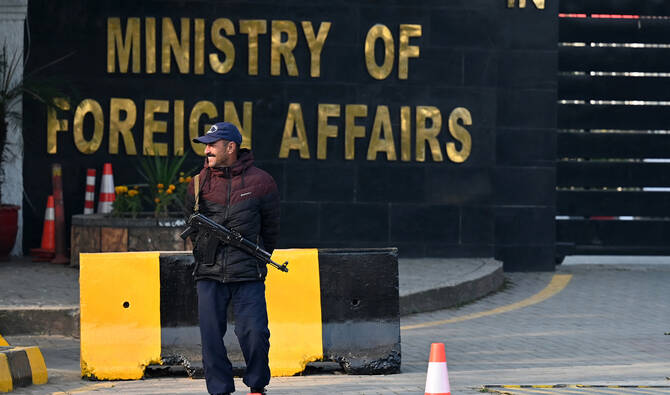
A Pakistani police officer stands guard outside the Ministry of Foreign Affairs in Islamabad on January 18, 2024. (AFP/File)
Short Url
Updated 23 November 2025
Follow

Pakistan condemns Indian minister’s ‘revisionist’ remarks about Sindh province

  • Rajnath Singh said ‘civilizationally, Sindh will always be a part of India and as far as land is concerned, borders can change’
  • Pakistan urges India to refrain from ‘provocative rhetoric,’ vows to safeguard its security, national independence and sovereignty

ISLAMABAD: The foreign office in Islamabad on Sunday condemned Indian Defense Minister Rajnath Singh’s “dangerously revisionist” remarks about Pakistan’s southern Sindh province, saying such statement reveal New Delhi’s “expansionist” designs.

Singh said that Sindhi Hindus from his generation never fully accepted the accession of the province to Pakistan in 1947, according to Indian media reports.

He said the province “will always be a part of India” civilizationally and that “who knows, tomorrow Sindh may return to India again” as borders can change, India’s The Hindu newspaper reported.

The Pakistani foreign office said such statements reveal the mindset that seeks to “challenge established realities and stands in clear violation of international law, the inviolability of recognized borders and the sovereignty of states.”

“We urge Mr. Rajnath Singh and other Indian leaders to refrain from provocative rhetoric that threatens regional peace and stability,” the Pakistani foreign office said, urging New Delhi to address grievances of marginalized communities and religious minorities in India.

“We call on India to take credible steps toward the genuine resolution of the Jammu and Kashmir dispute in accordance with UN Security Council resolutions and the aspirations of the Kashmiri people under occupation.”

Nuclear-armed India and Pakistan were carved out of the Indian subcontinent at the end of the British rule in 1947. The disputed Himalayan region of Kashmir has since been a flashpoint between the neighbors.

The two countries control part of the territory but claim it in full and have fought multiple wars over the region. Both engaged in a four-day military conflict in May over a militant attack in Indian-administered Kashmir that New Delhi blamed on Pakistan. Islamabad denied involvement.

The foreign office said that Pakistan remains committed to peaceful resolution of all disputes with India on the basis of justice, equity and established international legal norms.

“At the same time, as in the past, Pakistan is firmly resolved to safeguard its security, national independence and sovereignty,” it added.


Pakistan, global crypto exchange discuss modernizing digital payments, creating job prospects 

Updated 05 December 2025
Follow

Pakistan, global crypto exchange discuss modernizing digital payments, creating job prospects 

  • Pakistani officials, Binance team discuss coordination between Islamabad, local banks and global exchanges
  • Pakistan has attempted to tap into growing crypto market to curb illicit transactions, improve oversight

ISLAMABAD: Pakistan’s finance officials and the team of a global cryptocurrency exchange on Friday held discussions aimed at modernizing the country’s digital payments system and building local talent pipelines to meet rising demand for blockchain and Web3 skills, the finance ministry said.

The development took place during a high-level meeting between Finance Minister Muhammad Aurangzeb, Pakistan Virtual Assets Regulatory Authority (PVARA) Chairman Bilal bin Saqib, domestic bank presidents and a Binance team led by Global CEO Richard Teng. The meeting was held to advance work on Pakistan’s National Digital Asset Framework, a regulatory setup to govern Pakistan’s digital assets.

Pakistan has been moving to regulate its fast-growing crypto and digital assets market by bringing virtual asset service providers (VASPs) under a formal licensing regime. Officials say the push is aimed at curbing illicit transactions, improving oversight, and encouraging innovation in blockchain-based financial services.

“Participants reviewed opportunities to modernize Pakistan’s digital payments landscape, noting that blockchain-based systems could significantly reduce costs from the country’s $38 billion annual remittance flows,” the finance ministry said in a statement. 

“Discussions also emphasized building local talent pipelines to meet rising global demand for blockchain and Web3 skills, creating high-value employment prospects for Pakistani youth.”

Blockchain is a type of digital database that is shared, transparent and tamper-resistant. Instead of being stored on one computer, the data is kept on a distributed network of computers, making it very hard to alter or hack.

Web3 refers to the next generation of the Internet built using blockchain, focusing on giving users more control over their data, identity and digital assets rather than big tech companies controlling it.

Participants of the meeting also discussed sovereign debt tokenization, which is the process of converting a country’s debt such as government bonds, into digital tokens on a blockchain, the ministry said. 

Aurangzeb called for close coordination between the government, domestic banks and global exchanges to modernize Pakistan’s payment landscape.

Participants of the meeting also discussed considering a “time-bound amnesty” to encourage users to move assets onto regulated platforms, stressing the need for stronger verifications and a risk-mitigation system.

Pakistan has attempted in recent months to tap into the country’s growing crypto market, crack down on money laundering and terror financing, and promote responsible innovation — a move analysts say could bring an estimated $25 billion in virtual assets into the tax net.

In September, Islamabad invited international crypto exchanges and other VASPs to apply for licenses to operate in the country, a step aimed at formalizing and regulating its fast-growing digital market.