Pope urges release of 315 seized in Nigerian mass school kidnapping

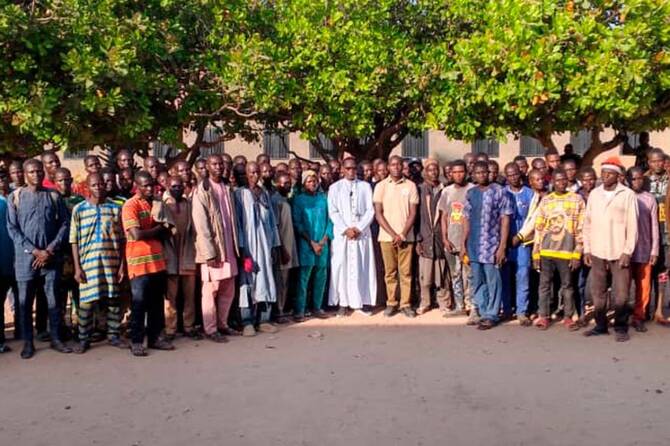
A photo shows relatives of abducted children pose for a photograph in the courtyard of St. Mary’s Catholic School in Papiri, Agwarra local government, Niger state. (Handout/AFP)
Short Url
Updated 23 November 2025
Follow

Pope urges release of 315 seized in Nigerian mass school kidnapping

  • Gunmen on Monday stormed a secondary school in Kebbi state, abducting 25 girls

VATICAN CITY: Pope Leo XIV called Sunday for the release of over 300 hostages taken from a Catholic school in one of the largest mass kidnappings in Nigeria.
“I learned with immense sadness the news of the kidnappings of priests, faithful, and students in Nigeria,” he said.
The Christian Association of Nigeria (CAN) on Saturday said gunmen had kidnapped more than 300 students and teachers in raids on two schools in the country.
“I make a heartfelt appeal for the immediate release of the hostages,” Leo said, expressing his “deep sorrow, especially for the many young boys and girls kidnapped and for their anguished families.”
“Let us pray for these brothers and sisters of ours and that churches and schools may always and everywhere remain places of safety and hope,” he said at the end of the Angelus prayer.
Gunmen on Monday stormed a secondary school in Kebbi state, abducting 25 girls. That was followed by an early Friday raid on St. Mary’s co-education school in Niger state.
The two abduction operations and an attack on a church in the west of the country, in which two people were killed and dozens abducted, came as US President Donald Trump threatened military action over what he called the persecution of Christians by radical Islamists in Nigeria.
Nigeria is still scarred by the kidnapping of nearly 300 girls by Boko Haram jihadists at Chibok in northeastern Borno state more than a decade ago. Some of those girls are still missing.


UK populist Farage targets Scottish town hit by immigration protests

Updated 3 sec ago
Follow

UK populist Farage targets Scottish town hit by immigration protests

  • The Brexit champion will host a “Scotland Needs Reform” event in Falkirk
  • The town has seen rival pro- and anti-immigration protests outside a hotel housing asylum seekers

FALKIRK, UK: Populist leader Nigel Farage will rally supporters in Scotland on Saturday, bidding to build on unexpectedly strong backing for his anti-immigration Reform UK party five months before elections to its devolved parliament.
The Brexit champion, whose party has been leading in UK-wide polls throughout the year, will host a “Scotland Needs Reform” event in Falkirk, northwest of the capital Edinburgh.
The town has seen rival pro- and anti-immigration protests outside a hotel housing asylum seekers, mirroring similar scenes in English towns and cities.
On the eve of Farage’s visit, some Falkirk voters voiced unease at the migrants being housed in its Cladhan Hotel since 2021.
“I don’t feel safe, I don’t feel comfortable,” retiree Karen, who declined to give her surname, told AFP.
“And that’s changed in the past few years, I would say, a lot.”
Farage’s planned two-hour rally at another Falkirk hotel follows Reform’s surprising rise in popularity among Scottish voters.
It has leapfrogged Labour — which governs in the UK parliament in London — to take second place behind the Scottish National Party (SNP) in several surveys focused on next May’s elections to the parliament in Edinburgh.
Reform UK, which has no leader and minimal political infrastructure in Scotland, won just seven percent of Scottish votes at the 2024 UK general election but is now regularly polling in the high teens.

- ‘Laying the ground’ -

It has been luring voters from the Conservatives and to, a lesser extent, Labour, according to political analysts.
They expect Reform to win its first Scottish Parliament seats on May 7, when a proportional voting system is used.
“They’ll be happy to have what could be more than a dozen Reform MSPs (Member of the Scottish Parliament) in Holyrood arguing the party’s case,” pollster John Curtice, politics professor at Glasgow’s University of Strathclyde, told AFP.
He added they would be “laying the ground for maybe going further in 2029” when the next UK-wide election is due and crucial Scottish constituencies will be up for grabs.
The party — formed in 2021 from the ashes of Farage’s Brexit Party — this week grabbed a massive financial boost after Thailand-based cryptocurrency investor and aviation entrepreneur Christopher Harborne gave it £9 million ($12 million).
Saturday is a rare visit north of the English border for Farage, 61, the veteran Euroskeptic who has long struggled for popularity among Scots.
In 2013, when leading his UK Independence Party (UKIP), police had to escort him from an Edinburgh pub after angry confrontations with opponents he later dubbed anti-English.

- ‘Niche market’ -

Scots overwhelmingly backed staying in the EU in the divisive 2016 Brexit referendum, making Farage an unpopular figure to many.
Dubbed an English nationalist by his critics, he has also long repelled supporters of Scottish independence from the UK.
His personal popularity remains low with 69 percent of Scots viewing him unfavorably, according to a November YouGov poll.
But Reform’s messaging appears to resonate with growing numbers in Scotland.
University of Edinburgh electoral politics lecturer Fraser McMillan said, like in England, it has established itself as a “protest vote against the mainstream parties” and “the most credible vehicle for socially conservative immigration attitudes.”
“There’s a relatively strong contingent of that in Scotland,” he told AFP.
However, it struggles to woo voters away from the SNP, who are typically pro-EU and back Scottish independence.
The SNP has governed in Edinburgh for nearly two decades and is expected to top the May 7 contest, but with a diminished vote share.
Curtice said the SNP was losing “virtually nothing” to Reform, whose rise was instead fragmenting the anti-independence vote.
Ultimately, Farage’s unpopularity among Scotland’s many Brexit opponents means he is tapping into “a niche market” of voters, Curtice told AFP.
“The ability of the party to do well in Scotland has to be lower than elsewhere,” he said.