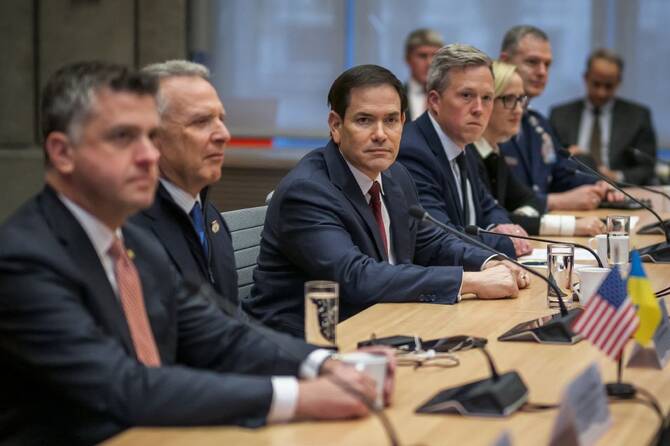

GENEVA: Washington and Kyiv said Sunday that any eventual deal to halt the war with Russia must fully uphold Ukraine’s sovereignty, after “constructive” talks between US, Ukrainian and European officials in Geneva.
After a day of meetings that kicked off based on a US proposal that was criticized as being in Russia’s favor, negotiators have drafted “an updated and refined peace framework,” a US-Ukraine joint statement said.
US President Donald Trump had given Ukraine until November 27 to approve his plan to end the nearly four-year conflict, which began after Russia launched a full-scale invasion.
But Kyiv was seeking changes to the draft that accepted a range of Russia’s hard-line demands, with the 28-point plan requiring the invaded country to cede territory, cut its army and pledge never to join NATO.
“The talks were constructive, focused, and respectful, underscoring the shared commitment to achieving a just and lasting peace,” the joint statement said.
“They reaffirmed that any future agreement must fully uphold Ukraine’s sovereignty and deliver a sustainable and just peace,” it said, noting “meaningful progress.”
Both sides pledged to keep working on joint proposals “in the coming days.”
But even as the White House said in a separate statement that the talks marked “a “significant step forward,” a Russian drone strike on the major Ukrainian city of Kharkiv killed four people, its mayor said.
US Secretary of State Marco Rubio boasted “tremendous” progress after a day of meetings, while the head of Ukraine’s delegation Andriy Yermak also told reporters the sides had made “very good progress.”
Rubio, whose delegation included Trump’s son-in-law Jared Kushner and diplomatic envoy Steve Witkoff, told reporters that the work to narrow the areas of disagreement had advanced “in a very substantial way.”
“I can tell you that the items that remain open are not insurmountable,” he said, adding “I honestly believe we’ll get there.”
Rubio stressed that any final agreement would “have to be agreed upon by the presidents, and there are a couple issues that we need to continue to work on” before trying to bring onboard the Kremlin, which welcomed the original proposal.
“Obviously, the Russians get a vote.”

Medical workers carry a body at the site of a building hit during Russian drone strikes, amid Russia's attack on Ukraine, in Kharkiv, Ukraine, on Nov. 23, 2025. (REUTERS)
‘Zero gratitude’ claim
His comments came after Trump earlier lashed out at Ukraine.
“UKRAINE ‘LEADERSHIP’ HAS EXPRESSED ZERO GRATITUDE FOR OUR EFFORTS,” Trump wrote on his Truth Social platform, also accusing European countries of not doing enough to stop the war, but offering no direct condemnation of Moscow.
Not long after, Ukrainian President Volodymyr Zelensky said on X that his country was “grateful to the United States... and personally to President Trump” for the assistance that has been “saving Ukrainian lives.”
Announcing a deadly Russian drone strike, Kharkiv mayor Igor Terekhov said on Telegram Sunday it was “truly horrible” that despite the negotiations, “Russian troops are attacking civilian objects, civilian infrastructure, residential buildings.”
The Ukrainian delegation had referred to a new version of the US draft plan, which has yet to be published, saying it “already reflects most of Ukraine’s key priorities.”
At the end of the day, Rubio said he thought Trump was “quite pleased at the reports we’ve given him about the amount of progress that’s been made.”
Asked about whether he believed a deal could be reached by Thursday, as demanded by the US president, he said “the deadline is we want to get this done as soon as possible.”
“I think we made a tremendous amount of progress. I feel very optimistic that we’re going to get there in a very reasonable period of time, very soon.”
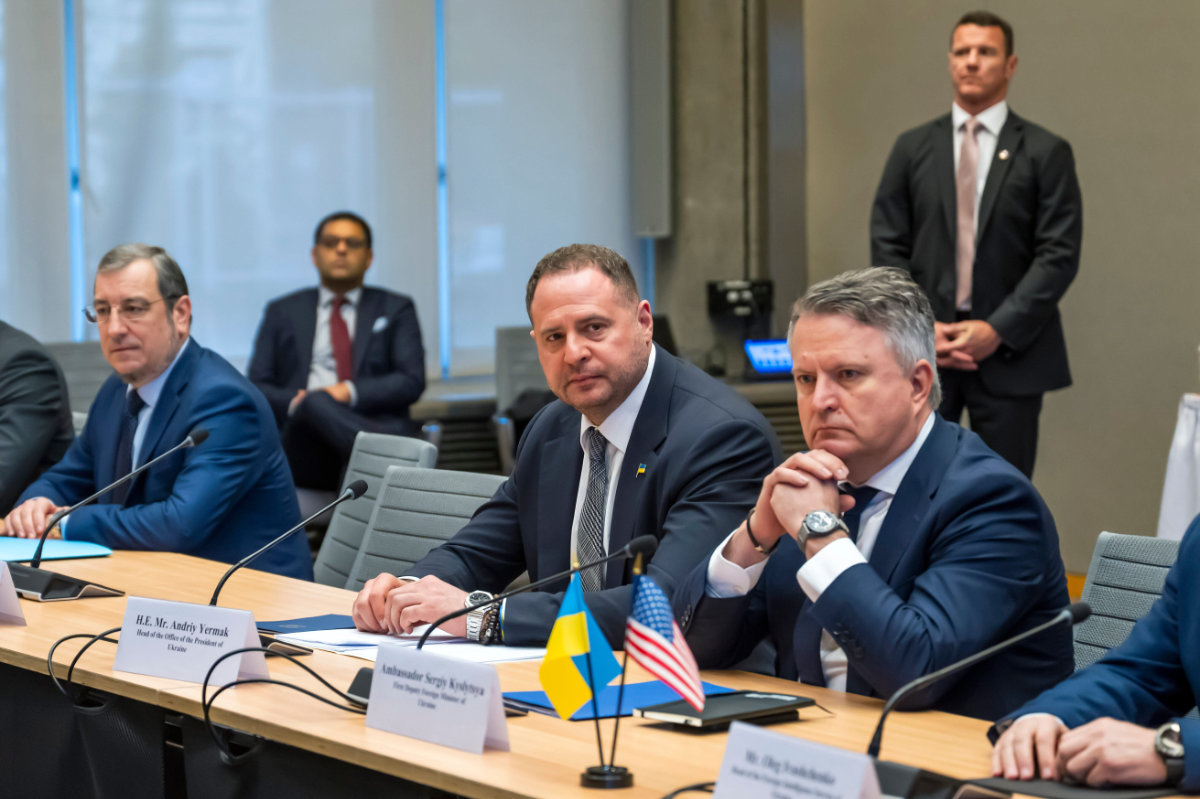
Head of the Office of the President of Ukraine Andriy Yermak, center, at the beginning of talks with the US delegation at the US Mission to International Organizations in Geneva, Switzerland, on Nov. 23, 2025. (Keystone via AP)
European ‘centrality’
Rubio said that his delegation had met Sunday with “national security advisers from various European countries.”
Ukraine’s delegation also met high-level officials from Britain, France and Germany.
The US plan was drafted without input from Ukraine’s European allies, who were scrambling Sunday to make their voices heard and boost Kyiv’s position.
“Ukraine must have the freedom and sovereign right to choose its own destiny. They have chosen a European destiny,” EU chief Ursula von der Leyen said in a statement, stressing that the “centrality” of the European Union’s role must be “fully reflected” in any peace plan.
A number of leaders called Trump Sunday, with Downing Street saying UK Prime Minister Keir Starmer and the US president had agreed “that we all must work together at this critical moment to bring about a just and lasting peace.”