At least 2 kids killed per day in Gaza since ceasefire: UNICEF

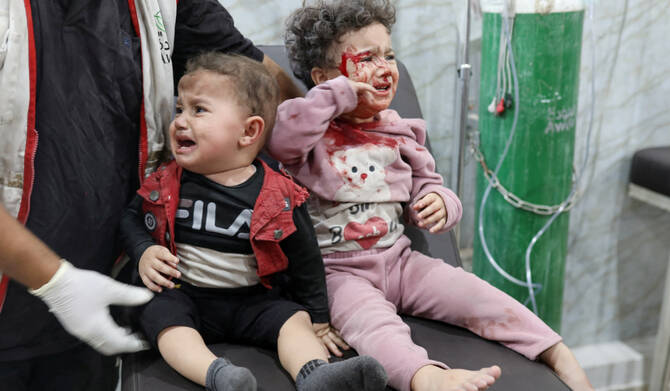
Palestinian children receive medical attention at Al-Awda Hospital, following an Israeli air strike, according to medics, in Gaza City November 22, 2025. (REUTERS)
Short Url
Updated 22 November 2025
Follow

At least 2 kids killed per day in Gaza since ceasefire: UNICEF

  • Medecins Sans Frontieres says it is treating women, children for fractures, gunshot wounds

GENEVA: At least 67 children have been killed in conflict-related incidents since the ceasefire began in Gaza, the United Nations children’s agency said.

“Dozens more have been injured. That is an average of almost two children killed every day since the ceasefire took effect,” UNICEF spokesperson Ricardo Pires said in Geneva.
UNICEF said on Thursday that a baby girl was killed in an airstrike in eastern Khan Younis in southern Gaza, alongside her parents. 
On Wednesday, seven children were killed in airstrikes in Gaza City and the south, UNICEF said.

FASTFACT

A nine-year-old girl was treated on Wednesday at a Gaza City hospital for an injury to her face caused by gunfire from an Israeli drone, MSF said, citing a nurse in Gaza.

Meanwhile, Medecins Sans Frontieres said that its medical teams in Gaza had treated Palestinian women and children this week for injuries from Israeli airstrikes and gunfire, almost six weeks into a fragile Israel-Hamas ceasefire.
Since Wednesday, medical staff in northern and southern Gaza have treated women and children with open fractures and gunshot wounds to their limbs and heads, according to Medecins Sans Frontieres, a charity also known as Doctors Without Borders.
MSF said that medical care had been provided in hospitals and clinics in Gaza City in the north and Rafah in the south.
A nine-year-old girl was treated on Wednesday at a Gaza City hospital for an injury to her face caused by gunfire from an Israeli drone, MSF said, citing a nurse in Gaza.
Under the ceasefire deal, Israel’s military pulled back to a so-called “yellow line,” leaving it in control of 53 percent of the Gaza Strip. Gaza City, the enclave’s largest urban area, is under Hamas control. Rafah is under Israeli control.
Both Israel and Hamas have accused each other of repeatedly violating the ceasefire, although it is still formally holding.
Israel’s military has said that since Oct. 10 it has killed individuals it described as “terrorists” crossing the yellow line, and carried out strikes it has said were in retaliation for attacks on its soldiers.
According to the Gaza Health Ministry, 312 Palestinians have been killed in Gaza by the Israeli military since Oct. 11.


GCC ambassadors hold discussions with Japan’s ruling party regarding Iran

Updated 8 sec ago
Follow

GCC ambassadors hold discussions with Japan’s ruling party regarding Iran

  • KONO Taro, head of the LDP’s international relations, participated in the high-level discussions alongside other senior officials
  • Dr. Ghazi Faisal Binzagr, Saudi Arabia’s ambassador to Japan, described the meeting as a timely opportunity to exchange views on the evolving regional situation

TOKYO: Gulf Cooperation Council (GCC) ambassadors met on Tuesday with leaders of Japan’s ruling Liberal Democratic Party (LDP) to explore deeper collaboration across multiple fields and tackle pressing issues related to Iran.

KONO Taro, head of the party’s international relations, participated in the high-level discussions alongside other senior officials.

Dr. Ghazi Faisal Binzagr, Saudi Arabia’s ambassador to Japan, described the meeting as a timely opportunity to exchange views on the evolving regional situation.

Ambassador Binzagr emphasized that during periods of heightened tension, open dialogue with trusted partners like Japan is essential. He noted that diplomacy and clear communication are vital for defusing conflict and maintaining regional stability.

Saudi Ambassador Binzagr further noted that the Gulf countries and Japan share a longstanding history of cooperation founded on mutual trust and common objectives of stability and prosperity. He stated, “In times such as these, it is precisely these enduring partnerships that allow constructive dialogue to prevail, and that help ensure that wisdom and restraint guide the path toward peace and stability in our region."

Kono underscored the strong bonds and active cooperation between Japan and the GCC, noting that Japan views its ties with the GCC as a strategic partnership.