WASHINGTON: President Donald Trump said Friday night that he’s “immediately” terminating temporary legal protections for Somali migrants living in Minnesota, further targeting a program seeking to limit deportations that his administration has already repeatedly sought to weaken.
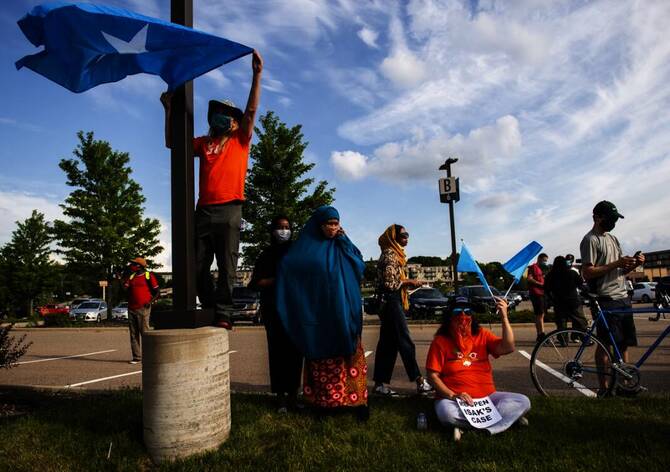
Minnesota has the nation’s largest Somali community. Many fled the long civil war in their east African country and were drawn to the state’s welcoming social programs.
But how many migrants would be affected by Trump’s announcement that he wants to end temporary protective status could be very small. A report produced for Congress in August put the number of Somalis covered by the program at just 705 nationwide.
Congress created the program granting Temporary Protective Status in 1990. It was meant to prevent deportations of people to countries suffering from natural disasters, civil strife or other dangerous conditions.
The designation can be granted by the Homeland Security secretary and is granted in 18-month increments.
The president announced his decision on his social media site, suggesting that Minnesota was “a hub of fraudulent money laundering activity.”
“Somali gangs are terrorizing the people of that great State, and BILLIONS of Dollars are missing. Send them back to where they came from,” Trump wrote. “It’s OVER!”
The Minnesota chapter of the Council on American-Islamic Relations said Trump’s decision “will tear families apart.” Executive Director Jaylani Hussein said in a statement late Friday, ”This is not just a bureaucratic change; it is a political attack on the Somali and Muslim community driven by Islamophobic and hateful rhetoric.”
Trump promised while campaigning to win back the White House last year that his administration would deport millions of people. As part of a broader push to adopt hard-line immigration policies, the Trump administration has moved to withdraw various protections that had allowed immigrants to remain in the United States and work legally.
That included ending TPS for 600,000 Venezuelans and 500,000 Haitians who were granted protection under President Joe Biden. The Trump administration has also sought to limit protections previously extended to migrants from Cuba and Syria, among other countries.

Trump says he’s terminating legal protections for Somali migrants in Minnesota
https://arab.news/4rxpj
Trump says he’s terminating legal protections for Somali migrants in Minnesota
- Minnesota has the largest Somali community in the US Many fled civil war in Somalia and were drawn to the state’s welcoming social programs
- The Temporary Protective Status program was created in 1990 to prevent deportations to dangerous countries
New ‘superfood’ transforms livelihoods in India’s rural east
- Known as fox nut or lotus seed, makhana is rich in protein, dietary fiber, minerals
- Most of the world’s makhana production is in Bihar, one of India’s poorest states
BIHAR: Wading through knee-deep, stagnant water, Mahesh Mukhia plunges his hands into the mud, pulling up handfuls of sludge that he and others toss into a large, partially submerged basket.
After a while, they shake the basket to drain away the water and debris. What remains is makhana — round black seeds that have lately gained popularity as India’s new superfood.
A regional Indian snack, also known as fox nut or lotus seed, makhana is the edible seed of the prickly waterlily. The plant grows in freshwater ponds and wetlands in southern and eastern Asia.
After makhana seeds are handpicked from pond beds, cleaned, and sun-dried, they are roasted at high heat so their hard black shells crack open and release the white, popcorn-like puffed kernels, which are eaten as snacks or used in dishes.
It has long been known for its nutritional value — high in plant-based protein and dietary fiber, the seeds are also rich in minerals and gluten-free — which over the past few years have helped it gain global attention and are transforming farmlands in Bihar, one of India’s poorest states.
“Earlier, people were not researching it but now, after research, makhana’s nutritional values have been highlighted. Now this is a superfood. That’s why demand is growing everywhere,” said Mahesh Mukhia, a farmer in Kapchhahi village in Bihar’s Darbhanga district, whose family has been harvesting the seeds for generations.
“The difference is that my forefathers did farming in a traditional way, but we’ve learnt to do it in a scientific way,” Mukhia told Arab News.
“There is Bhola Paswan Shastri Agricultural College in the neighboring Purnea district. I went there for training. After I started practicing farming the way I learnt, the yield increased by more than 30 percent.”
Makhana farming is highly labor-intensive, starting with the cultivation of water lilies in shallow ponds. The plants require constant monitoring as they are sensitive to water levels and pests.
Harvesting takes place between August and October. Workers pluck the seeds by hand and then dry them under the sun for several days before they can be processed.
The processing and roasting of makhana also require significant effort. The dried seeds are first de-shelled by manually cracking them, followed by multiple rounds of roasting to make them crisp.
Whole families are involved in the production, which has been expanding since 2020, when the state government introduced the Makhana Development Scheme.
Besides training in farming and processing, growers who cultivate fox nut receive $820 per hectare.
“The rate has also gone up. The makhana that we used to sell at 200-300 ($2-$3) rupees per kg is now selling at 1,000 ($12) or 1,500 rupees per kg,” Mukhia said.
“Makhana farmers are now making a profit. Those who are growing makhana are earning well, those who are popping it are also doing well, and those involved in trading are making profits too. We are getting good demand from everywhere. I just received an order for 25 tonnes recently.”
Bihar currently produces over 85 percent of India’s makhana and accounts for most of the world’s production, according to Ministry of Commerce and Industry estimates.
According to reports by the Indian Brand Equity Foundation and the Agricultural and Processed Food Products Export Development Authority, India accounts for roughly 85 to 90 percent of the world’s production.
Farmland where the crop is grown has increased many times over the past decade and can now be compared to the area covering half of New York City.
More than 600,000 people are involved in the makhana industry in Bihar, according to Niraj Kumar Jha, Darbhanga district’s horticulture officer.
“Earlier, we were cultivating 5,000 hectares in the Kosi and Mithlanchal regions. But now it has expanded to 35,000 hectares, and with many supportive schemes, farmers are increasingly encouraged to grow makhana,” he said.
“We are strengthening our marketing channels. We’ll reach the metro cities as well as world markets ... We can see that makhana is growing very popular, not only in India.”


