G20 leaders meet in South Africa seeking agreement, despite US boycott

1 / 3
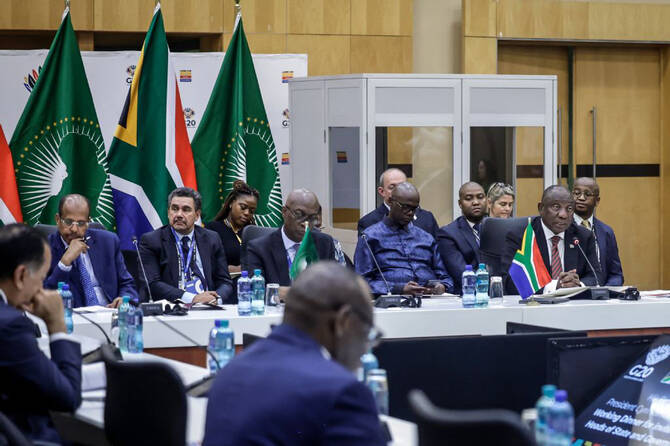
South Africa's President Cyril Ramaphosa delivers remarks during a working dinner for invited African heads of state and government at the Sandton Convention Centre on November 21, 2025, ahead of the G20 leaders' Summit. (AFP)
2 / 3
South Africa's President Cyril Ramaphosa (2nd R) delivers remarks during a working dinner for invited African heads of state and government at the Sandton Convention Centre in Sandton on November 21, 2025, ahead of the G20 leaders' Summit. (AFP)
3 / 3
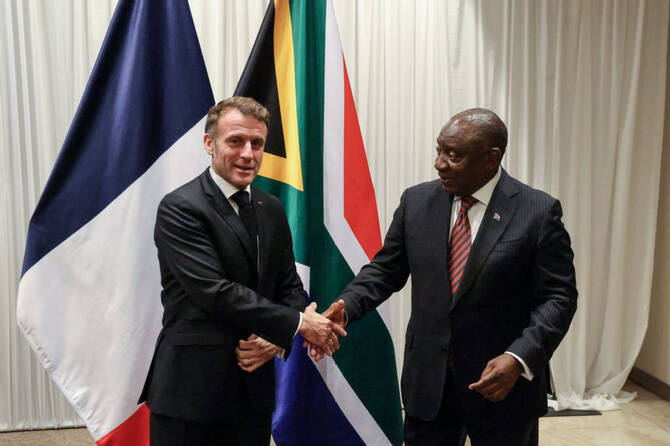
France’s President Emmanuel Macron (L) shakes hands with South Africa's President Cyril Ramaphosa (R) during their bilateral meeting at the Sandton Convention Centre in Sandton on November 21, 2025, ahead of the G20 leaders' Summit. (POOL / AFP)
Short Url
Updated 22 November 2025
Follow

G20 leaders meet in South Africa seeking agreement, despite US boycott

  • US boycotts summit over alleged persecution of white South Africans
  • Climate change a contentious issue in summit discussions

JOHANNESBURG : Leaders of the Group of 20 top economies gathered for a US-boycotted summit in South Africa on Saturday, seeking a deal on a draft declaration drawn up without US input in a surprise move that a senior White House official described as “shameful.”
G20 envoys have agreed on a draft leaders’ declaration ahead of the weekend summit in Johannesburg, in which several of the top agenda items are about climate change. The draft was drawn up without seeking US consensus, four sources familiar with the matter said on Friday.
One of those sources confirmed late on Friday that the draft made references to climate change, despite objections from the administration of US President Donald Trump, who doubts the scientific consensus that warming is caused by human activities.


UN Secretary-General Antonio Guterres attends a media briefing inside the G20 Summit venue at the Nasrec Expo Centre, ahead of the summit in Johannesburg, South Africa, on November 21, 2025. (REUTERS)

Trump has indicated that it will boycott the summit because of allegations, widely discredited, that the host country’s Black majority government persecutes its white minority.
The US president has also rejected the host nation’s agenda of promoting solidarity and helping developing nations adapt to weather disasters, transition to clean energy and cut their excessive debt costs.
The boycott had put a dampener on President Cyril Ramaphosa’s plans to trumpet South Africa’s role in promoting multilateral diplomacy, but some analysts suggested it might benefit it, if other members embrace the summit’s agenda and make headway on a substantive declaration.
It was not clear what concessions had to be made on the language to get everyone to agree. The United States had objected to any mention of climate or renewable energy in the discussion, and some other members are often reticent about it.
Three out of four of South Africa’s planned top agenda items — preparing for climate-induced weather disasters, financing the transition to green energy, and ensuring the rush for critical minerals benefits producers — are largely about climate change.
The fourth is about a more equitable system of borrowing for poor countries.
The United States will host the G20 in 2026 and Ramaphosa said he would have to hand over the rotating presidency to an “empty chair.” The South African presidency has rejected the White House’s offer to send the US charge d’affaires for the G20 handover.


US allows oil majors to broadly operate in Venezuela, new energy investments

Updated 53 min 59 sec ago
Follow

US allows oil majors to broadly operate in Venezuela, new energy investments

  • Treasury Department issues general license allowing Chevron, BP, Eni, Shell and Repsol to operate oil and gas operations in Venezuela
  • Move is the most significant relaxation of sanctions on Venezuela since US forces captured and removed President Nicolas Maduro

WASHINGTON: The US ​eased sanctions on Venezuela’s energy sector on Friday, issuing two general licenses that allow global energy companies to operate oil and gas projects in the OPEC member and for other companies to negotiate contracts to bring in fresh investments. The move was the most significant relaxation of sanctions on Venezuela since US forces captured and removed President Nicolas Maduro last month.
The Treasury Department’s Office of Foreign Assets Control issued a general license allowing Chevron, BP, Eni, Shell and Repsol to operate oil and gas operations in Venezuela. Those companies still have offices in the country and stakes in projects, and are among the main partners of state-run ‌company PDVSA.
The authorization ‌for the oil majors’ operations requires payments for royalties and Venezuelan ​taxes ‌to ⁠go through ​the US-controlled ⁠Foreign Government Deposit Fund.
The other license allows companies around the world to enter contracts with PDVSA for new investments in Venezuelan oil and gas. The contracts are contingent on separate permits from OFAC.
The authorization does not allow transactions with companies in Russia, Iran, or China or entities owned or controlled by joint ventures with people in those countries.
The licenses “invite American and other aligned companies to play a constructive role in supporting economic recovery and responsible investment, ” the US State Department said in a release. Additional authorizations may be issued “as necessary,” it said.
A spokesperson for Chevron, ⁠the only US oil firm currently operating in Venezuela, said the company welcomed ‌the new licenses.
“The new General Licenses, coupled with recent changes ‌in Venezuela’s Hydrocarbons Law, are important steps toward enabling the further development ​of Venezuela’s resources for its people and for advancing ‌regional energy security,” the spokesperson said in a statement.
Eni said it is assessing the opportunities in ‌Venezuela that the authorization opens up.

Oil law reform

The US licenses follow a sweeping reform of Venezuela’s main oil law approved last month, which grants autonomy for foreign oil and gas producers to operate, export and cash sale proceeds under existing joint ventures with PDVSA or through a new production-sharing contract model.
The US has had sanctions on Venezuela since ‌2019 when President Donald Trump imposed them during his first administration. Trump is now seeking $100 billion in investments by energy companies in Venezuela’s oil and gas sector. ⁠US Energy Secretary Chris Wright ⁠said on Thursday, during his second day of a trip to Venezuela, that oil sales from the country since Maduro’s capture have hit $1 billion and would hit another $5 billion in months.
Wright said the US will control the proceeds from the sales until Venezuela stands up a “representative government.” Since last month, the Treasury issued several other general licenses to facilitate oil exports, storage, imports and sales from Venezuela. It also authorized the provision of US goods, technology, software or services for the exploration, development or production of oil and gas in Venezuela.
The Venezuelan government expropriated assets of Exxon Mobil and ConocoPhillips in 2007 under then-President Hugo Chavez. The Trump administration is trying to get those companies to invest in Venezuela as well. At a meeting at the White House with Trump last month, Exxon Mobil CEO Darren Woods said Venezuela was “uninvestable” at ​the moment.
Wright said on Thursday that Exxon, ​which no longer has an office in Venezuela, is in talks with the government there and gathering data about the oil sector. Exxon did not immediately comment.