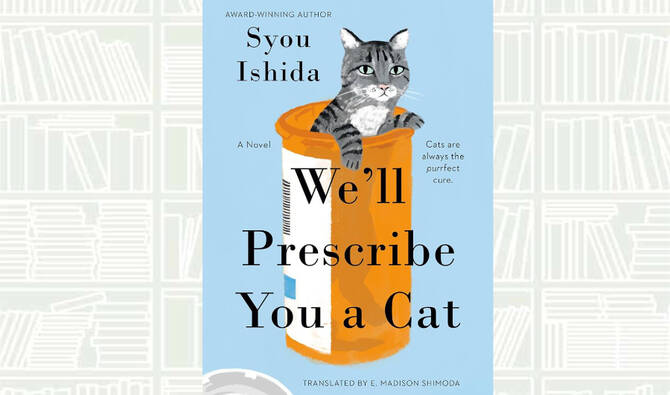
What We Are Reading Today: ‘We’ll Prescribe You a Cat’

Photo/Supplied
Short Url
Updated 21 November 2025
Follow

What We Are Reading Today: ‘We’ll Prescribe You a Cat’

  • The stories are mischievously stretched across five chapters, each dedicated to a cat: Bee, Margot, Koyuki, Tank and Tangerine, and Mimita

In the wildly popular 2024 Japanese novel “We’ll Prescribe You a Cat,” penned by award-winning Kyoto-born Japanese author Syou Ishida and translated into English by E. Madison Shimoda, you will go on a quick, quirky ride set in Kyoto that is cat-centric, playful and surprisingly relatable.

At the heart of it is the Kokoro Clinic for the Soul, a peculiar place that seemingly appears and disappears at will. It is visible only to those truly in need of some serious healing.

Once you eventually find it, you are greeted by a particularly heavy door and a doctor who seems to laugh at almost everything.

At the end of each visit, the reluctant “patient” is handed a prescription: a cat they are meant to take home for an average dose of 10 days. A paper bag of cat food and personalized instructions on how to deal with the animal are to be picked up on the way out.

None of these new pet guardians feel like their chosen cat would last that long. And they would all be right — by being wrong.

The stories are mischievously stretched across five chapters, each dedicated to a cat: Bee, Margot, Koyuki, Tank and Tangerine, and Mimita.

The number five, which is constantly repeated throughout the book, seems to carry cultural weight in Japan, suggesting balance and harmony, such as with the five senses and the five elements.

“Cats can solve most problems,” says the doctor. Often they create the very same problems they later seemingly solve.

One story follows an overworked man with insomnia; another shows a woman learning to trust herself, a theme common to all the tales. The stories gradually go from simple to the more complex.

Each tale stands alone, yet all explore the same theme: how felines can both wreck and restore a life, often simultaneously, leaving a paw-shaped mark along the way.

The book somehow avoids being too cutesy or kitschy. You will feel like you want to spend all nine lives with these five stories.

After flipping to the final page, you will likely want to linger longer. Not to worry, there is already a sequel, “We’ll Prescribe You Another Cat," which I will definitely crawl into next.

Volume three in the series has also already been released in Japan and will be published in English soon as “Welcome to the Kokoro Cat Clinic.”


Book Review: ‘The Penguin Book of Polish Short Stories’

Updated 05 December 2025
Follow

Book Review: ‘The Penguin Book of Polish Short Stories’

  • In 39 stories spanning the last century to the present day, this collection gathers short stories by writers who lived in different eras and different worlds


If there was ever a book published in 2025 that encapsulates the spirit and diversity of Polish writing, it is “The Penguin Book of Polish Short Stories,” an anthology edited and translated by Antonia Lloyd-Jones and published by Penguin.

In 39 stories spanning the last century to the present day, this collection gathers short stories by writers who lived not only in different eras, but in literally — and figuratively — different worlds.

From the oldest story in this book: “A New Love,” by Jaroslaw Iwaszkiewicz from 1925, to the newest: “The Isles,” which was written specifically for the anthology in late 2023, by Dorota Maslowska, the collection spans and expands to various timelines and moods.

The impact over the 100 years is huge. The book offers different political, legal and ideological systems.

The book had a herculean task to fully understand the context and nuances of the various eras; the First World War, the Second Polish Republic — the 20-year period of Polish independence between the two world wars — the Second World War, and beyond.

This anthology is curated in such a way that it covers the growth of a country that had been drenched in horrors, but also in joy — and everything in between.

The introduction explains: “This is a book for any English-language reader who likes short stories, and who is interested in exploring Polish short stories in particular.”

It goes on to explain that no previous knowledge of Polish literature is required in order to comprehend and appreciate the stories contained within.

Polish literature, and especially fiction, had not been “very familiar” to English-language readers, the book states, despite three Nobel prizes and literature since 1980. 

The critically acclaimed 63-year-old Polish author and activist Olga Tokarczuk — perhaps most known for winning a Nobel Prize in Literature in 2018 — wrote the preface.

“You may have random and unrelated cause to remember these stories many years from now, even if you’ve forgotten the names of their authors, and the impressions they leave will allow you to see Polish literature as an integral, rather than a peripheral part of the world’s humanist-and-cultural heritage,” Tokarczuk writes.