

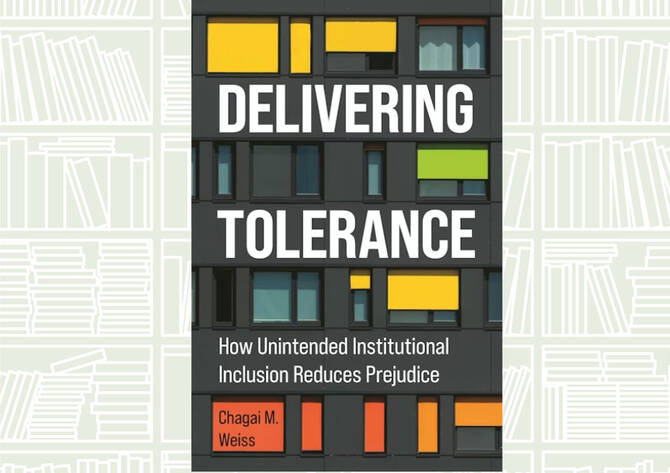
What We Are Reading Today: ‘Delivering Tolerance’ by Changai Weiss

Short Url
Updated 21 November 2025
Follow

What We Are Reading Today: ‘Delivering Tolerance’ by Changai Weiss

Decades of social science research focuses on reducing prejudice, which is considered an impediment to intergroup cooperation.

Reducing prejudice is notoriously challenging, however, because it is durable and because it motivates avoidance of experiences that would improve intergroup relations.

In “Delivering Tolerance,” Chagai Weiss argues that instrumental, and often unintended, minority inclusion in public institutions that provide essential services can facilitate various forms of exposure to out-group service providers that reduces prejudice at scale.


Book Review: ‘The Penguin Book of Polish Short Stories’

Updated 05 December 2025
Follow

Book Review: ‘The Penguin Book of Polish Short Stories’

  • In 39 stories spanning the last century to the present day, this collection gathers short stories by writers who lived in different eras and different worlds


If there was ever a book published in 2025 that encapsulates the spirit and diversity of Polish writing, it is “The Penguin Book of Polish Short Stories,” an anthology edited and translated by Antonia Lloyd-Jones and published by Penguin.

In 39 stories spanning the last century to the present day, this collection gathers short stories by writers who lived not only in different eras, but in literally — and figuratively — different worlds.

From the oldest story in this book: “A New Love,” by Jaroslaw Iwaszkiewicz from 1925, to the newest: “The Isles,” which was written specifically for the anthology in late 2023, by Dorota Maslowska, the collection spans and expands to various timelines and moods.

The impact over the 100 years is huge. The book offers different political, legal and ideological systems.

The book had a herculean task to fully understand the context and nuances of the various eras; the First World War, the Second Polish Republic — the 20-year period of Polish independence between the two world wars — the Second World War, and beyond.

This anthology is curated in such a way that it covers the growth of a country that had been drenched in horrors, but also in joy — and everything in between.

The introduction explains: “This is a book for any English-language reader who likes short stories, and who is interested in exploring Polish short stories in particular.”

It goes on to explain that no previous knowledge of Polish literature is required in order to comprehend and appreciate the stories contained within.

Polish literature, and especially fiction, had not been “very familiar” to English-language readers, the book states, despite three Nobel prizes and literature since 1980. 

The critically acclaimed 63-year-old Polish author and activist Olga Tokarczuk — perhaps most known for winning a Nobel Prize in Literature in 2018 — wrote the preface.

“You may have random and unrelated cause to remember these stories many years from now, even if you’ve forgotten the names of their authors, and the impressions they leave will allow you to see Polish literature as an integral, rather than a peripheral part of the world’s humanist-and-cultural heritage,” Tokarczuk writes.