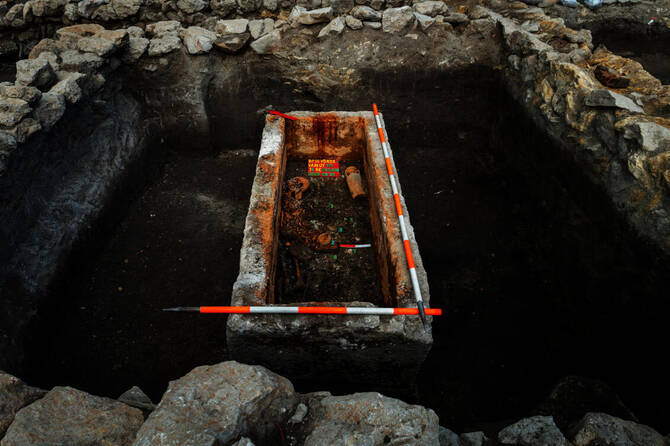
BUDAPEST: A remarkably well-preserved Roman sarcophagus has been unearthed in Hungary’s capital, offering a rare window into the life of the young woman inside and the world she inhabited around 1,700 years ago.
Archaeologists with the Budapest History Museum discovered the limestone coffin during a large-scale excavation in Obuda, a northern district of the city that once formed part of Aquincum, a bustling Roman settlement on the Danube frontier.
Untouched by looters and sealed for centuries, the sarcophagus was found with its stone lid still fixed in place, secured by metal clamps and molten lead. When researchers carefully lifted the lid, they uncovered a complete skeleton surrounded by dozens of artifacts.
“The peculiarity of the finding is that it was a hermetically sealed sarcophagus. It was not disturbed previously, so it was intact,” said Gabriella Fenyes, the excavation’s lead archaeologist.
The coffin lay among the ruins of abandoned houses in a quarter of Aquincum vacated in the 3rd century and later repurposed as a burial ground. Nearby, researchers uncovered a Roman aqueduct and eight simpler graves, but none approaching the richness or pristine condition of the sealed tomb.
Keeping with Roman funerary customs, the sarcophagus held an array of objects: two completely intact glass vessels, bronze figures and 140 coins. A bone hair pin, a piece of amber jewelry and traces of gold-threaded fabric, along with the size of the skeleton, point to the grave belonging to a young woman.
The objects, Fenyes said, were “items given to the deceased by her relatives for her eternal journey.”
“The deceased was buried very carefully by her relatives. They must have really loved who they buried here,” she said.
During the Roman period, much of what is now Hungary formed the province of Pannonia, whose frontier ran along the right bank of the Danube River less than a mile (1.6 kilometers) from the site. A short distance away stood a legionary camp guarding the empire’s border, and the newly found structures are believed to have been part of the civilian settlement that grew around it.
Anthropologists will now examine the young woman’s remains, a process expected to reveal more about her age, health and origins. But even now, the grave’s placement and abundance of artifacts offer strong clues.
The sarcophagus and its contents “definitely make it stand out,” said Gergely Kostyal, a Roman-period specialist and coleader of the project. “This probably means that the deceased was well-to-do or of a higher social status.”
“It is truly rare to find a sarcophagus like this, untouched and never used before, because in the fourth century it was common to reuse earlier sarcophagi,” he added. “It is quite clear that this sarcophagus was made specifically for the deceased.”
Excavators also removed a layer of mud roughly 4 centimeters (1.5 inches) thick from inside the coffin that Fenyes hopes could contain more treasures.
“I suspect we could find jewelry. We haven’t found any earrings or other jewelry belonging to the woman, so I hope that these small items will turn up during the sifting of the mud,” she said.
For Fenyes, the discovery of the Roman sarcophagus is not only of scientific significance, but an emotionally resonant insight into the devotion displayed by people in an ancient time.
“I was very touched by the care and expression of love that we were able to get a glimpse of,” she said. “Even now, I shudder to think how painful it must have been for the people at that time to bury this young lady.”


![]()

Archaeologists lift the lid on a 1,700-year-old Roman sarcophagus hidden beneath Budapest
Short Url
https://arab.news/nbh6v
Archaeologists lift the lid on a 1,700-year-old Roman sarcophagus hidden beneath Budapest
- Archaeologists with the Budapest History Museum discovered the limestone coffin during a large-scale excavation in Obuda
- Untouched by looters and sealed for centuries, the sarcophagus was found with its stone lid still fixed in place


Latest updates


© 2026 SAUDI RESEARCH & PUBLISHING COMPANY, All Rights Reserved And subject to Terms of Use Agreement.