

Youth activist turning trauma into treatment in Lebanon

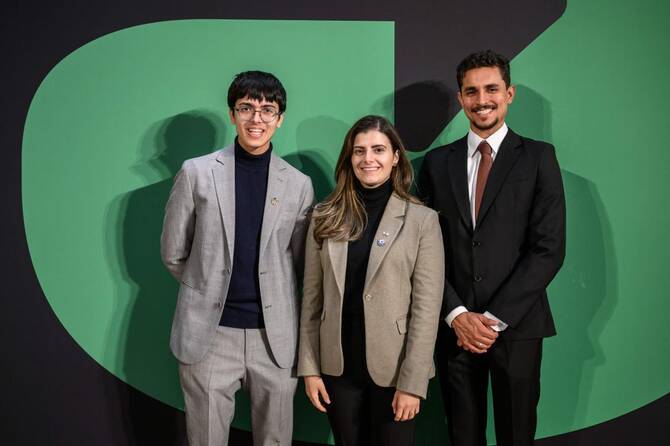
(From L) Young activists India’s Dev Karan, Lebanon’s Marina El Khawand and Brazil’s Salvino Oliveira pose on the eve of the Young Activists Summit award ceremony at the UN in Geneva, on Nov. 19, 2025. (AFP)
Short Url
Updated 20 November 2025
Follow

Youth activist turning trauma into treatment in Lebanon

  • Now a lawyer, Khawand recalls hesitating outside the door, fearful of what she might find inside
  • “I entered and I saw an old lady, pale and not moving,” she said, describing the relief she felt when she saw a slight movement in the woman’s chest

GENEVA: Marina El Khawand was 18 when she saw her home town of Beirut shattered by the giant 2020 port explosion and decided she needed to help.
Today, at 24, she is among five laureates at Thursday’s Young Activists Summit awards at the UN in Geneva, and described how the trauma of that day spawned a movement that has helped provide free medication and consultation to thousands in need.
“I needed to do something,” said Khawand, who was starting her second year of law school when the explosion ripped through large parts of Beirut.
In the chaos of the blast, which claimed more than 220 lives, her family urged her to leave the country to continue her studies abroad.
But she told AFP in an interview that she decided to volunteer at the explosion site for a few days before leaving.
“I was traumatized... I walked between dead bodies, there was blood everywhere,” she said, describing feeling powerless — unable to offer much help.

- ‘War zone’ -

But one day she ventured alone to one of the heaviest hit neighborhoods, Karantina, which was like “a war zone,” and went into a building in search of a sick, elderly woman who had refused to evacuate.
Now a lawyer, Khawand recalls hesitating outside the door, fearful of what she might find inside.
“I entered and I saw an old lady, pale and not moving,” she said, describing the relief she felt when she saw a slight movement in the woman’s chest.
She noticed an empty medication distributor in the woman’s hand, and recognized it as the same asthma inhaler her mother used.
Khawand quickly snapped a picture of the dosage and rushed to get a new one.
But Lebanon’s health care system had taken a hit after the country’s economy went into free fall in 2019, plunging many into poverty and sparking medication shortages.
She visited three pharmacies without any luck, shocked to find that such a common medication was so hard to come by.
She thought: “This woman survived the explosion... I cannot accept that she will die because she doesn’t have her medication.”
Her mother did not have the same dosage as the woman, so Khawand determined that her best shot was to post an appeal on Instagram.
An influencer she had tagged called her two hours later to tell her she had secured 12 boxes.

- ‘Health beyond borders’ -

“I was stunned,” Khawand said, describing her panicked rush to get the medication to the woman in time.
After taking a few puffs on the inhaler, the woman gave Khawand “the most heartfelt hug.”
“She whispers in my ear: Thank you for saving my life,” Khawand said, tears glistening in her eyes.
“That sentence changed me,” she said, describing it as the moment she realized “my purpose in life would be to save lives.”
After that experience, Khawand founded the Medonations non-profit aimed at providing free and equal medical assistance to vulnerable communities in Lebanon.
Growing in the past five years to have collection points in over 65 countries, it says it has served more than 25,000 families across Lebanon with medical supplies and surgeries.
Khawand’s team also provided oxygen machines during the Covid-19 pandemic, and during last year’s deadly war between Israel and Hezbollah, helped provide displaced people with sanitary products, diapers, and medication.
She has also set up the Free HealthTech Clinic, with kits containing advanced AI-integrated devices enabling doctors to examine patients remotely, assess their prescriptions and adjust their medication.
“The doctor can be in Switzerland, the patient can be in Lebanon, and they can see the vital signs in real time,” Khawand said.
“It’s health beyond borders.”


US officials say Gaza stabilization force will not fight Hamas

Updated 8 sec ago
Follow

US officials say Gaza stabilization force will not fight Hamas

  • An American two-star general is under consideration to lead the ISF, but no decision has been made, officials said

NEW YORK: International troops could be deployed in the Gaza Strip as early as next month to form a UN-authorized stabilization force, two US officials said, but it remains unclear how Hamas will be disarmed.
Officials said the International Stabilization Force, or ISF, would not fight Hamas. 
They said many countries have expressed interest in contributing, and US officials are currently working out the size of the ISF, its composition, housing, training, and rules of engagement.

There is a lot of quiet planning that’s going on behind the scenes right now for phase two of the peace deal.

Karoline Leavitt, White House spokesperson

An American two-star general is under consideration to lead the ISF, but no decision has been made, officials said.
Deployment of the force is a key part of the next phase of US President Donald Trump’s Gaza peace plan. 
Under the first phase, a fragile ceasefire in the two-year war began on Oct.10, and Hamas released hostages, and Israel freed detained Palestinians.
“There is a lot of quiet planning that’s going on behind the scenes right now for phase two of the peace deal,” White House spokesperson Karoline Leavitt said. 
“We want to ensure an enduring and lasting peace.”
Indonesia has said it is prepared to deploy up to 20,000 troops to take on health and construction-related tasks in Gaza.
“It is still in the planning and preparation stages,” said Rico Sirait, spokesperson of the Indonesian Defense Ministry. 
“We are now preparing the organizational structure of the forces to be deployed.”

Israel still controls 53 percent of Gaza, while nearly all the 2 million people in the enclave live in the remaining Hamas-held area. The plan — which needs to be finalized by the so-called Board of Peace — is for the ISF to deploy in the area held by Israel, the US officials said.
Then, according to the Trump peace plan, as the ISF establishes control and stability, Israeli troops will gradually withdraw “based on standards, milestones, and timeframes linked to demilitarization.”
A UN Security Council resolution adopted on Nov. 17 authorized a Board of Peace and countries working with it to establish the ISF. 
Trump said on Wednesday that an announcement on which world leaders will serve on the Board of Peace will be made early next year.
The Security Council authorized the ISF to work alongside newly trained and vetted Palestinian police to stabilize security “by ensuring the process of demilitarizing the Gaza Strip, including the destruction and prevention of rebuilding of the military, terror, and offensive infrastructure, as well as the permanent decommissioning of weapons from non-state armed groups.”
However, it remains unclear exactly how that would work.
US Ambassador to the UN Mike Waltz noted on Thursday that the Security Council authorized the ISF to demilitarize Gaza by all means necessary, which means the use of force. 
“Obviously, that’ll be a conversation with each country,” he told Israel’s Channel 12, adding that discussions on rules of engagement were underway.
Hamas has said the issue of disarmament has not been discussed with them formally by the mediators — the US, Egypt, and Qatar — and the group’s stance remains that it will not disarm until a Palestinian state is established.
Israel’s Prime Minister Benjamin Netanyahu said in a speech on Sunday that the second phase would move toward demilitarization and disarmament.
“Now that raises a question: Our friends in America want to try and establish a multinational task force to do the job,” he said. “I told them I welcome it. Are volunteers here? Be my guest,” Netanyahu said.
“We know there are certain tasks that this force can perform ... but some things are beyond their abilities, and perhaps the main thing is beyond their abilities, but we will see about that,” he said.