
ISLAMABAD: Pakistan’s Finance Minister Muhammad Aurangzeb said on Wednesday Saudi Arabia’s previously signaled $10 billion investment appetite for the country remained unchanged, with Islamabad now preparing “bankable” private-sector projects as both sides move away from crisis financing and toward long-term, business-to-business (B2B) economic engagement.
Pakistan and Saudi Arabia signed a Strategic Defense Pact in September, while economic discussions have advanced in parallel under an evolving Saudi–Pakistan Economic Cooperation Framework announced last month. For decades, Riyadh has supported Islamabad primarily through central bank deposits and deferred oil facilities, but Crown Prince Mohammed bin Salman last year conveyed a shift toward equity-based, commercially viable investments, setting the $10 billion benchmark.
In an interview to Arab News, Aurangzeb said Pakistan was now better positioned to seek such investment due to early signs of macroeconomic stabilization after a prolonged crisis. Inflation, which hit a historic peak of nearly 38 percent in May 2023, has since eased considerably, the rupee has stabilized and foreign exchange reserves have recovered following strict fiscal and monetary tightening. International rating agencies, including Fitch and Moody’s, have also revised Pakistan’s outlook upward after years of downgrades, citing improved external liquidity and more disciplined policy implementation. Pakistan is midway through a $7 billion IMF program approved in September 2024, with the Fund’s second review completed and a board decision expected in early December, developments that signal to investors that macroeconomic risks are gradually receding.
These improvements, Aurangzeb said, had strengthened Pakistan’s credibility at a time when it was seeking to convert geopolitical goodwill — from Saudi Arabia, China, the United States and GCC partners — into long-term foreign direct investment. The government now wanted the private sector to lead the next phase of economic engagement while it focused on creating a transparent, predictable investment environment.
“From Saudi Arabia’s perspective, they are ready, willing and able. Now, in some sense, the ball is in our court to come up with investable, bankable projects,” the finance minister told Arab News.
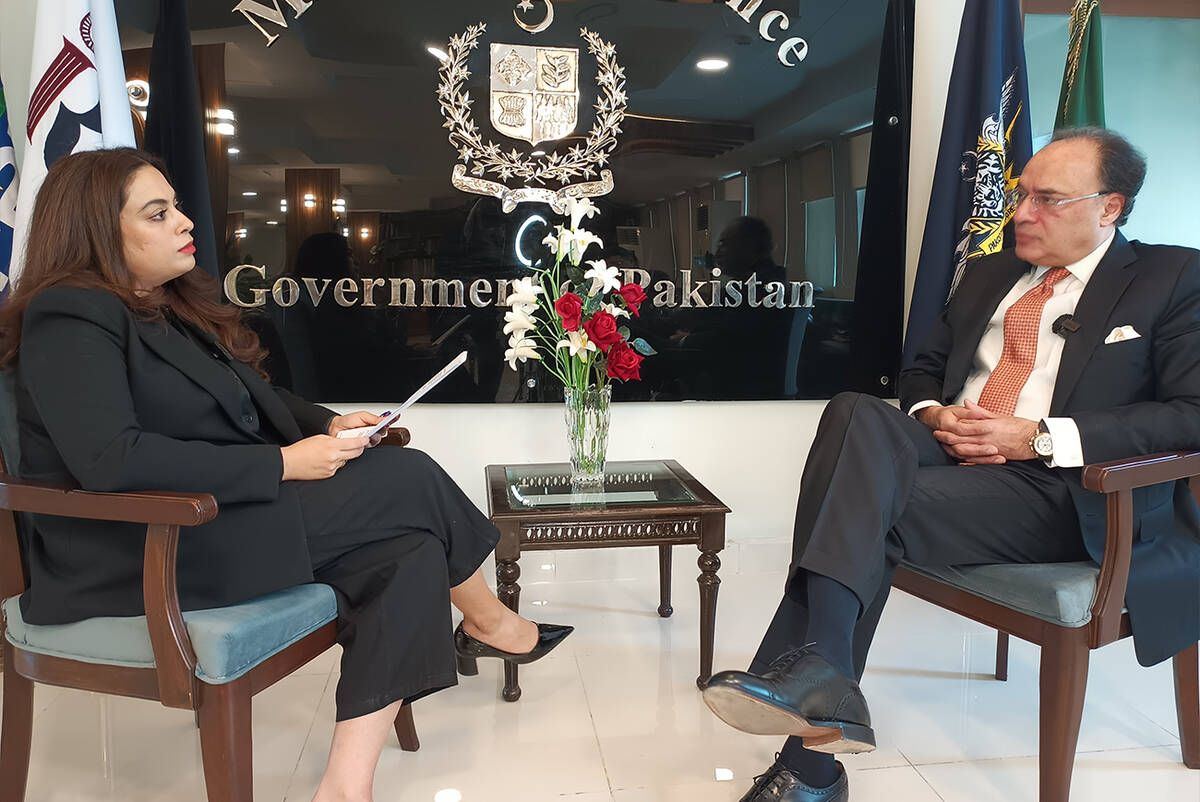
Pakistan’s Finance Minister Muhammad Aurangzeb (right) speaks during an interview with Arab News in Islamabad on November 18, 2025. (AN)
The government’s objective, he added, was to move beyond short-term financing arrangements:
“It’s not aid, it has to be led by trade and investment. Because quite frankly, that is going to bring sustainability at both ends.”
Both governments have identified minerals and mining, IT, agriculture, food and tourism as priority sectors for Saudi investment. Manufacturing is also emerging as a potential area of collaboration, particularly as Saudi Arabia begins preparations for hosting the 2034 FIFA World Cup, which is driving demand for sports-related industrial capacity inside the Kingdom.
Aurangzeb cited Forward Sports Sialkot, the Pakistani sports equipment company that produces Adidas’s official World Cup match balls and recently displaced a Chinese competitor as the German brand’s largest football supplier.
Forward Sports met Saudi officials during the Future Investment Initiative summit in Riyadh last month to explore a model in which high-precision manufacturing takes place in Pakistan, with finishing, packaging and regional distribution shifted to Saudi Arabia as part of its industrial localization push, Aurangzeb said.
“I just see this is the start of that kind of process as we move forward.”
REKO DIQ AND CRITICAL MINERALS
A major focus of discussions with foreign investors is Reko Diq, Pakistan’s flagship copper-and-gold mining project in Balochistan and one of the world’s largest undeveloped copper deposits. Operated by Barrick Gold with federal and provincial government stakes, the project has attracted interest from Saudi Arabia through Manara Minerals — backed by the Public Investment Fund (PIF) and Ma’aden — which has offered to acquire a 15 percent stake.
Aurangzeb said the long-awaited financial close for Reko Diq was now imminent.
“The financial close, from my perspective, is around the corner,” he said.
He explained that the International Finance Corporation (IFC) was leading the debt consortium, a role that signals strong due diligence and comfort for global lenders because IFC typically structures and anchors large, complex resource-sector financings.
One of the final elements, the minister noted, was the participation of the US Export-Import Bank (US Exim), which had temporarily paused new approvals during the recent US government shutdown. With the US government now fully reopened, he said Exim’s involvement should resume “relatively soon.”
Aurangzeb said the financing structure was now essentially in place, with the IFC-led consortium having assembled roughly $3.5 billion in project debt, and only final lender approvals remaining.
“Everything is complete. I think in the coming weeks, this should be finalized and the financial close should be there.”
He added that he met the IFC managing director and all consortium partners during a recent visit to Washington, reinforcing his confidence that closure was near.
The minister underscored Reko Diq’s transformative potential for Pakistan’s stagnant export base. With annual exports stuck at roughly $30 billion, the mine’s first year of operation alone is expected to generate $2.8 billion in export potential, nearly 10 percent of Pakistan’s total exports today.
“This is a game changer,” he said.
Beyond Reko Diq, Pakistan is in discussions with the United States and other partners on critical minerals, a sector that has become central to global supply chain strategies as countries seek alternative sources of copper, lithium, cobalt and rare earths.
An American official told Arab News on condition of anonymity a $1 billion-plus critical minerals deal had been finalized with US investors, but Aurangzeb said while interest was high, negotiations were ongoing.
“For obvious reasons, minerals and mining and critical minerals is a key area of interest. And that we are moving forward.”
He added: “There’s tremendous interest and there’s tremendous potential at our end.”
Aurangzeb said Pakistan’s goal was clear: to channel improving economic fundamentals and favorable geopolitics into long-term, private-sector-led investment flows, with Saudi Arabia emerging as one of the most consequential partners in that shift.
“And all of this is all about translating that into trade and investment. And all of this is going to be private sector-led, across the board.”