

Pakistan, EU to review bilateral cooperation in key Strategic Dialogue this week

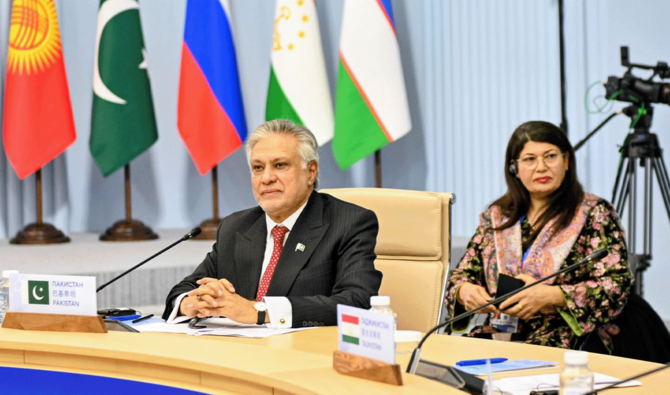
Deputy Prime Minister of Pakistan attending the SCO Council of Heads of Government in Moscow, Russia in a picture shared by the Ministry of Foreign Affairs of Pakistan on November 18, 2025. (@ForeignOfficePk/X)
Short Url
Updated 19 November 2025
Follow

Pakistan, EU to review bilateral cooperation in key Strategic Dialogue this week

  • Deputy PM Ishaq Dar to visit Brussels from Nov. 19-21, co-chair seventh session of Pakistan-EU Strategic Dialogue
  • EU is one of Pakistan’s largest trading partners, accounting for more than 30 percent of exports under GSP Plus scheme

ISLAMABAD: Deputy Prime Minister Ishaq Dar will visit Brussels this week to co-chair the seventh session of the Pakistan–European Union Strategic Dialogue, the foreign office said on Wednesday, where the two sides will review bilateral cooperation across all sectors.

The Strategic Dialogue is the highest level of institutionalized interaction between the two sides during which they review cooperation across all sectors under the Pakistan-EU Strategic Engagement Plan 2019.

The Strategic Engagement Plan, signed in 2019, is the main framework guiding Pakistan-EU cooperation on political, economic and security issues, including trade, migration, development, climate change and education.

Dar will undertake a visit to Brussels from Nov. 19-21 to co-chair the seventh session of the dialogue, the statement said. 

“The deputy prime minister/foreign minister’s visit to Brussels marks a significant milestone in Pakistan-EU relations,” it said. 

“Pakistan remains committed to developing a comprehensive and mutually beneficial partnership with the EU.”

During the visit, Dar will also participate in the fourth EU Indo-Pacific Ministerial Forum and meet senior EU officials on the sidelines of the event.

The EU is one of Pakistan’s largest trading partners, accounting for more than 30 percent of exports under the GSP Plus preferential trade scheme.

This scheme grants countries’ exports duty-free access to the European market in exchange for voluntarily agreeing to implement 27 international core conventions, including those on human and civil rights. 

More than 300 EU companies already operate in Pakistan, while the European Investment Bank has supported major projects in water, sanitation and energy.



IMF mission begins talks in Islamabad as Pakistan seeks next program review

Updated 5 sec ago
Follow

IMF mission begins talks in Islamabad as Pakistan seeks next program review

  • Finance ministry confirms ‘kick-off meeting’ with visiting IMF delegation
  • Review critical for next tranche under $7 billion bailout program

Karachi: Pakistan began formal talks with a visiting International Monetary Fund (IMF) delegation on Monday as the country prepares for the next review of its $7 billion bailout program.

The IMF team is in Pakistan to conduct a review under the Extended Fund Facility (EFF) approved in September 2024, a multi-year program aimed at stabilizing the economy after a balance-of-payments crisis, high inflation and dwindling foreign exchange reserves.

Pakistan has so far received roughly $3 billion of the EFF. Successful completion of the latest review could pave the way for the release of the next tranche of funds, subject to IMF board approval.

Separately in 2024, Pakistan also secured about $1.3 billion under the IMF’s Resilience and Sustainability Facility, a climate-focused funding window aimed at strengthening the country’s capacity to manage environmental and disaster-related risks.

“Kick-off meeting with IMF Mission held today,” the finance ministry said on Monday as it shared visuals of Finance Minister Muhammad Aurangzeb and senior officials meeting the delegation in Islamabad.

IMF country representative in Pakistan, Mahir Binici, told Arab News in an emailed statement; 

“An IMF mission led by Ms. Iva Petrova has started discussions with the authorities in Karachi and Islamabad on the third review of Pakistan’s Extended Fund Facility (EFF) arrangement and the second review of the Resilience and Sustainability Facility (RSF).”

The discussions are expected to focus on Pakistan’s fiscal performance, revenue collection targets, structural reform implementation and broader macroeconomic stability measures agreed under the program.

The review comes at a sensitive time for Pakistan’s economy, with rising global oil prices and regional instability adding pressure to inflation and external accounts. Analysts say continued IMF engagement remains crucial for maintaining investor confidence and securing external financing.

Pakistan entered the IMF program to restore macroeconomic stability, strengthen public finances and rebuild foreign exchange reserves. Authorities have repeatedly described the reform agenda as necessary to ensure long-term economic resilience.

Further meetings between technical teams are expected over the coming days.